After-Meal Blood Sugar: What Matters and What Helps
A rise after eating is expected; your diabetes risk is better assessed with established blood tests than a single meal-time reading.
Blood glucose rises after food, so one post-meal reading does not tell you whether you have prediabetes or diabetes. Established assessments include A1C, fasting plasma glucose, and sometimes an oral glucose tolerance test. If prevention is your goal, a sustainable eating pattern and regular physical activity have stronger support than trying to eliminate every rise on a glucose graph. Pregnancy and prior gestational diabetes call for separate testing plans.7826
What a post-meal number can and can’t tell you
Glucose from food enters your bloodstream, and insulin helps move it into your cells. A change after a meal is part of that process. The concern in prediabetes and diabetes is that glucose levels are higher than they should be over time, not that a graph ever moves upward.78
Suppose you check after a bowl of cereal and see a higher number than you saw before breakfast. That number may describe that moment, but it isn’t a diagnosis. The type of test matters: a home meter measures glucose in a small blood sample, while a continuous glucose monitor, or CGM, measures glucose through a sensor under the skin and shows changes across the day. Neither turns an isolated meal response into a diagnosis of prediabetes.13
For that question, established blood tests give you a clearer next step. A fasting plasma glucose test measures glucose after a fast; an A1C reflects average glucose over about three months. An oral glucose tolerance test assesses the response to a measured glucose drink. On the MedlinePlus prediabetes reference, a fasting result of 100 to 125 mg/dL or an A1C of 5.7% to 6.4% falls in the prediabetes range. Those are thresholds for the named tests, not targets to apply to a reading taken after your usual lunch.73
Why a CGM graph isn’t a report card
CGM can show patterns that a one-time blood test misses. In a systematic review, people classified as having prediabetes tended to have higher CGM measures than people with normal glucose test results. But the researchers said more prospective work is needed to learn whether those measures predict who will develop type 2 diabetes. The review did not establish a universal post-meal target for people without diabetes.3
Interpretation is still unsettled even among specialists. In one study, 18 clinicians reviewed selected, potentially challenging CGM reports from people without diabetes, alongside their A1C and fasting glucose results. Their recommendations about who needed follow-up showed poor agreement. That doesn’t mean you should ignore a concern. It means a surprising sensor reading is better treated as a reason to consider your overall risk and established testing, rather than as a verdict about a particular food.57
What to change if prevention is the goal
If you’re at risk of type 2 diabetes, focus on habits you can keep, rather than trying to make every post-meal line flat. Regular physical activity and a healthy eating plan are recommended ways to help prevent or delay type 2 diabetes; for someone with prediabetes, a healthy reduced-calorie eating plan is one option described by MedlinePlus. Activity can also lower blood glucose. These recommendations concern longer-term health, not a promise that any one meal or walk will produce a particular sensor reading.78
The distinction matters when you see advice to rearrange every meal to prevent a “spike.” A pilot study followed 30 healthy adult women through short, fixed-sequence lifestyle interventions. During a combined dietary intervention involving calorie-tailored, low-glycemic-index foods and regular meals, some CGM measures of glucose change were lower. The activity intervention showed smaller, less consistent changes on the study’s rate-of-change measure. Because the intervention order wasn’t randomized and the diet changed several things at once, the study can’t tell you which food change did the work, whether it was better than activity for long-term health, or whether either approach prevented diabetes.4
A practical way to use that distinction: choose an eating pattern you can live with and make room for regular movement. If a walk fits after lunch, it can be part of that activity habit. You don’t need to use a sensor to prove you’ve “earned” your meal. If you want to know whether you have prediabetes, ask for an established glucose assessment instead of testing more and more individual foods.783
Pregnancy and a history of gestational diabetes are different
Pregnancy isn’t the time to borrow targets or interpretations from general wellness posts. Screening for gestational diabetes is part of prenatal care, and an abnormal screening result may need diagnostic testing. If gestational diabetes is diagnosed, meal-related checks can have a specific purpose within a pregnancy care plan.29
A history of gestational diabetes also changes the question after birth. It is a risk factor for later type 2 diabetes, even if you feel well. In a retrospective cohort of women with gestational diabetes in China, postpartum follow-up used an oral glucose tolerance test 4 to 12 weeks after delivery; 430 women, or 29.9% of those who completed screening, had an abnormal result. That proportion describes the women who returned for testing, not everyone in the cohort or all women with prior gestational diabetes. If you’ve had gestational diabetes, make a postpartum glucose-testing plan with your pregnancy care team rather than relying on occasional home readings.67
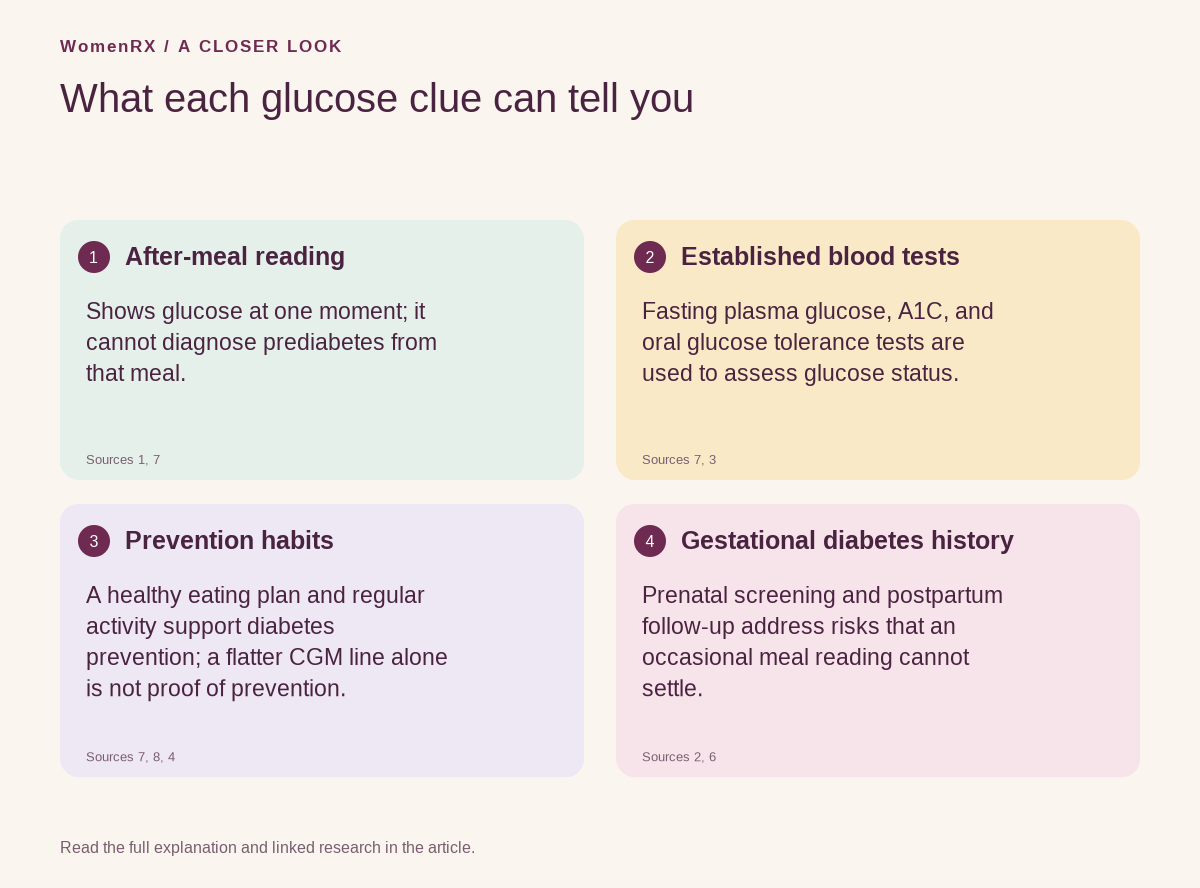
What each glucose clue can tell you
After-meal reading: Shows glucose at one moment; it cannot diagnose prediabetes from that meal.17
Established blood tests: Fasting plasma glucose, A1C, and oral glucose tolerance tests are used to assess glucose status.73
Prevention habits: A healthy eating plan and regular activity support diabetes prevention; a flatter CGM line alone is not proof of prevention.784
Gestational diabetes history: Prenatal screening and postpartum follow-up address risks that an occasional meal reading cannot settle.26
Read the figure as text
A meal reading, a diagnostic test, a lifestyle change, and pregnancy follow-up answer different questions.- After-meal reading: Shows glucose at one moment; it cannot diagnose prediabetes from that meal.17
- Established blood tests: Fasting plasma glucose, A1C, and oral glucose tolerance tests are used to assess glucose status.73
- Prevention habits: A healthy eating plan and regular activity support diabetes prevention; a flatter CGM line alone is not proof of prevention.784
- Gestational diabetes history: Prenatal screening and postpartum follow-up address risks that an occasional meal reading cannot settle.26
More questions, answered
Do I need a continuous glucose monitor to prevent diabetes?
A CGM shows how glucose changes, but established blood tests are used to assess prediabetes. CGM patterns may add information in some situations; researchers have not yet established how to use them to predict future diabetes in people without it. Regular activity and a healthy eating plan do not require a sensor.378
Sources you can check
- Blood Glucose | Blood Sugar | Diabetes | MedlinePlusAccessed 2026-09-25Return to first citation
- Prenatal Testing | Gestational Diabetes | MedlinePlusAccessed 2026-09-25Return to first citation
- Differences in Continuous Glucose Monitoring Metrics Between Prediabetes and Normoglycemia: A Systematic Review and Meta-Analysis.Rákóczi G, Nagy J, Jozaee S, Jozaee S, Szentes BL, Lee J, Rancz A, Hegyi P, Agócs G, Sipter E. · Journal of diabetes science and technology · 2026Return to first citation
- Dietary Intervention Is Associated with Lower CGM-Derived Glucose Rate-of-Change in Healthy Young Women: A Pilot Fixed Sequential-Intervention Study.Lejk A, Myśliwiec K, Chrzanowski J, Skalska M, Stefanowicz-Bielska A, Musiał-Paździor M, Herstowska M, Margas Z, Drzewińska K, Iwaszko I, Szewczyk K, Pernak B, Kropidłowska J, Anto... · Nutrients · 2026Return to first citation
- Expert Clinical Interpretation of Continuous Glucose Monitor Reports From Individuals Without Diabetes.Spartano NL, Prescott B, Walker ME, Shi E, Venkatesan G, Fei D, Lin H, Murabito JM, Ahn D, Battelino T, Edelman SV, Fleming GA, Freckmann G, Galindo RJ, Joubert M, Lansang MC, Made... · Journal of diabetes science and technology · 2026Return to first citation
- Postpartum Glucose Follow-up Screening Among Women With Gestational Diabetes Mellitus: A Retrospective Cohort Study.Zhang J, Xu T, Cao Q, Mao C, Zhou F, Wang X. · Maternal-fetal medicine (Wolters Kluwer Health, Inc.) · 2024Return to first citation
- Prediabetes | Hyperglycemia | MedlinePlusAccessed 2026-09-25Return to first citation
- How to Prevent Diabetes: MedlinePlusAccessed 2026-09-25Return to first citation
- Gestational diabetes - Treatment - NHSAccessed 2026-09-25Return to first citation