When a GLP-1 May Enter a Prediabetes Plan
A GLP-1 medicine may be discussed when weight-related treatment is also relevant, but prediabetes alone doesn’t establish that it’s the right choice.
A GLP-1 medicine isn’t a routine prescription just because you have prediabetes. Clinicians consider your glucose results and other risk factors, while lifestyle support remains the foundation of prevention. Metformin has more established prevention evidence for selected higher-risk people. A GLP-1 discussion may arise when you also have a relevant weight-treatment indication, but diabetes-prevention findings alone don’t establish eligibility. 2 5
Prediabetes is a risk signal, not a medication prescription
Prediabetes means blood sugar is above the normal range but below the range used to diagnose diabetes. It raises the chance of developing type 2 diabetes, but progression isn’t certain. The clinical question is not only whether your result falls in the prediabetes range, but how your overall risk and health goals shape the next step. 1 4
A clinician may look at your A1C and other glucose results, whether those results are changing, and risk factors such as body weight and a history of gestational diabetes. In a 2024 review’s summary of American Diabetes Association guidance, features that especially favor considering metformin include an A1C above 6.0%, fasting glucose above 110 mg/dL, a BMI of at least 35, age 25-59, and prior gestational diabetes. These are reasons to assess risk and discuss options, not a checklist for GLP-1 eligibility. Family history can also be part of the broader risk picture. 5 1
What the prevention evidence actually compares
Lifestyle support remains part of prevention whether or not medication is considered. In the Diabetes Prevention Program, participants had impaired glucose tolerance and elevated fasting glucose. Over an average 2.8 years, the intensive lifestyle group had 58% fewer new diabetes diagnoses than the control group; the metformin group had 31% fewer. Those are relative reductions in that study population, not a prediction of what will happen for every person with an A1C in the prediabetes range. The lifestyle program involved ongoing teaching and support, not just advice to eat differently. 4
Metformin has the most established long-term medication evidence for prevention in selected higher-risk groups. The 2024 review reports that, in the Diabetes Prevention Program, women with prior gestational diabetes had a significant reduction in progression to diabetes when assigned metformin. That history makes prevention planning especially relevant; it doesn’t automatically mean you need medication or qualify for a GLP-1 drug. 2 5
Separate diabetes prevention from weight-treatment eligibility
Incretin medicines can support weight loss, which may improve some factors linked to diabetes risk. But weight loss doesn’t guarantee that diabetes will be prevented, and evidence for lowering risk in selected study populations is not the same as approval or eligibility for a particular medicine. The 2024 review notes that weight loss varies and that follow-up matters. 5
The distinction matters because a medicine may be considered for a separate weight-management indication rather than prescribed specifically to prevent diabetes. A 2024 review summarizing ADA guidance says no drug had a specific U.S. indication for diabetes prevention at the time of that guidance. Prediabetes, a higher A1C, or prior gestational diabetes cannot stand in for a particular product’s current eligibility criteria. If a GLP-1 medicine is proposed, the concrete question is which medicine and which indication the clinician is considering for you. 5
GLP-1 prevention studies don’t settle the question on their own. For example, a retrospective community-practice study reported fewer diabetes diagnoses in a group given metformin, pioglitazone, a GLP-1 receptor agonist, and lifestyle treatment than in a lifestyle-only group. Because the medicines were combined and treatment wasn’t randomly assigned, the study can’t show how much benefit came from the GLP-1 medicine itself. 3
Put your results into a follow-up plan
Start with the actual glucose results, not just the word prediabetes. An A1C above 6.0% is one feature highlighted in guidance summarized for considering metformin, while glucose values closer to the diabetes range generally signal greater progression risk. Then consider the rest of the picture: prior gestational diabetes, weight-related health needs, and family history if relevant. Those details help distinguish someone who may benefit from a more intensive prevention discussion from someone whose immediate plan may focus on lifestyle support and reassessment. 4 5 1
If medication comes up, keep two decisions separate. First, what prevention approach fits your risk and preferences? Second, if a GLP-1 medicine is suggested, what condition would that particular product treat, and do you meet its current criteria? Agree on which glucose test will be repeated and when the results and weight-related goals will be reviewed. Follow-up can show whether the plan is helping; a weight response alone shouldn’t be treated as proof that diabetes has been prevented. 5
If you’re pregnant or planning a pregnancy, include that in the discussion of your prevention and weight-related goals.
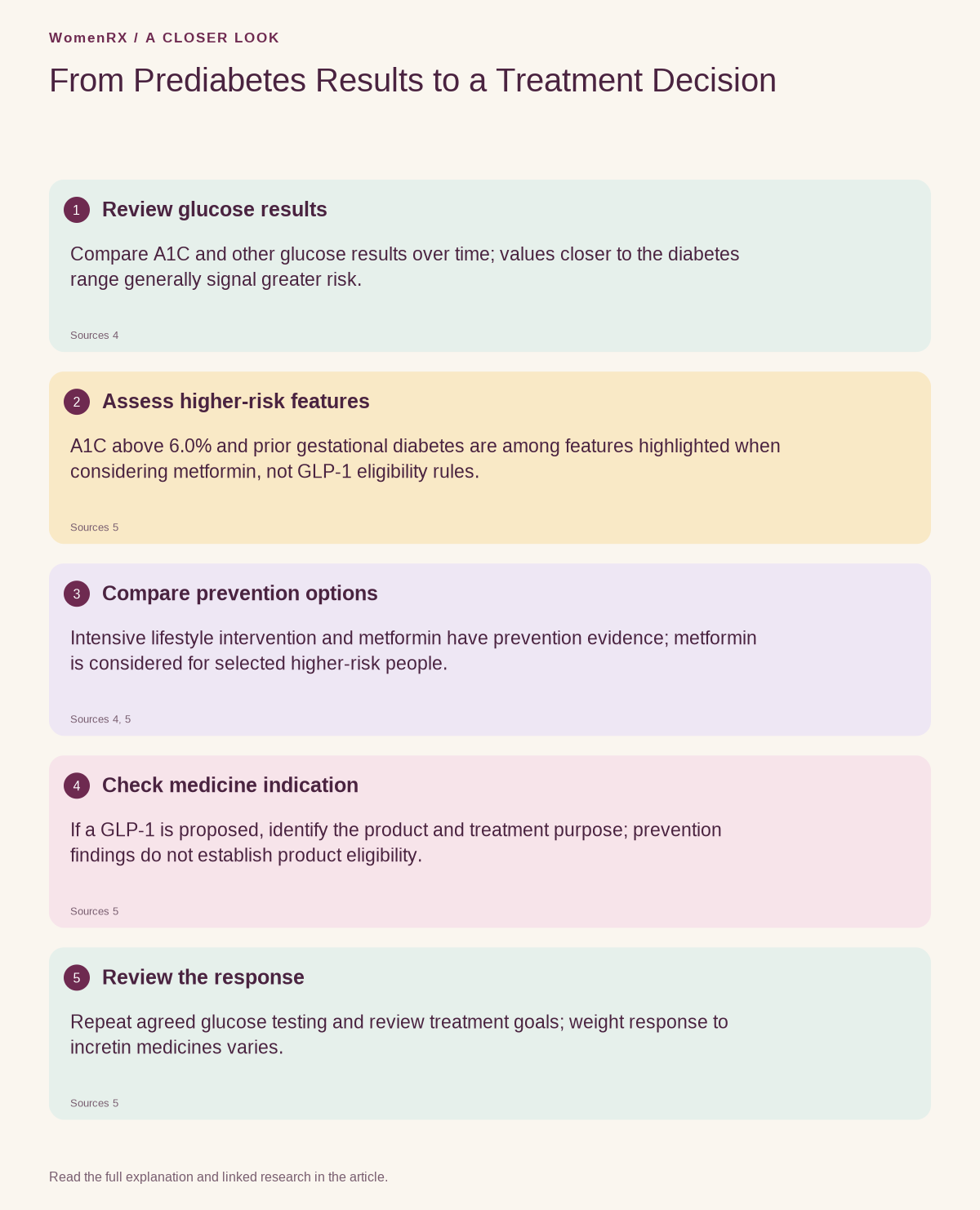
From Prediabetes Results to a Treatment Decision
Review glucose results: Compare A1C and other glucose results over time; values closer to the diabetes range generally signal greater risk.4
Assess higher-risk features: A1C above 6.0% and prior gestational diabetes are among features highlighted when considering metformin, not GLP-1 eligibility rules.5
Compare prevention options: Intensive lifestyle intervention and metformin have prevention evidence; metformin is considered for selected higher-risk people.45
Check medicine indication: If a GLP-1 is proposed, identify the product and treatment purpose; prevention findings do not establish product eligibility.5
Review the response: Repeat agreed glucose testing and review treatment goals; weight response to incretin medicines varies.5
Read the figure as text
This flow shows how glucose results and risk features lead to prevention choices, a separate medicine-eligibility check, and follow-up.- Review glucose results: Compare A1C and other glucose results over time; values closer to the diabetes range generally signal greater risk.4
- Assess higher-risk features: A1C above 6.0% and prior gestational diabetes are among features highlighted when considering metformin, not GLP-1 eligibility rules.5
- Compare prevention options: Intensive lifestyle intervention and metformin have prevention evidence; metformin is considered for selected higher-risk people.45
- Check medicine indication: If a GLP-1 is proposed, identify the product and treatment purpose; prevention findings do not establish product eligibility.5
- Review the response: Repeat agreed glucose testing and review treatment goals; weight response to incretin medicines varies.5
More questions, answered
Does a history of gestational diabetes mean I should take a GLP-1?
No. Prior gestational diabetes makes prevention planning especially relevant, and it is among the features a 2024 review says may support considering metformin. It does not, by itself, establish eligibility for a GLP-1 medicine. 5
Sources you can check
- Diabetes - NHSAccessed 2026-09-25Return to first citation
- From insulin resistance to incretin receptor agonism in the prevention of type 2 diabetes mellitus in obese individuals.Teofilović B, Trkulja J, Grujić-Letić N, Gligorić E, Baletic D, Tomić L, Mesarović A, Rašković A. · Current medical research and opinion · 2026Return to first citation
- Successful treatment of prediabetes in clinical practice using physiological assessment (STOP DIABETES).Armato JP, DeFronzo RA, Abdul-Ghani M, Ruby RJ. · The lancet. Diabetes & endocrinology · 2018Return to first citation
- Should Prediabetes be Treated Pharmacologically?Davidson MB. · Diabetes therapy : research, treatment and education of diabetes and related disorders · 2023Return to first citation
- Modern-Day Management of the Dysglycemic Continuum: An Expert Viewpoint from the Arabian Gulf.Alessa T, Al Awadi F, Al Kaabi J, Al Mamari A, Al Ozairi E, Alromaihi D, Elhadd T, Gunaid AA, Hassanein M, Jayyousi AA, Kalimat R, Brand KMG. · Diabetes, metabolic syndrome and obesity : targets and therapy · 2024Return to first citation