What GLP-1 Medicines May Change in Your Cholesterol
Some studies find small improvements in LDL and triglycerides, but a better cholesterol panel is not the same as proof that your heart risk is fully managed.
In adults with type 2 diabetes, pooled trial estimates found that GLP-1 medicines lowered LDL cholesterol and triglycerides modestly compared with placebo; HDL did not change significantly. Those lab shifts don’t show that your cholesterol treatment can be stopped. Heart-event benefits have been reported for certain medicines in specific high-risk groups, but they aren’t established as a result of cholesterol changes alone. 6 5 4
What the lab changes look like
A lipid panel measures more than one number. LDL cholesterol is one marker used to assess cardiovascular risk; triglycerides are another type of blood fat measured on the same panel. HDL is also reported, but a higher HDL number by itself doesn’t guarantee protection from heart disease. 1 3
A network meta-analysis of 168 randomized trials involving 72,195 adults with type 2 diabetes found that GLP-1 receptor agonists lowered LDL cholesterol by an estimated 0.14 mmol/L and triglycerides by 0.14 mmol/L compared with placebo. The analysis did not find a significant change in HDL. These are pooled estimates across medicines and trials, not a promise of the same change for every person or every drug. The trials lasted from 12 to 78 weeks, and the results apply to adults with type 2 diabetes. 6
That distinction matters if you’re using a GLP-1 medicine for weight management rather than diabetes, or if you don’t have diabetes. The estimates above shouldn’t automatically be applied to those situations. Your starting lipid levels, health conditions, and treatment all help shape what a result means. 1 6
A lab improvement isn’t an event-prevention result
A lower LDL or triglyceride value is a change in a risk marker. It is not, on its own, proof that a medicine prevents heart attacks or strokes through that specific change. In a meta-regression of eight cardiovascular-outcomes trials involving 60,079 people with type 2 diabetes, trial-level LDL reductions were not associated with the reduction in major cardiovascular events. The analysis found associations with reductions in blood sugar and body weight instead. Because this compared trial-level changes, it cannot tell us which change caused any individual’s outcome. 5
There is separate evidence that some GLP-1 medicines reduce cardiovascular events in particular groups. A review describes benefits in cardiovascular-outcomes trials among people with type 2 diabetes, many of whom had established cardiovascular disease. That is evidence about those medicines and trial populations, not proof that a modest lipid shift is the reason for the benefit or that every GLP-1 medicine has the same outcome evidence. 4
For women, one key limitation is that the pooled lipid results presented in the meta-analysis do not give a women-specific estimate. The study describes similar sex distributions across included trials, but those pooled results can’t tell you whether the average lipid change differs for women. 6
Keep cholesterol care in the full picture
A GLP-1-related change in a lipid panel doesn’t automatically replace a statin or another cholesterol medicine that was prescribed for your risk. Cholesterol decisions depend on more than one result, including health conditions and other risk factors; some people need medicine in addition to lifestyle changes. 1 2
At a medication review, useful questions include:
- Which parts of my lipid panel are we following: LDL, non-HDL, triglycerides, or more than one?
- How does my overall cardiovascular risk affect the cholesterol goal and treatment plan?
- When should we compare my next lipid panel with my starting result?
- If a number improves, would that change any prescribed cholesterol medicine, or is it still needed for my overall risk?
- If I’m planning a pregnancy or could become pregnant, how should that affect the review of my GLP-1 and cholesterol medicines?
If pregnancy is part of your plans, bring both medicines into that discussion before changing either one. A cholesterol result alone can’t tell you what to do with either prescription.
The useful comparison is not simply “before versus after.” It’s your lipid results alongside your overall risk, the reason each medicine was prescribed, and whether you have a condition such as diabetes or established cardiovascular disease that changes the evidence that applies to you. 1 4 6
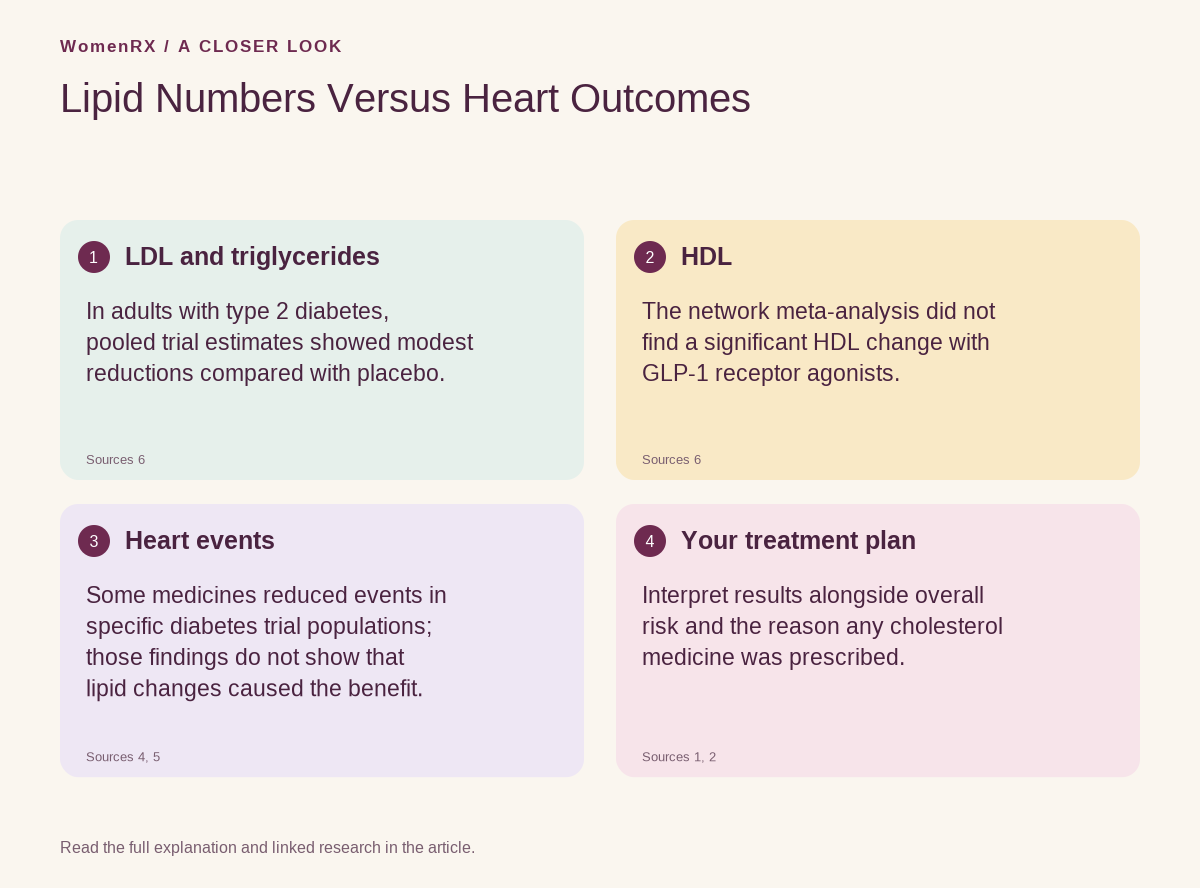
Lipid Numbers Versus Heart Outcomes
LDL and triglycerides: In adults with type 2 diabetes, pooled trial estimates showed modest reductions compared with placebo.6
HDL: The network meta-analysis did not find a significant HDL change with GLP-1 receptor agonists.6
Heart events: Some medicines reduced events in specific diabetes trial populations; those findings do not show that lipid changes caused the benefit.45
Your treatment plan: Interpret results alongside overall risk and the reason any cholesterol medicine was prescribed.12
Read the figure as text
These are related but different kinds of evidence: a lipid panel measures blood markers, while cardiovascular-outcomes trials count events in defined study populations.- LDL and triglycerides: In adults with type 2 diabetes, pooled trial estimates showed modest reductions compared with placebo.6
- HDL: The network meta-analysis did not find a significant HDL change with GLP-1 receptor agonists.6
- Heart events: Some medicines reduced events in specific diabetes trial populations; those findings do not show that lipid changes caused the benefit.45
- Your treatment plan: Interpret results alongside overall risk and the reason any cholesterol medicine was prescribed.12
Sources you can check
- Cholesterol Levels: What You Need to Know: MedlinePlusAccessed 2026-09-25Return to first citation
- High cholesterol - Medicines for high cholesterol - NHSAccessed 2026-09-25Return to first citation
- High-Density Lipoprotein Dysfunction and Atherosclerotic Cardiovascular Disease: From Quantity to Quality.Arun AJ, Kaneki S, Baig M, Frishman WH, Aronow WS. · Cardiology in review · 2025Return to first citation
- The benefits of GLP1 receptors in cardiovascular diseases.Ferhatbegović L, Mršić D, Macić-Džanković A. · Frontiers in clinical diabetes and healthcare · 2023Return to first citation
- Association Between the Magnitude of Glycemic Control and Body Weight Loss With GLP-1 Receptor Agonists and Risk of Atherosclerotic Cardiovascular Disease: A Systematic Review and Meta-analyses of Randomized Diabetes Cardiovascular Outcomes Trials.Gomes DA, Presume J, de Araújo Gonçalves P, Almeida MS, Mendes M, Ferreira J. · Cardiovascular drugs and therapy · 2025Return to first citation
- The comparative efficacy of SGLT-2 inhibitors and GLP-1 receptor agonists on metabolic benefits in T2DM patients: a systematic review and network meta-analysis.Tong J, Li N, Hu F, Yue Y. · European journal of medical research · 2026Return to first citation