Family History, Diabetes Risk, and GLP-1 Medicines
Diabetes in your family can raise your risk, but it doesn’t diagnose diabetes or determine whether a GLP-1 medicine is right for you.
A family history of type 2 diabetes is one part of your risk picture, not a diagnosis or a stand-alone reason to use a GLP-1 medicine. Glucose test results, your health history, including gestational diabetes, and the specific medicine’s intended use matter too. Ask what your results show and which, if any, treatment indication fits your situation. 126
A family history is a clue, not a prediction
Having a close relative with diabetes can raise your chance of developing type 2 diabetes, but it doesn’t mean you will definitely develop it. Families share more than genes, including aspects of their environment and daily routines, so family history is useful context rather than a verdict. 1
It also doesn’t tell you whether your blood glucose is currently in the diabetes range. Diabetes is diagnosed using blood tests, including A1C and other glucose tests. Risk factors for type 2 diabetes include family history, prediabetes, higher body weight, age, high blood pressure, and PCOS. The right next step is to consider those factors alongside your test results, not to treat your family tree as a diagnosis. 2
Where GLP-1 medicines fit
GLP-1-based medicines are used for particular medical purposes, and those purposes vary by medicine and product. For example, semaglutide has a US approval for chronic weight management and a separate cardiovascular-risk indication for certain adults with established cardiovascular disease and overweight or obesity. Tirzepatide is described in a clinical review as approved for diabetes treatment. These examples show why the name of a medicine alone doesn’t establish whether it fits your situation. 36
A family history by itself doesn’t establish a treatment indication. Even if diabetes runs in your family, the discussion may be about checking your glucose, addressing other risk factors, or choosing a medicine for a separate eligible condition, not preventing diabetes with a GLP-1 medicine solely because of inherited risk.
There is research on these medicines in people with prediabetes, but that is a different group from people whose only known risk factor is family history. A review summarized trials in people with obesity and prediabetes that found less progression to diabetes with semaglutide or tirzepatide. Those findings don’t show that family history alone is enough to select treatment. 5
If you’ve had gestational diabetes
Gestational diabetes matters because it is linked to a higher risk of developing type 2 diabetes later. If you’ve had it, mention when it happened and whether you’ve had glucose testing since pregnancy. A study protocol describes a trial designed to test semaglutide for diabetes prevention in women with both recent gestational diabetes and postpartum prediabetes. A protocol explains what researchers plan to study; it isn’t evidence that the treatment has been proven for prevention in this group. 24
A focused conversation about your risk
You can make the discussion more useful by bringing four details:
- Family pattern: Which close relatives have type 2 diabetes, if you know, and about when they were diagnosed. Family history helps frame risk but can’t determine your glucose level. 12
- Glucose results: Ask whether you need a blood test and what your A1C or other glucose results mean. Blood tests are used to diagnose diabetes. 2
- Pregnancy history: Share any history of gestational diabetes, especially if you haven’t discussed follow-up testing since then. 24
- Other health factors and goals: Mention relevant conditions such as high blood pressure or PCOS, and clarify whether you’re asking about diabetes treatment, weight management, or prevention. These questions can point to different options. 236
If testing shows prediabetes, ask what prevention options make sense for you. MedlinePlus describes healthy eating, maintaining a healthy weight, and regular physical activity as steps that may help prevent or delay type 2 diabetes. The evidence about GLP-1 medicines in prediabetes doesn’t turn family history alone into an indication. 25
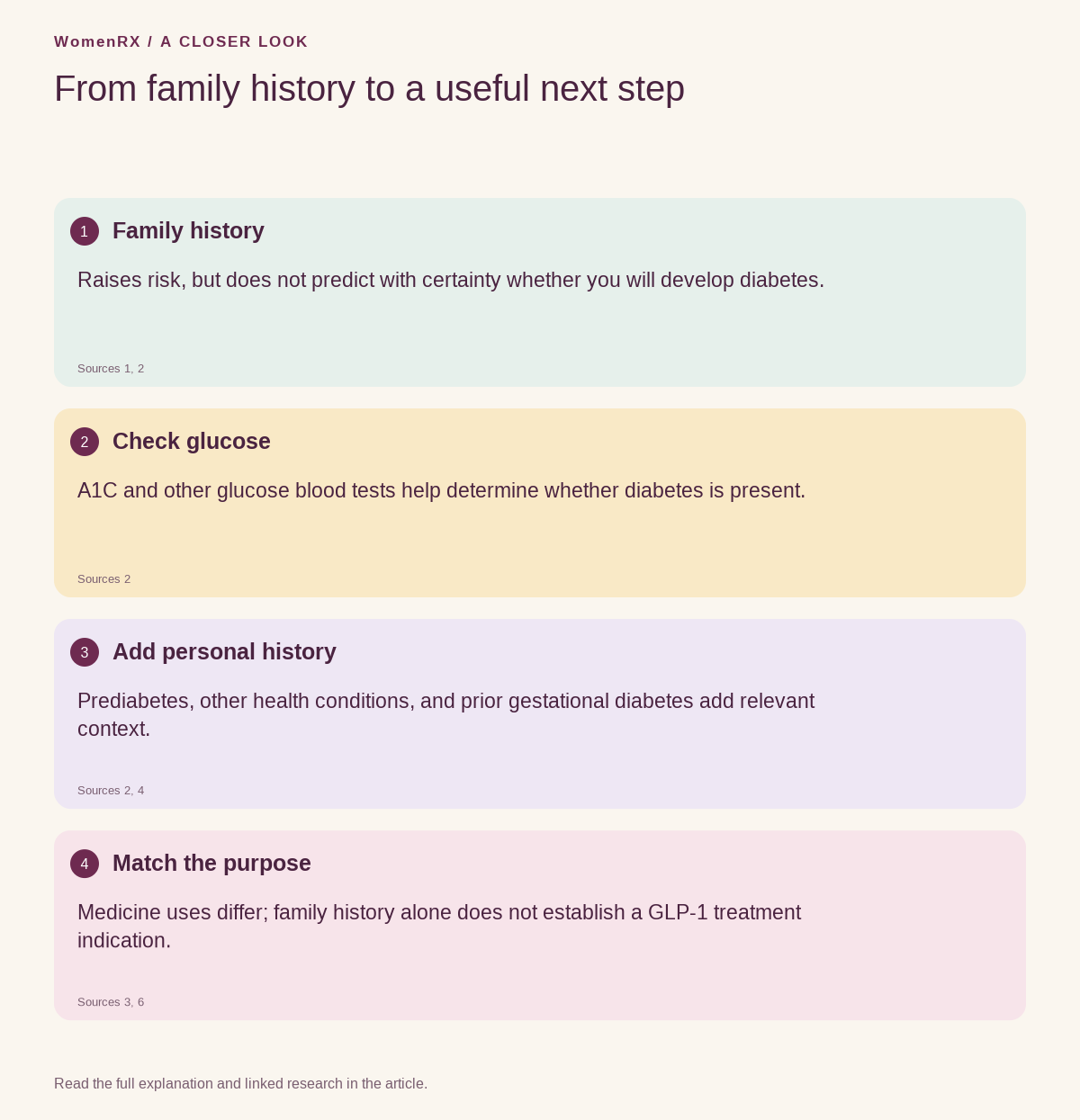
From family history to a useful next step
Family history: Raises risk, but does not predict with certainty whether you will develop diabetes.12
Check glucose: A1C and other glucose blood tests help determine whether diabetes is present.2
Add personal history: Prediabetes, other health conditions, and prior gestational diabetes add relevant context.24
Match the purpose: Medicine uses differ; family history alone does not establish a GLP-1 treatment indication.36
Read the figure as text
Family history starts a risk conversation. Glucose results, pregnancy history, other health factors, and the medicine’s intended use help shape what comes next.- Family history: Raises risk, but does not predict with certainty whether you will develop diabetes.12
- Check glucose: A1C and other glucose blood tests help determine whether diabetes is present.2
- Add personal history: Prediabetes, other health conditions, and prior gestational diabetes add relevant context.24
- Match the purpose: Medicine uses differ; family history alone does not establish a GLP-1 treatment indication.36
More questions, answered
Does diabetes in a parent mean I’ll develop it?
No. A close family member with diabetes can raise your risk, but it doesn’t mean you will definitely develop the condition. Glucose testing and your broader health history help show what your risk means for you. 12
Does a past gestational diabetes diagnosis change the discussion?
Yes. Gestational diabetes is a relevant risk marker for later type 2 diabetes, so mention it when discussing glucose testing and prevention. It does not, by itself, establish that a GLP-1 medicine is appropriate. 24
Sources you can check
- Family History: MedlinePlusAccessed 2026-09-25Return to first citation
- Diabetes | Type 1 Diabetes | Type 2 Diabetes | MedlinePlusAccessed 2026-09-25Return to first citation
- Cardiovascular Risk Reduction With Tirzepatide, a Dual GIP/GLP-1 Agonist, in Patients With Type 2 Diabetes Mellitus.Terui S, Minami T, Nakamura K, Terauchi Y. · Journal of lipid and atherosclerosis · 2026Return to first citation
- Semaglutide for prevention of type 2 diabetes in women with postpartum prediabetes after gestational diabetes: protocol for a Belgian multicentre double-blind randomised placebo-controlled trial.Vanlaer Y, Embo N, Bochanen N, Van Wilder N, Vereecke G, Wierckx K, Verhaegen A, Coremans P, Philips JC, Lytrivi M, Oriot P, Vandewalle S, Cuypers J, Deconinck B, Laenen A, Mathieu... · BMJ open · 2026Return to first citation
- Semaglutide and tirzepatide in prediabetes: Evidence for diabetes prevention and cardiovascular protection.Tentolouris A, Siafarikas C, Ntanasis-Stathopoulos I, Anastasiou IA, Kalara E, Briasoulis A. · Primary care diabetes · 2026Return to first citation
- Association between semaglutide 2.4 mg and risk of cardiovascular events in people with overweight or obesity without atherosclerotic cardiovascular disease in the real-world: The SCORE - primary prevention study.Smolderen KG, Mena-Hurtado C, Divino V, Zhao Z, Chen Y, Boland J, Chao A, Song J, Smolarz BG, Knop FK, Nanna MG. · American journal of preventive cardiology · 2026Return to first citation