Can You Use a GLP-1 Medicine With Hypothyroidism?
Hypothyroidism usually isn’t the thyroid history named in the tumor warning, but taking levothyroxine makes follow-up worth discussing.
Yes, hypothyroidism or Hashimoto disease alone is not the thyroid history that rules out Wegovy (semaglutide) or Zepbound (tirzepatide). Their warnings name a personal or family history of medullary thyroid carcinoma (MTC), or multiple endocrine neoplasia syndrome type 2 (MEN 2). If you take levothyroxine, discuss how your thyroid levels will be followed, especially if your weight changes or you’re considering an oral medicine. 25613
The thyroid warning is about a specific history
Seeing “thyroid tumors” on a weight-loss medicine’s warning can be startling when you already have a thyroid diagnosis. The distinction is which diagnosis. Hypothyroidism means your thyroid doesn’t make enough hormone. Hashimoto disease, its most common cause, is an autoimmune condition that can damage the thyroid. Neither is the personal or family history named as a reason not to use Wegovy or Zepbound. Those medicines are contraindicated if you or a family member has had medullary thyroid carcinoma (MTC), or if you have multiple endocrine neoplasia syndrome type 2 (MEN 2). 625
The boxed warnings come from thyroid C-cell tumors seen in rodents. It isn’t known whether these medicines cause MTC in humans. That uncertainty is real, but it doesn’t turn every thyroid condition into the same risk. If someone in your family had “thyroid cancer” and you don’t know the type, finding out whether it was MTC is more useful than simply reporting a family history of thyroid trouble. 25
A new neck lump, persistent hoarseness, trouble swallowing, or shortness of breath should be reported promptly. Those are symptoms the product information identifies as possible signs of a thyroid tumor, not a way to diagnose one yourself. The labels also say routine calcitonin blood tests or thyroid ultrasound are of uncertain value for detecting MTC early in people taking these medicines. 25
Thyroid replacement raises a different question
If you take levothyroxine, the day-to-day issue is keeping your replacement dose appropriate as circumstances change. Its dose is individualized using symptoms and thyroid blood tests; body weight, pregnancy, other medicines, and food taken with the tablet can matter. You don’t need to change your thyroid dose in anticipation of starting a GLP-1 medicine, but it makes sense to agree on when to reassess it. 1
There are two reasons to raise this at the prescribing visit. First, weight change may alter thyroid hormone requirements. Second, GLP-1 medicines can delay stomach emptying, creating a question about how an oral medicine such as levothyroxine is absorbed. A six-month comparative study of oral semaglutide and levothyroxine in people with type 2 diabetes and hypothyroidism discussed both possibilities and called for reassessment of thyroid treatment. It does not establish that everyone taking an injected GLP-1 medicine needs a levothyroxine dose change, or provide a universal testing schedule. 3
If you’re considering an oral semaglutide product, tell the prescriber exactly when and how you currently take levothyroxine. Both medicines have administration considerations, so ask for a plan that fits the particular products you’re prescribed rather than making up a spacing routine yourself. If you develop persistent symptoms that could reflect too much or too little thyroid replacement, bring them up rather than assuming they’re an effect of the new weight-loss medicine. Thyroid blood tests help sort out symptoms that can have more than one cause. 316
Pregnancy planning changes the conversation
If pregnancy is possible or you’re planning it, say so before starting a weight-loss medicine. That conversation needs to cover the specific GLP-1 product and your thyroid treatment, rather than treating them as one decision. Thyroid hormone replacement can be used during pregnancy, and many women already taking it need a different dose and closer blood-test follow-up while pregnant. After delivery, thyroid treatment needs another review; US levothyroxine prescribing information calls for postpartum TSH follow-up. Don’t change or stop levothyroxine on your own while sorting out a pregnancy plan. 61
Make the prescribing visit specific
Bring the name of your thyroid condition, your current levothyroxine product, and any recent thyroid test results you have. Be precise about any personal or family thyroid cancer history, including whether it was MTC. Then ask: “If I start this particular medicine and my weight changes, when should we recheck my thyroid levels?” If the proposed medicine is oral, add: “How should I take it alongside my levothyroxine?” If you’re planning a pregnancy or have recently given birth, ask how that changes both plans. These questions separate the tumor warning from the practical job of keeping hypothyroidism well treated. 25136
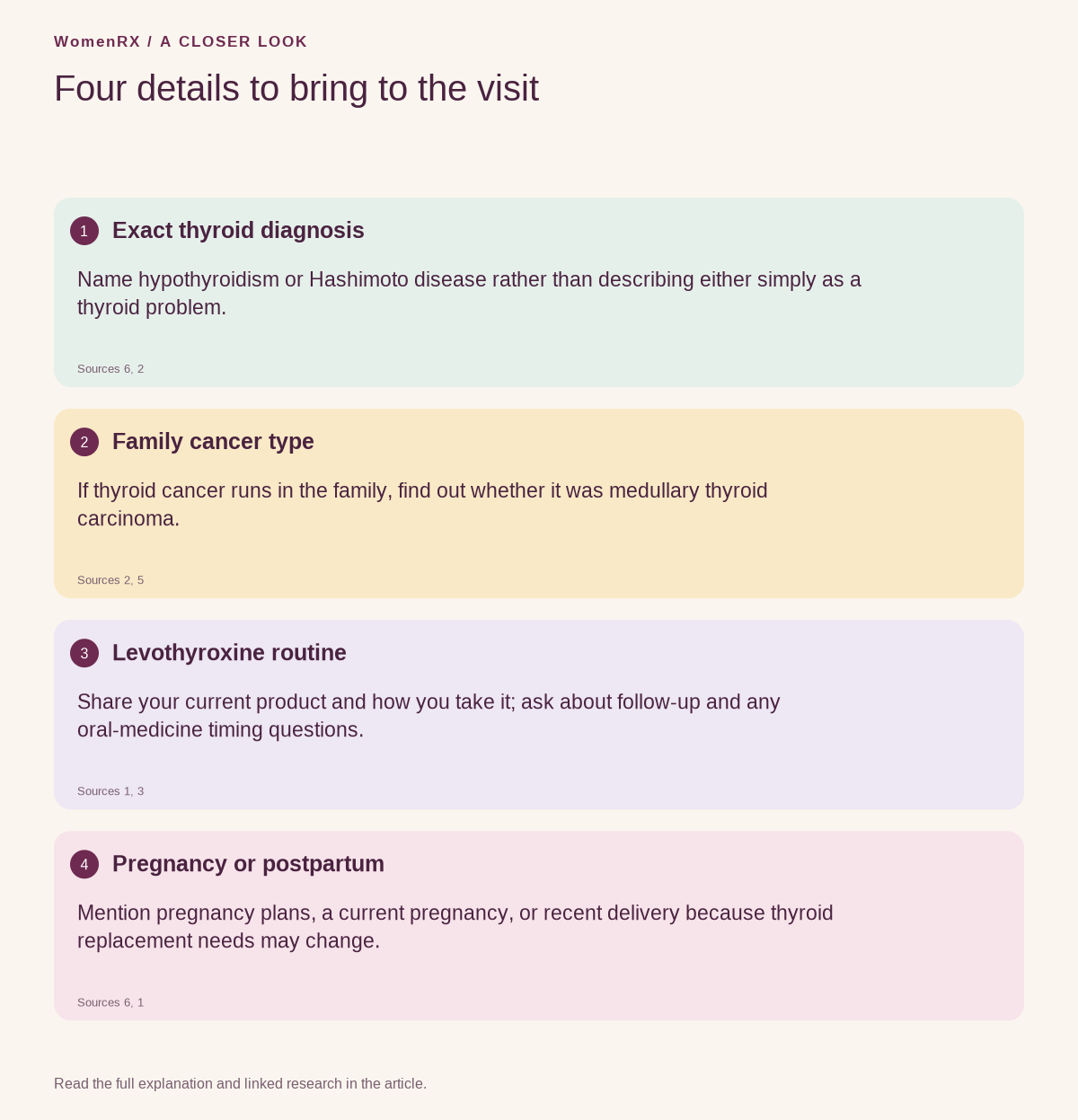
Four details to bring to the visit
Exact thyroid diagnosis: Name hypothyroidism or Hashimoto disease rather than describing either simply as a thyroid problem.62
Family cancer type: If thyroid cancer runs in the family, find out whether it was medullary thyroid carcinoma.25
Levothyroxine routine: Share your current product and how you take it; ask about follow-up and any oral-medicine timing questions.13
Pregnancy or postpartum: Mention pregnancy plans, a current pregnancy, or recent delivery because thyroid replacement needs may change.61
Read the figure as text
These details help separate the tumor-warning question from thyroid-replacement follow-up; the list is not a risk score.- Exact thyroid diagnosis: Name hypothyroidism or Hashimoto disease rather than describing either simply as a thyroid problem.62
- Family cancer type: If thyroid cancer runs in the family, find out whether it was medullary thyroid carcinoma.25
- Levothyroxine routine: Share your current product and how you take it; ask about follow-up and any oral-medicine timing questions.13
- Pregnancy or postpartum: Mention pregnancy plans, a current pregnancy, or recent delivery because thyroid replacement needs may change.61
More questions, answered
Does Hashimoto disease make a GLP-1 medicine less effective?
That hasn’t been established. A small retrospective study followed 51 adults with both hypothyroidism and type 2 diabetes who took oral semaglutide for six months and reported improvements in several metabolic measures. Without an appropriate comparison group, it couldn’t determine whether thyroid replacement changed semaglutide’s effects. 4
Are thyroid blood tests the same as screening for the tumor warning?
No. Thyroid hormone tests help assess whether your levothyroxine dose is right. The Wegovy and Zepbound labels say the value of routine calcitonin testing or thyroid ultrasound for early MTC detection during treatment is uncertain. 125
Sources you can check
- LEVOTHYROXINE SODIUM TABLET [CARDINAL HEALTH 107, LLC] | US prescribing information and patient instructionsAccessed 2026-09-25Return to first citation
- WEGOVY (SEMAGLUTIDE) INJECTION, SOLUTION WEGOVY (SEMAGLUTIDE) TABLET [NOVO NORDISK PHARMACEUTICAL INDUSTRIES, LP] | US prescribing information and patient instructionsAccessed 2026-09-25Return to first citation
- Combined Treatment of Type 2 Diabetes and Hypothyroidism: Impact of Oral Semaglutide and Levothyroxine on Cardiometabolic and Thyroid Parameters: A 6-Month Comparative Study.Tilici DM, Costinescu RM, Paun DL, Stegaru D, Grecu BM, Costea M, Guja C. · Epidemiologia (Basel, Switzerland) · 2026Return to first citation
- Modulation of metabolic syndrome components by oral semaglutide in hypothyroid-T2DM patients: a retrospective analysis.Tilici DM, Costinescu RM, Paun DL, Paun SC, Guja C. · Journal of medicine and life · 2025Return to first citation
- ZEPBOUND (TIRZEPATIDE) INJECTION, SOLUTION ZEPBOUND (TIRZEPATIDE) INJECTION, SOLUTION ZEPBOUND KWIKPEN (TIRZEPATIDE) INJECTION, SOLUTION [ELI LILLY AND COMPANY] | US prescribing information and patient instructionsAccessed 2026-09-25Return to first citation
- Hypothyroidism (Underactive Thyroid) - NIDDKAccessed 2026-09-25Return to first citation