GLP-1 Medicines and Blood Pressure: What to Track
GLP-1 medicines may be associated with lower blood pressure, but the evidence doesn’t predict what will happen to your readings.
Some research finds lower blood-pressure readings or better blood-pressure control among people taking GLP-1 medicines, but much of the evidence is observational or comes from people with diabetes taking combination treatment. That doesn’t prove the medicine caused the change or show that it prevents heart attacks or strokes. If you take blood-pressure medicine too, track readings and share changes with your prescriber rather than adjusting treatment on your own. 4 5
What the readings show, and what they don’t
Blood pressure may improve while someone is taking a GLP-1 medicine, but the available findings don’t tell you exactly what will happen in your case. In a U.S. survey analysis of adults with hypertension, blood pressure was controlled in an estimated 66% of GLP-1 users and 24% of nonusers. Only 45 people in the study reported using a GLP-1 medicine, and the groups differed substantially: 99% of users had diabetes, compared with 18% of nonusers. Because this was a cross-sectional comparison, it cannot show that the medicine caused better control or estimate its blood-pressure effect for women taking it for weight loss. 4
A separate post hoc analysis followed people with type 2 diabetes and hypertension in Japan who began combination treatment with a GLP-1 medicine and an SGLT2 inhibitor. Average office blood pressure changed from 141.8/82.4 mmHg at baseline to 135.2/78.5 after treatment addition and 131.7/79.4 after combination therapy. Because this was combination treatment in a specific population, the change can’t be attributed to the GLP-1 medicine alone or assumed to apply to everyone. 5
These studies report blood-pressure measurements, not proof that a particular GLP-1 medicine prevents cardiovascular events. A guideline from the Austrian Diabetes Association describes GLP-1 medicines as contributing to blood-pressure lowering in diabetes, while also emphasizing that blood-pressure treatment remains a priority. 6
Why your other treatment and health changes matter
Weight changes can affect blood pressure: maintaining a healthy weight is one of the measures MedlinePlus identifies as helpful for controlling it. If your weight or readings change after starting treatment, share both with the person managing your blood pressure. That information may help them assess whether your existing treatment still fits. 2
Also mention changes in food or fluid intake, especially if you take a diuretic. Diuretics lower blood pressure in part by removing water and sodium from the body. A change in intake doesn’t by itself tell you whether blood pressure or medication needs have changed, so share it as context with your care team rather than changing medication yourself. 3
GLP-1 medicines aren’t a replacement for prescribed blood-pressure treatment. High blood pressure often has no symptoms, and treatment may include medication as well as lifestyle measures. Keep following your current plan unless the prescriber managing it changes it. 1 3
A practical way to monitor
Record a baseline reading if you have one, then keep a simple log of readings during treatment. Add the date, your GLP-1 medicine, any blood-pressure medicines, and any notable changes in weight, eating, or drinking. Ask the person prescribing your treatment how often they want you to check and which readings should prompt a call. This record can show whether readings are shifting without assuming that the medicine is the cause.
If you had high blood pressure during pregnancy, include that in your medical history when discussing blood-pressure care. These findings don’t establish GLP-1 medicines as a way to prevent or treat pregnancy-related hypertension.
A reading higher than 180 systolic and higher than 120 diastolic is identified as a hypertensive crisis in MedlinePlus guidance and warrants medical care right away. Don’t use a hoped-for effect from a GLP-1 medicine as a reason to wait or change prescribed treatment. 1
A blood-pressure log that adds context
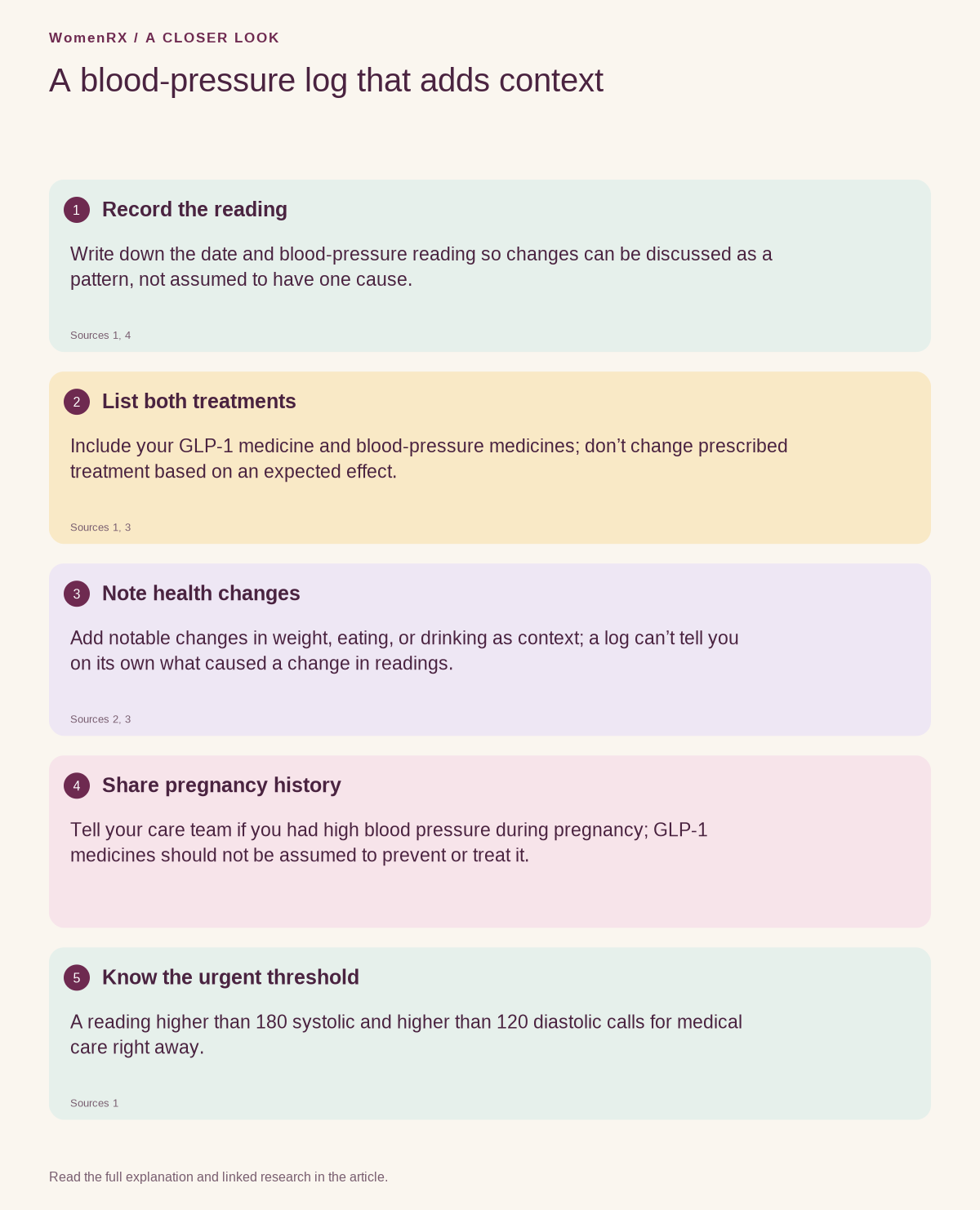
Record the reading: Write down the date and blood-pressure reading so changes can be discussed as a pattern, not assumed to have one cause.14
List both treatments: Include your GLP-1 medicine and blood-pressure medicines; don’t change prescribed treatment based on an expected effect.13
Note health changes: Add notable changes in weight, eating, or drinking as context; a log can’t tell you on its own what caused a change in readings.23
Share pregnancy history: Tell your care team if you had high blood pressure during pregnancy; GLP-1 medicines should not be assumed to prevent or treat it.
Know the urgent threshold: A reading higher than 180 systolic and higher than 120 diastolic calls for medical care right away.1
Read the figure as text
Use the same short record to help discuss trends with the person managing your blood pressure. Ask them how often to check and what readings should prompt contact.- Record the reading: Write down the date and blood-pressure reading so changes can be discussed as a pattern, not assumed to have one cause.14
- List both treatments: Include your GLP-1 medicine and blood-pressure medicines; don’t change prescribed treatment based on an expected effect.13
- Note health changes: Add notable changes in weight, eating, or drinking as context; a log can’t tell you on its own what caused a change in readings.23
- Share pregnancy history: Tell your care team if you had high blood pressure during pregnancy; GLP-1 medicines should not be assumed to prevent or treat it.
- Know the urgent threshold: A reading higher than 180 systolic and higher than 120 diastolic calls for medical care right away.1
More questions, answered
Should I stop my blood-pressure medicine if my readings fall?
Don’t stop or change it on your own. Blood-pressure treatment is a plan, and research can’t establish how any one person’s readings will respond to a GLP-1 medicine. Share your readings with the prescriber managing your blood pressure. 1 4
Does lower blood pressure mean a GLP-1 medicine prevents a heart attack or stroke?
Not by itself. These studies report blood-pressure readings or control; they don’t establish that a particular person’s change in readings prevents a heart attack or stroke. 4 5
Sources you can check
- High Blood Pressure | Hypertension | MedlinePlusAccessed 2026-09-25Return to first citation
- How to Prevent High Blood Pressure: MedlinePlusAccessed 2026-09-25Return to first citation
- Blood Pressure Medicines | MedlinePlusAccessed 2026-09-25Return to first citation
- Blood Pressure Control Among U.S. Adults With Hypertension, Stratified by Glucagon-Like Peptide 1 (GLP-1) Receptor Agonist Use: Evidence From the National Health and Nutrition Examination Survey, 2017-2020.Elfezzani N, Mambu TM, Nnanna JU, Iwu II, Nedassa BW, Nathan-Otu E, Ekome O, Idinmachukwu E, Massud NA, Osueni A. · Cureus · 2026Return to first citation
- Influence of combination therapy with SGLT2 inhibitors and GLP-1 receptor agonists on the management of blood pressure in Japanese patients with diabetes.Matsushita T, Wada Y, Saburi M, Kobayashi K, Tsukamoto S, Kawanami D, Suzuki D, Tsuriya D, Wakui H, Kanasaki K, Muta Y, Tamura K, Takeuchi Y, Toyoda M. · Hypertension research : official journal of the Japanese Society of Hypertension · 2026Return to first citation
- [Individualizing antihypertensive therapy in diabetes mellitus. Guidelines of the Austrian Diabetes Association (Update 2026)].Saely CH, Schernthaner GH, Brix JM, Klauser-Braun R, Zitt E, Drexel H, Schernthaner G. · Wiener klinische Wochenschrift · 2026Return to first citation