Insulin Resistance: What Testing Can, and Can’t, Tell You
Risk factors can prompt glucose testing, and the result helps clarify whether the next goal is prevention or diabetes care.
Symptoms and risk factors cannot confirm insulin resistance. A1C, fasting glucose, and an oral glucose tolerance test assess blood sugar rather than directly measuring insulin sensitivity. PCOS and prior gestational diabetes matter to risk discussions, but neither confirms insulin resistance. If testing shows elevated glucose, the next step depends on how the result is interpreted: a prevention discussion or assessment for diabetes. Neither path requires proving that insulin resistance has been “reversed.” 1 2 3 4
Risk factors can raise questions about insulin resistance. Glucose testing offers a more useful next step than trying to identify it from symptoms: the result can help distinguish a prevention conversation from care for diagnosed diabetes.
Start with risk factors, not a symptom checklist
Insulin resistance means the body’s cells respond less effectively to insulin. It can be part of the biology behind type 2 diabetes, but it isn’t the same thing as diabetes: blood glucose may remain in the normal range even when insulin sensitivity is changing. In PCOS research, early insulin resistance is described as potentially silent, and one review notes that standardized protocols for insulin-resistance testing are lacking in PCOS assessment. Symptoms alone cannot confirm insulin resistance in PCOS. 3 4
The useful starting point is your overall risk and whether blood-glucose testing is appropriate. Risk factors for type 2 diabetes include older age, family history, overweight or obesity, physical inactivity, and a history of gestational diabetes. 4
PCOS belongs in that conversation, too. It is associated with insulin resistance, but a PCOS diagnosis does not tell you whether you personally have it. Likewise, having had gestational diabetes raises later type 2 diabetes risk; it is not a standalone diagnosis of insulin resistance. 1 4
What the common blood tests show
A1C, fasting plasma glucose, and a two-hour glucose measurement during a 75-gram oral glucose tolerance test are used to diagnose diabetes. Diabetes-range thresholds are A1C at or above 6.5%, fasting plasma glucose at or above 126 mg/dL, or two-hour glucose at or above 200 mg/dL during that test. 4
Those results answer a glucose question: is blood sugar in the diabetes range? They do not, by themselves, directly measure how sensitive the body is to insulin. Insulin and related calculations such as HOMA-IR are used in research and some clinical discussions, but a review of PCOS assessment describes a lack of standardized protocols for insulin-resistance testing. In that context, a result from one such measure needs interpretation alongside the rest of your health picture. 3
A glucose result in the normal range is reassuring about the measure tested without ruling out every change in insulin sensitivity. One longitudinal study of 16,333 initially normoglycemic adults found that a research score based on fasting insulin and C-peptide was associated with later prediabetes or type 2 diabetes. The study shows why researchers are investigating these measures; it does not establish that everyone needs this score or that it is a routine diagnostic test. 2
What follows a normal, elevated, or diabetes-range result
If your glucose result is normal: Consider it alongside your risk factors rather than treating it as a verdict on insulin sensitivity. For example, PCOS or a history of gestational diabetes is still relevant to a discussion about future glucose testing. An isolated insulin-related result does not establish a glucose-based diagnosis or a universal definition of “reversal.” 1 2 3 4
If your glucose result is elevated but not in the diabetes range: Ask how the result should be interpreted and whether it changes your future diabetes risk. Don’t use a cutoff from a research study as a diagnosis for yourself. Prediabetes is not one uniform biological state; people can differ in insulin sensitivity, insulin secretion, and other factors. 2 5
This is the prevention pathway, not automatically a medication plan for diagnosed diabetes. A concrete discussion can start with what you could sustain: opportunities for physical activity, changes to food choices, and whether weight management is relevant to you. These are components of type 2 diabetes care; research on prediabetes also examines intensive lifestyle modification, but it does not establish one identical benefit or routine for every person with elevated glucose. A review reports the greatest glycemic benefit from intensive lifestyle modification in a studied subgroup characterized by fatty liver. That finding does not mean you need a subtype label before discussing changes you could make. The realistic aim is to address risk over time, not to demonstrate a permanent “reversal” on an insulin test. 4 5
If your result is in the diabetes range: The next conversation is about assessing diabetes and, if type 2 diabetes is diagnosed, choosing care based on blood sugar and other health needs. The treatment options below are for diagnosed type 2 diabetes, not automatically for an isolated insulin-resistance result. 4
What care can mean after a type 2 diabetes diagnosis
For people with type 2 diabetes, weight management, diet, and physical activity are components of care. No single diet has been proven best for health outcomes in type 2 diabetes. Physical activity can reduce A1C and improve cardiovascular risk factors. Metformin is generally a first-line medication for reaching A1C targets; GLP-1 receptor agonists or SGLT2 inhibitors are options for people with type 2 diabetes and cardiovascular or kidney conditions, or high cardiovascular risk. These are treatment approaches for diagnosed type 2 diabetes and related health needs, not a universal prescription for an insulin-resistance result. 4
A useful next conversation is specific: “Which risk factors apply to me, how should I understand my glucose result, and what would we do differently based on it?” If you have PCOS or a past gestational diabetes diagnosis, mention it when discussing your risk and testing. The aim is a clear assessment and a plan tied to your health, not chasing an isolated insulin number.
Risk, glucose testing, and what follows
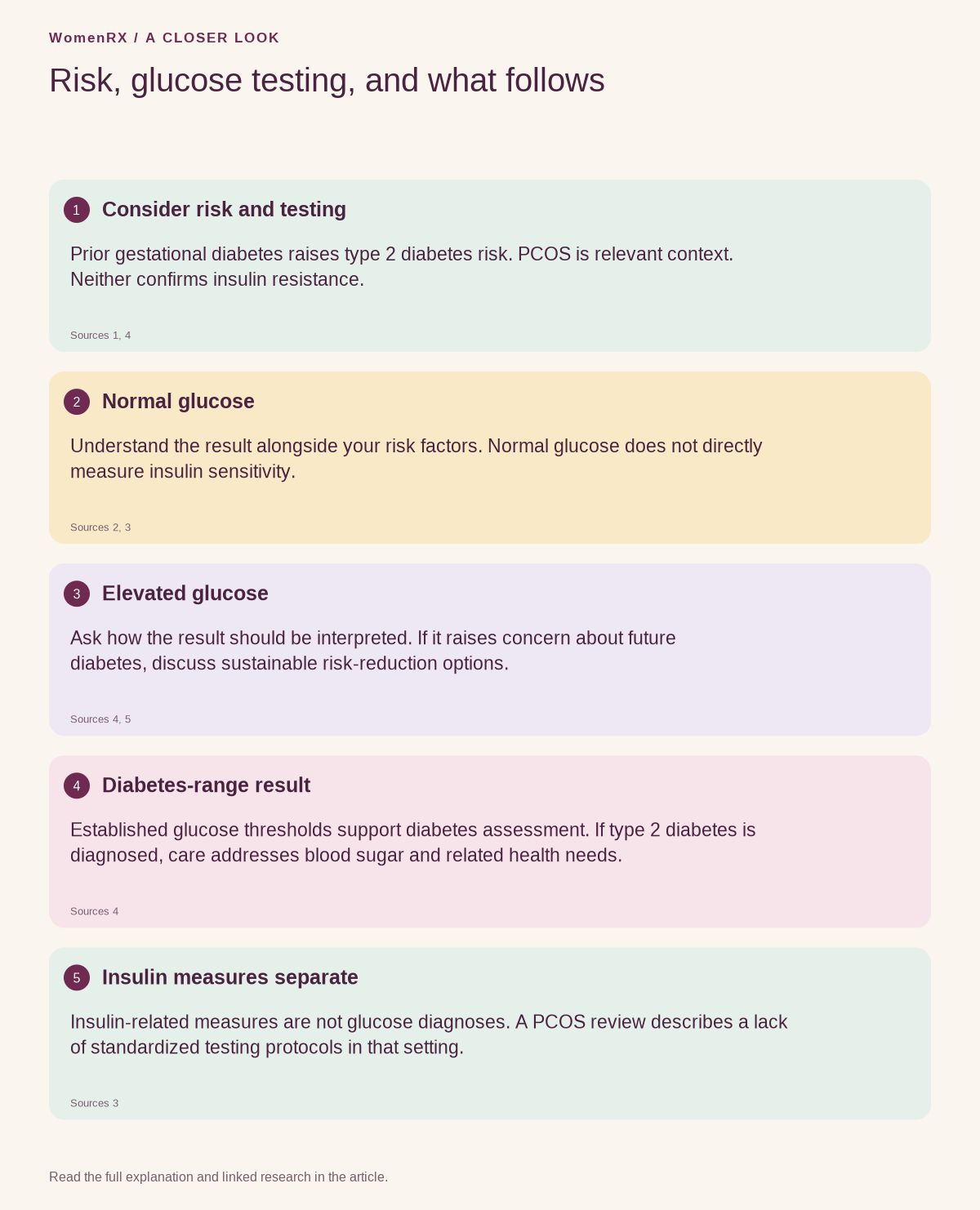
Consider risk and testing: Prior gestational diabetes raises type 2 diabetes risk. PCOS is relevant context. Neither confirms insulin resistance.14
Normal glucose: Understand the result alongside your risk factors. Normal glucose does not directly measure insulin sensitivity.23
Elevated glucose: Ask how the result should be interpreted. If it raises concern about future diabetes, discuss sustainable risk-reduction options.45
Diabetes-range result: Established glucose thresholds support diabetes assessment. If type 2 diabetes is diagnosed, care addresses blood sugar and related health needs.4
Insulin measures separate: Insulin-related measures are not glucose diagnoses. A PCOS review describes a lack of standardized testing protocols in that setting.3
Read the figure as text
Risk factors can prompt glucose testing. The result then shapes the next discussion; insulin-related measures answer a separate question.- Consider risk and testing: Prior gestational diabetes raises type 2 diabetes risk. PCOS is relevant context. Neither confirms insulin resistance.14
- Normal glucose: Understand the result alongside your risk factors. Normal glucose does not directly measure insulin sensitivity.23
- Elevated glucose: Ask how the result should be interpreted. If it raises concern about future diabetes, discuss sustainable risk-reduction options.45
- Diabetes-range result: Established glucose thresholds support diabetes assessment. If type 2 diabetes is diagnosed, care addresses blood sugar and related health needs.4
- Insulin measures separate: Insulin-related measures are not glucose diagnoses. A PCOS review describes a lack of standardized testing protocols in that setting.3
More questions, answered
Does PCOS mean I have insulin resistance?
No. PCOS is associated with insulin resistance, but the conditions are not interchangeable, and PCOS alone does not confirm insulin resistance. It is useful context when discussing glucose testing and future diabetes risk. 1 3
What if my insulin result is high but my glucose test is normal?
The tests answer different questions. Insulin-related measures are being studied for risk assessment, but a PCOS review describes a lack of standardized insulin-resistance testing protocols in that setting. Ask what the insulin result would change about your care in light of your glucose result and other risk factors. 2 3
Sources you can check
- Prevalence of subclinical hypothyroidism in polycystic ovary syndrome and its impact on insulin resistance: a systematic review and meta-analysis.Shekarian A, Mazaheri-Tehrani S, Shekarian S, Pourbazargan M, Setudeh M, Abhari AP, Fakhrolmobasheri M, Heidarpour M. · BMC endocrine disorders · 2025Return to first citation
- Insulin resistance is associated with incident prediabetes and type 2 diabetes in normoglycemic individuals.Louie JZ, Shiffman D, Meigs JB, Taylor SW, Melander O, Abbasi F, McPhaul MJ. · Diabetes & metabolic syndrome · 2026Return to first citation
- Recognizing the Role of Insulin Resistance in Polycystic Ovary Syndrome: A Paradigm Shift from a Glucose-Centric Approach to an Insulin-Centric Model.Parker J, Briden L, Gersh FL. · Journal of clinical medicine · 2025Return to first citation
- Diagnosis and Treatment of Type 2 Diabetes in Adults: A Review.Kalyani RR, Neumiller JJ, Maruthur NM, Wexler DJ. · JAMA · 2025Return to first citation
- Beyond Glucose-Rethinking Prediabetes for Precision Prevention.Wagner R, Selvin E, Sehgal R, Prystupa K, Misra S, Fritsche A, Heni M. · Diabetes care · 2026Return to first citation