Insulin Resistance Supplements: What the Evidence Can Tell You
Myo-inositol has been studied in several different groups, but results from one condition or outcome don’t establish a best supplement for insulin resistance.
There isn’t enough evidence to name a best supplement or say that one reverses insulin resistance. Myo-inositol has shown changes in glucose-related markers in specific studies, but results vary by population, and one PCOS study tested a blend rather than myo-inositol alone. Clarify what condition and outcome your lab results relate to before weighing a supplement. 4 6
Start with what “insulin resistance” means in your situation
Insulin resistance is discussed in several distinct settings, including PCOS, obesity with fatty liver disease, and gestational diabetes. A result or supplement finding from one setting doesn’t automatically apply to another. The studies in these groups also measured different things, from fasting glucose and insulin estimates to reproductive hormone measures and pregnancy outcomes. 4 5 6
So rather than asking only, “Which supplement lowers insulin resistance?”, ask what your clinician is evaluating and what change would matter for you. For example, is the concern a glucose-related lab result, PCOS symptoms, diabetes risk, or glucose management during pregnancy? These are not interchangeable goals.
Myo-inositol: promising signals, not a universal answer
Myo-inositol is one of the supplements studied, but the human evidence in these studies is mixed and specific to the populations tested. In a small randomized trial, 48 patients with obesity and fatty liver disease received myo-inositol or placebo for eight weeks. Several insulin-resistance indices improved in the myo-inositol group, but the study was short and limited to that group of patients. It doesn’t establish long-term benefit or show that myo-inositol prevents diabetes. 4
A different randomized trial studied a combination of myo-inositol, zinc, and a prebiotic in 10- to 18-year-olds with obesity and insulin resistance. The combination did not improve the primary insulin-resistance measure compared with placebo. A post hoc analysis found differences in some more severely affected subgroups, but that result is exploratory and cannot establish a reliable benefit for other groups. 2
In one retrospective PCOS study, 25 people took a multi-ingredient combination that included myo-inositol. Researchers reported changes in metabolic and reproductive hormone measures, but the study cannot show whether myo-inositol itself caused them. 6 Separately, a rat study of myo-inositol and PCOS cannot establish a treatment effect in women. 3
Taken together, these findings make myo-inositol worth discussing in a relevant context, not a proven answer for everyone with suspected insulin resistance.
Keep the measured outcome in view
A lower HOMA-IR or a change in fasting insulin is a change in a study measure. It is not, by itself, proof that a supplement has reversed the underlying problem or prevented a future health outcome. The eight-week fatty-liver study measured metabolic markers, while the PCOS combination study also assessed reproductive and hormone measures. Neither design establishes broad, lasting benefit across different conditions. 4 6
Pregnancy is a separate conversation. A meta-analysis of four randomized trials involving 317 women with gestational diabetes reported lower insulin-treatment requirements and lower HOMA-IR with myo-inositol alongside routine treatment. It did not find clear differences in birth weight, cesarean delivery, or NICU admission. Those results concern treatment in women who already had gestational diabetes; they do not establish that a supplement is appropriate before pregnancy, prevents gestational diabetes, or replaces pregnancy care. 5
What to clarify before choosing a supplement
Bring the discussion back to your situation: What diagnosis or risk is being assessed? Has the reason for the insulin-resistance concern been assessed, including whether PCOS or fatty liver disease is part of the picture? Which lab result is driving the concern, and what outcome would treatment aim to change? If you have PCOS, ask whether the goal is metabolic, menstrual, or fertility-related, since a finding about one outcome doesn’t prove an effect on the others.
Also mention medicines and supplements you already take. Metformin is a prescription medicine, not a supplement; US prescribing information for a metformin-containing product describes its use to improve glucose tolerance in type 2 diabetes. That is different from evidence that an over-the-counter product treats insulin resistance, and the studies above do not establish that a supplement can replace prescribed care. 1
The exact medicine matters for safety. In the glipizide-and-metformin combination product, glipizide stimulates insulin release, and the label warns that certain other medicines can increase its glucose-lowering effect and the risk of low blood sugar. That warning is about the combination product, not metformin alone or a demonstrated interaction with myo-inositol. Naming the product you take makes the supplement discussion more precise. 1
If you’re pregnant, planning pregnancy, or being treated for diabetes, make that part of the supplement discussion. Evidence from gestational-diabetes trials does not settle what is appropriate for someone planning pregnancy or taking other treatment. 5
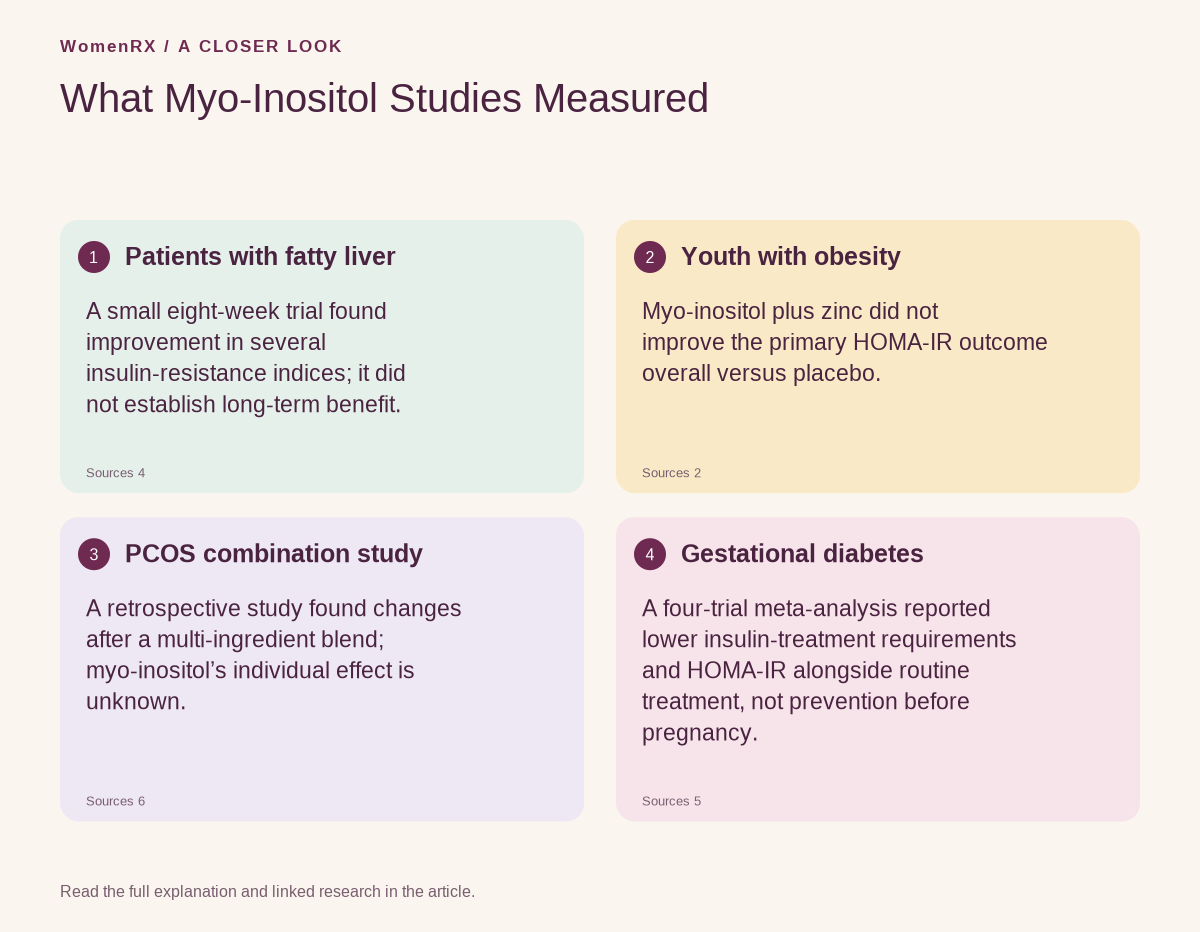
What Myo-Inositol Studies Measured
Patients with fatty liver: A small eight-week trial found improvement in several insulin-resistance indices; it did not establish long-term benefit.4
Youth with obesity: Myo-inositol plus zinc did not improve the primary HOMA-IR outcome overall versus placebo.2
PCOS combination study: A retrospective study found changes after a multi-ingredient blend; myo-inositol’s individual effect is unknown.6
Gestational diabetes: A four-trial meta-analysis reported lower insulin-treatment requirements and HOMA-IR alongside routine treatment, not prevention before pregnancy.5
Read the figure as text
The findings depend on who was studied, what was taken, and which outcome was measured. A change in one marker is not proof of a broader treatment effect.- Patients with fatty liver: A small eight-week trial found improvement in several insulin-resistance indices; it did not establish long-term benefit.4
- Youth with obesity: Myo-inositol plus zinc did not improve the primary HOMA-IR outcome overall versus placebo.2
- PCOS combination study: A retrospective study found changes after a multi-ingredient blend; myo-inositol’s individual effect is unknown.6
- Gestational diabetes: A four-trial meta-analysis reported lower insulin-treatment requirements and HOMA-IR alongside routine treatment, not prevention before pregnancy.5
More questions, answered
Does a PCOS study prove myo-inositol works for PCOS?
Not on its own. The PCOS study described here was retrospective and tested a combination of ingredients, so it cannot isolate myo-inositol’s effect or establish that the results apply to everyone with PCOS. 6
Can gestational-diabetes research guide supplement use before pregnancy?
Not by itself. The meta-analysis examined women already diagnosed with gestational diabetes who received myo-inositol alongside routine treatment. It does not establish a pre-pregnancy benefit or show that the supplement prevents gestational diabetes. 5
Sources you can check
- GLIPIZIDE AND METFORMIN HYDROCHLORIDE TABLET, FILM COATED [REMEDYREPACK INC.] | US prescribing information and patient instructionsAccessed 2026-09-25Return to first citation
- Efficacy of myo-inositol and zinc on insulin resistance in a paediatric population with obesity.Antoniotti V, Partenope C, Solito A, Mancioppi V, Baima J, Medina F, Dimarakis S, Agostini A, Sista MT, Monzani A, Scotti L, Rabbone I, Prodam F, Bellone S. · Diabetes, obesity & metabolism · 2025Return to first citation
- Exploring the role of Myo-inositol in alleviating insulin resistance in polycystic ovary syndrome through the AMPK/GLUT4 pathway.Song G, Liu N, He J, Tang S, Yu Y, Song L. · Molecular biology reports · 2025Return to first citation
- The effect of myo-inositol supplementation on AMPK/PI3K/AKT pathway and insulin resistance in patients with NAFLD.Aghajani T, Arefhosseini S, Ebrahimi-Mameghani M, Safaralizadeh R. · Food science & nutrition · 2024Return to first citation
- Influence of myo-inositol on metabolic status for gestational diabetes: a meta-analysis of randomized controlled trials.Chen H, Xiong J, Li Z, Chen Y, Zhang M, Chen D, Liu B. · The journal of maternal-fetal & neonatal medicine : the official journal of the European Association of Perinatal Medicine, the Federation of Asia and Oceania Perinatal Societies, the International Society of Perinatal Obstetricians · 2024Return to first citation
- Improved insulin sensitivity and reproductive profile in overweight/obese PCOS patients undergoing integrative treatment with carnitines, L-arginine, L-cysteine and myo-inositol.Genazzani AD, Battipaglia C, Foschi M, Semprini E, Aio C, Spelta E, Kostrzak A, Rusce ML, Szeliga A, Meczekalski B. · Gynecological endocrinology : the official journal of the International Society of Gynecological Endocrinology · 2025Return to first citation