Can You Feel Insulin Resistance, or Does It Require Testing?
Insulin resistance usually has no noticeable symptoms, but skin changes and risk factors can make glucose testing worth discussing.
Usually, you can’t feel insulin resistance. It often has no symptoms, and clinicians generally assess related risks rather than use a direct insulin-resistance test. Dark, thickened skin folds may warrant a closer look but don’t identify the cause. Thirst or frequent urination can point to high blood glucose instead. Laboratory tests can check for prediabetes or diabetes. 2345
What a change in your skin can tell you
If you’ve noticed darker, thicker skin on your neck, in your armpits, or around your groin, it may be acanthosis nigricans. The patches often develop gradually and may have no other symptoms, though they can sometimes itch. A clinician can usually recognize the skin finding by examining it. That examination doesn’t, by itself, explain why it appeared. Possible causes include type 2 diabetes, other hormone-related conditions, and certain medicines; some people have the patches without another condition. New or uncertain skin changes are worth having checked rather than assuming they mean insulin resistance. 2
Insulin resistance means cells in your muscles, fat, and liver don’t respond to insulin as well as they should. Insulin helps glucose move from your blood into your cells. But a skin change is not a measurement of how your body responds to insulin, and it can’t establish insulin resistance on its own. 35
Feeling unwell may be about glucose, not insulin resistance itself
Insulin resistance and prediabetes usually have no symptoms. Thirst, frequent urination, tiredness, headaches, and blurred vision can occur when blood glucose is high. They’re reasons to discuss glucose testing, not a way to identify insulin resistance. People can also have diabetes risk factors without symptoms. If you’re frequently thirsty or urinating often, don’t wait for a skin change before raising it with a clinician. 345
That distinction is useful: insulin resistance describes how the body responds to a hormone; glucose tests show what is happening to blood sugar. The two are related, but a glucose reading isn’t a direct measure of insulin sensitivity. A home glucose meter can show a reading at a particular moment; it cannot diagnose diabetes. 345
What testing can answer
Clinicians may not test directly for insulin resistance; that test is primarily used in research. Instead, they can assess your risk and use blood tests to look for prediabetes or diabetes. A fasting plasma glucose test measures blood sugar at one point in time, while an A1C test estimates average blood glucose over roughly three months. An oral glucose tolerance test measures how blood glucose changes after a glucose drink. A clinician will usually use a second test to confirm a diabetes diagnosis. 45
Which test makes sense depends on the question. For example, if you’re concerned about new darkened skin folds, you can ask both, “What might be causing this skin change?” and “Do my history or symptoms suggest I should be tested for prediabetes or diabetes?” The first calls for an assessment of the skin and its possible causes; the second may call for blood testing. 24
If you have polycystic ovary syndrome (PCOS), it belongs in that risk discussion. PCOS is among the conditions associated with a greater chance of insulin resistance or prediabetes, but having PCOS does not prove you have either one. A clinician can consider it alongside your other risk factors when deciding whether glucose testing makes sense. A normal glucose result answers a question about your blood sugar; it isn’t a direct test of insulin sensitivity. 45
Pregnancy changes the testing question
During pregnancy, glucose assessment follows a different path. Testing for gestational diabetes is recommended even when you don’t feel unwell; the National Institute of Diabetes and Digestive and Kidney Diseases describes testing for pregnant women without previously diagnosed diabetes between 24 and 28 weeks. Pregnancy can also affect how an A1C result is interpreted, so an A1C that seems straightforward outside pregnancy may not be the right answer to a pregnancy-related question. If you’ve had gestational diabetes, testing after birth checks for type 2 diabetes. 14
What each clue can answer
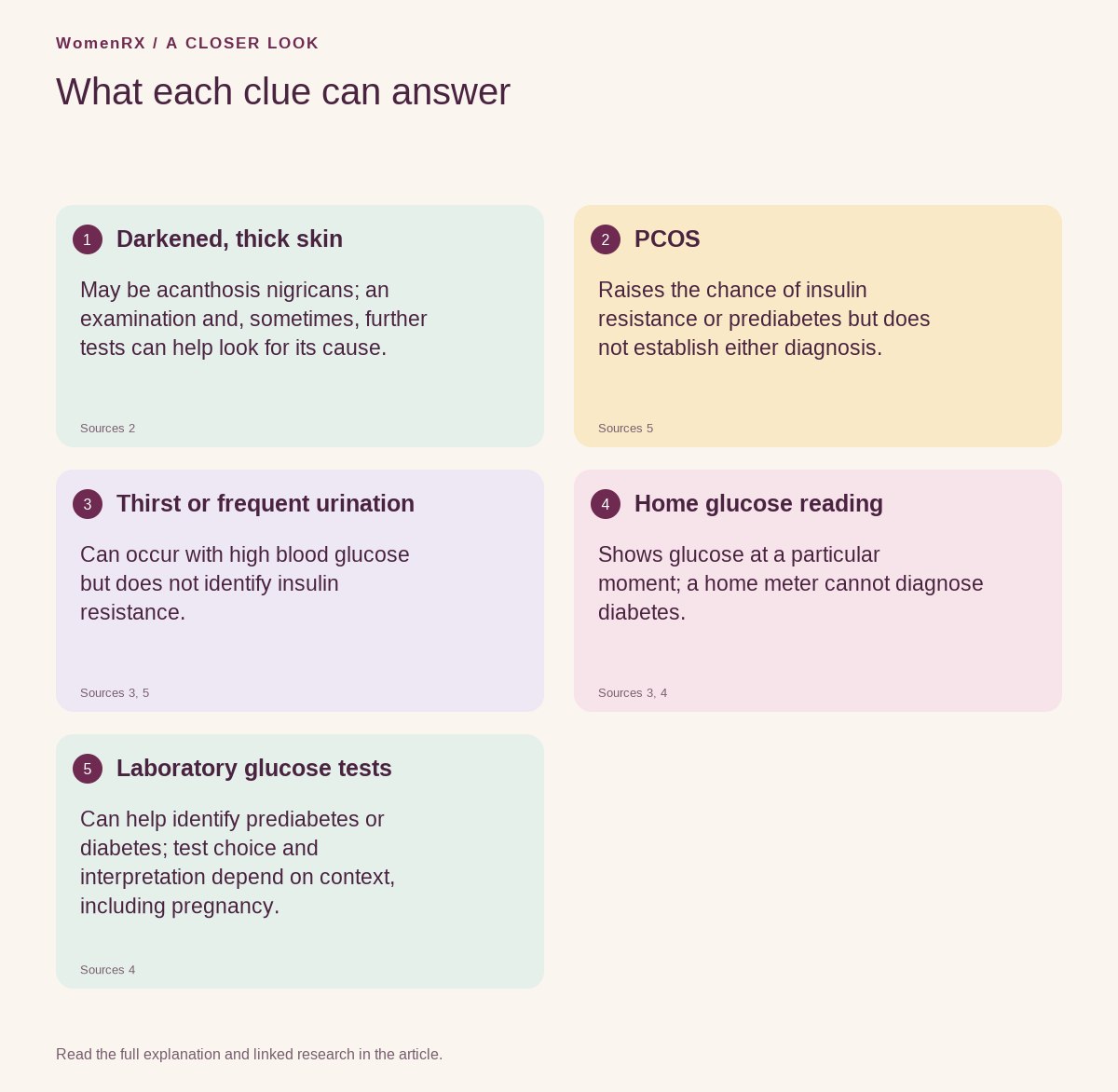
Darkened, thick skin: May be acanthosis nigricans; an examination and, sometimes, further tests can help look for its cause.2
PCOS: Raises the chance of insulin resistance or prediabetes but does not establish either diagnosis.5
Thirst or frequent urination: Can occur with high blood glucose but does not identify insulin resistance.35
Home glucose reading: Shows glucose at a particular moment; a home meter cannot diagnose diabetes.34
Laboratory glucose tests: Can help identify prediabetes or diabetes; test choice and interpretation depend on context, including pregnancy.4
Read the figure as text
A skin finding, a risk factor, a symptom, and a blood test provide different kinds of information.- Darkened, thick skin: May be acanthosis nigricans; an examination and, sometimes, further tests can help look for its cause.2
- PCOS: Raises the chance of insulin resistance or prediabetes but does not establish either diagnosis.5
- Thirst or frequent urination: Can occur with high blood glucose but does not identify insulin resistance.35
- Home glucose reading: Shows glucose at a particular moment; a home meter cannot diagnose diabetes.34
- Laboratory glucose tests: Can help identify prediabetes or diabetes; test choice and interpretation depend on context, including pregnancy.4
More questions, answered
Would one normal home glucose reading rule out a problem?
No. A home meter measures glucose at that moment and cannot diagnose diabetes. If you have symptoms or risk factors, ask whether a laboratory blood test is appropriate. 34
Sources you can check
- Prenatal Testing | Gestational Diabetes | MedlinePlusAccessed 2026-09-25Return to first citation
- Acanthosis nigricans - NHSAccessed 2026-09-25Return to first citation
- Blood Glucose | Blood Sugar | Diabetes | MedlinePlusAccessed 2026-09-25Return to first citation
- Diabetes Tests & Diagnosis - NIDDKAccessed 2026-09-25Return to first citation
- Insulin Resistance & Prediabetes - NIDDKAccessed 2026-09-26Return to first citation