What TSH, T4, T3, and Antibody Tests Tell You
TSH and thyroid hormones work as a pair; antibodies answer a different question about possible cause.
TSH measures a signal from the pituitary gland; T4 and T3 measure thyroid hormones. A high TSH with low free T4 points to an underactive thyroid, while a high TSH with free T4 in range is a different pattern: the signal is raised, but the measured hormone isn’t low. A low TSH with high T4 or T3 usually points toward an overactive thyroid. Antibodies offer clues about cause, not current hormone levels.109
First, separate TSH from thyroid hormone
A thyroid report can feel like a collection of unrelated numbers. The useful starting point is that TSH and thyroid hormones measure different parts of the same system. TSH is made by the pituitary gland and signals the thyroid to make hormones. T4 and T3 measure thyroid hormones in your blood. TSH is usually the first test ordered, but a flagged TSH is not a diagnosis by itself. Ask how it relates to any free T4 result drawn at the same time.210
High TSH with low free T4 points to an underactive thyroid gland: the pituitary is sending a stronger signal, but the measured hormone is low. High TSH with free T4 in range is different. The signal is raised, but free T4 has not fallen below the lab’s range. TSH can change before thyroid-hormone levels become abnormal, so ask what this combination means for you rather than treating the two patterns as equivalent.10 Low TSH with high T4 or T3 usually points toward an overactive thyroid.9
A value just outside the printed range deserves a different conversation from a clear, persistent abnormality. Symptoms matter, but symptoms associated with thyroid dysfunction are common and nonspecific. Ask what the combination suggests and whether a repeat test would clarify a borderline or unexpected finding.8
Not every result follows the usual pattern. For example, a low TSH paired with a low free T4 does not fit the simple assumption that a low TSH always means too much thyroid hormone. That combination needs a closer look at the circumstances and, sometimes, follow-up testing. A published postpartum case illustrates how results can change during thyroiditis and initially resemble a different thyroid problem; one case does not tell you how to interpret your own result.6
Free T4, total T4, and T3 answer different questions
Free T4 and total T4 are different measurements. Changes in the proteins that carry thyroid hormone can affect total T4 differently from free T4. For example, oral estrogens and estrogen-containing contraceptives can affect a thyroid-hormone binding protein. If your report says only “T4,” check whether it means free or total before comparing it with another result.310
T3 measures another thyroid hormone in your blood. If T3 appears on your report, ask why it was tested and how it relates to the other results. T3 can help clarify suspected overactivity when TSH is low but free T4 is in range; it is rarely helpful for identifying an underactive thyroid. During pregnancy, a clinical review describes TSH as the principal first test and says the relevance of measuring free T3 is unclear.107
Antibodies can suggest a cause, not the hormone level
Thyroid antibody tests look for markers that can help identify an autoimmune thyroid disorder. The specific antibody matters: thyroid peroxidase antibodies, often written TPO antibodies, and TSH-receptor antibodies, often written TRAb, are complementary tests used when evaluating thyroid disease. An antibody result does not measure T4 or T3, so a positive result alone does not establish that you currently have too little or too much thyroid hormone.2410
If an antibody is flagged, a useful question is: Which antibody was tested, and what do my TSH and free T4 show at the same time? That keeps a clue about a possible cause separate from evidence about current thyroid function.210
The context that can change the reading
Pregnancy changes the comparison. Thyroid test interpretation changes during pregnancy, and TSH should be assessed against a pregnancy-stage-specific reference range rather than an ordinary nonpregnant range. Free T4 testing can also be affected by assay interference. If you take levothyroxine, pregnancy may mean more blood tests to check whether your treatment still fits your hormone levels.71
After birth, the question may change again. Postpartum thyroiditis and Graves’ disease can both be relevant when thyroid hormone levels are high, but their management differs. A review does not recommend routine thyroid-function screening for every woman without symptoms after birth. It identifies circumstances in which testing should be considered, including a previous episode of postpartum thyroiditis, Graves’ disease, Hashimoto’s thyroiditis treated with thyroid hormone, or known TPO-antibody positivity. Tell the person interpreting your results that you’ve recently given birth, especially if the numbers have changed over time.5
Medicines and supplements belong in the picture. Biotin, found in some supplements, can affect thyroid tests. If you take levothyroxine, certain medicines can affect your response to it; rifampin is one example. Oral estrogens can affect thyroid-hormone binding. Bring an accurate list of what you take rather than trying to explain an unexpected number by changing anything yourself.13
Your next move can be specific: check the lab’s reference range and whether the result is free or total T4; compare tests drawn at the same time; and ask what the pattern means in your circumstances. That is more useful than deciding what one highlighted number means on its own.37810
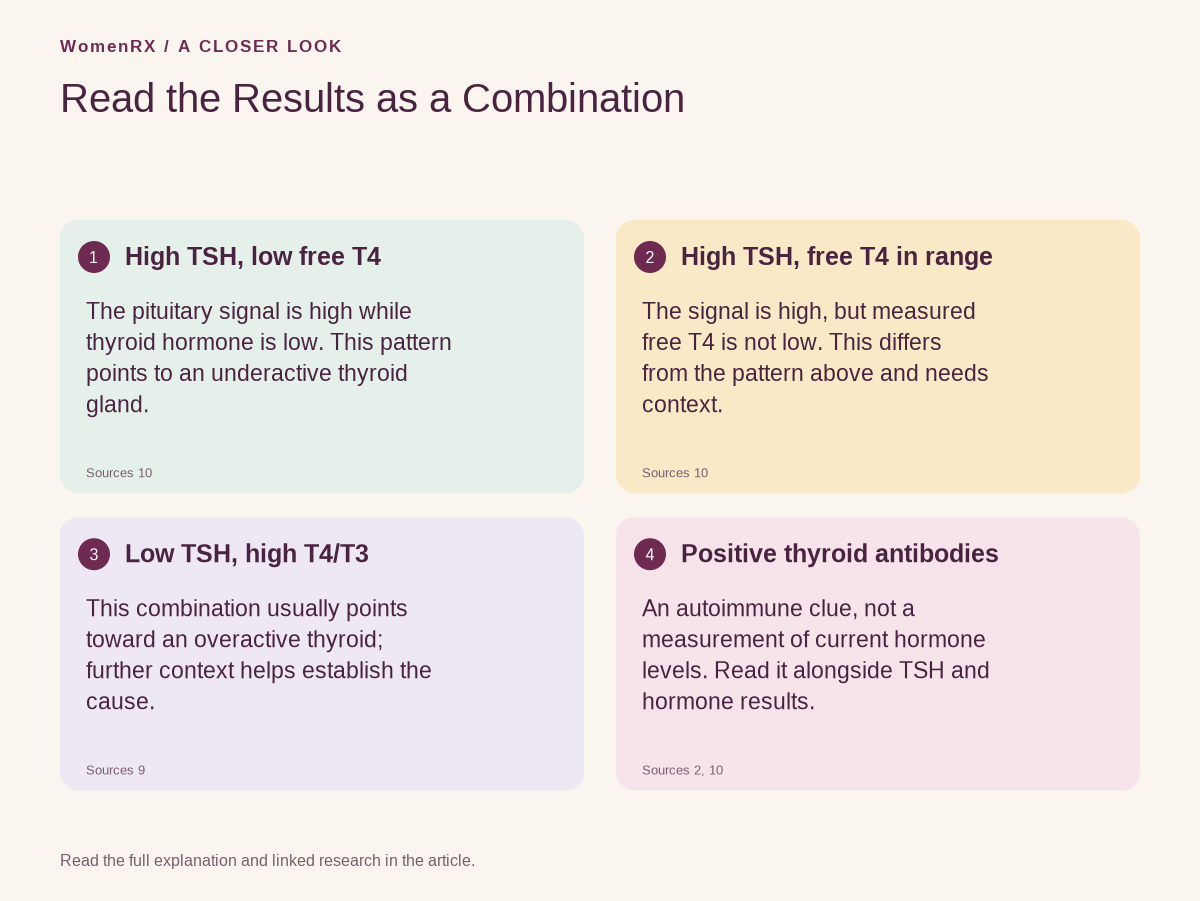
Read the Results as a Combination
High TSH, low free T4: The pituitary signal is high while thyroid hormone is low. This pattern points to an underactive thyroid gland.10
High TSH, free T4 in range: The signal is high, but measured free T4 is not low. This differs from the pattern above and needs context.10
Low TSH, high T4/T3: This combination usually points toward an overactive thyroid; further context helps establish the cause.9
Positive thyroid antibodies: An autoimmune clue, not a measurement of current hormone levels. Read it alongside TSH and hormone results.210
Read the figure as text
TSH and free T4 show different parts of thyroid function. Antibodies add a clue about possible cause.- High TSH, low free T4: The pituitary signal is high while thyroid hormone is low. This pattern points to an underactive thyroid gland.10
- High TSH, free T4 in range: The signal is high, but measured free T4 is not low. This differs from the pattern above and needs context.10
- Low TSH, high T4/T3: This combination usually points toward an overactive thyroid; further context helps establish the cause.9
- Positive thyroid antibodies: An autoimmune clue, not a measurement of current hormone levels. Read it alongside TSH and hormone results.210
More questions, answered
Does a positive thyroid antibody test mean I need thyroid medicine?
Not on its own. Antibodies can help identify an autoimmune cause, while TSH and thyroid-hormone tests address current thyroid function. Ask how the antibody result changes the interpretation of your hormone results and whether any follow-up is needed.210
Sources you can check
- Levothyroxine: a medicine for an underactive thyroid (hypothyroidism) - NHSAccessed 2026-09-25Return to first citation
- Thyroid Tests: MedlinePlusAccessed 2026-09-25Return to first citation
- LEVOTHYROXINE SODIUM TABLET [CARDINAL HEALTH 107, LLC] | US prescribing information and patient instructionsAccessed 2026-09-25Return to first citation
- Autoimmune Thyroid Diseases.Petranović Ovčariček P, Görges R, Giovanella L. · Seminars in nuclear medicine · 2024Return to first citation
- An update on thyroid disorders in the postpartum period.Peng CC, Pearce EN. · Journal of endocrinological investigation · 2022Return to first citation
- Biochemical transition during triphasic postpartum thyroiditis: confusion with central hypothyroidism.Oyibo SO, Green OS, Laliwala NM, Sagi SV. · Endocrinology, diabetes & metabolism case reports · 2021Return to first citation
- Interpretation of thyroid function tests during pregnancy.Visser WE, Peeters RP. · Best practice & research. Clinical endocrinology & metabolism · 2020Return to first citation
- Biochemical Testing of the Thyroid: TSH is the Best and, Oftentimes, Only Test Needed - A Review for Primary Care.Sheehan MT. · Clinical medicine & research · 2016Return to first citation
- Overactive thyroid (hyperthyroidism) - Diagnosis - NHSAccessed 2026-09-25Return to first citation
- Thyroid Function Tests | American Thyroid AssociationAccessed 2026-09-25Return to first citation