How Semaglutide Changes Appetite and Weight
Semaglutide activates GLP-1 receptors, and clinical trials link that action with feeling fuller, eating less, and weight loss over time.
Semaglutide activates receptors for GLP-1, a hormone involved in glucose regulation. In trials, people taking semaglutide reported less hunger and greater fullness, and ate less in measured meals. When lower food intake continues over time, weight can fall. The appetite studies report overall adult results, not whether effects differ by sex or reproductive stage. 1 2 3
The signal behind the appetite change
Semaglutide is a GLP-1 receptor agonist: it binds to and activates the receptor that responds to the natural hormone GLP-1. That describes the drug’s target, but it doesn’t mean appetite or weight changes come from one simple switch. 1
In randomized trials, semaglutide was associated with less hunger, more fullness and satiety, and changes in food cravings or food reward. Those experiences can make eating less feel different from trying to impose a restriction by willpower alone. They don’t mean everyone will notice the same changes, or that appetite is the only factor shaping weight. 2 3
From appetite to food intake
A useful distinction is between how hungry people say they feel and how much they eat when food is available. In a 60-week randomized trial, 120 adults with overweight or obesity received semaglutide 2.4 mg or placebo. The semaglutide group ate less than the placebo group at a measured, freely chosen lunch at weeks 20, 40, and 60. Some reported appetite differences were clearer at week 20 and weren’t statistically different between groups at weeks 40 and 60. The measured eating difference remained. 2
That pattern matters: a person’s moment-to-moment sense of hunger may not fully capture changes in eating behavior. The trial suggests that lower food intake can persist even as some subjective appetite effects become less distinct. It doesn’t prove exactly which biological pathway accounts for that difference. 2
A separate 20-week randomized trial in 61 adults with obesity found lower measured food intake and body weight in the oral semaglutide group than in the placebo group. The study used a dose-escalated 50 mg daily regimen, so its results describe that trial rather than every semaglutide product or regimen. 3
How eating less can affect weight
If someone takes in less energy over time, that can contribute to weight loss. The trial evidence connects semaglutide with both lower measured food intake and lower body weight, but it doesn’t mean the amount or pace of change will be the same for every person. In the 20-week oral trial, average body weight fell 9.8% in the semaglutide group and 1.5% in the placebo group. That result belongs to the study’s participants and regimen, not to an individual prediction. 3
This is a more useful explanation than saying semaglutide simply “speeds up metabolism.” These trials point to changes in appetite and food intake as part of how weight loss may occur. They don’t establish that semaglutide causes weight loss by increasing energy expenditure. 2 3
Is delayed stomach emptying the main reason?
Semaglutide’s appetite effects are sometimes explained as food staying in the stomach longer. But one 20-week study of oral semaglutide found no statistically significant difference in gastric emptying at that point, using paracetamol absorption as its measure. That one test doesn’t settle every question about stomach function, but it cautions against treating slower stomach emptying as the sole explanation for appetite or weight changes. 3
What the evidence says about women
The randomized appetite studies report overall results for adults, rather than showing whether appetite or weight responses differ by sex or reproductive stage. They don’t establish a distinct mechanism for women or tell us whether effects vary across menstrual cycles, pregnancy, postpartum, perimenopause, or postmenopause. Those questions remain open; the observed appetite and food-intake findings shouldn’t be recast as women-specific. 2 3
The practical takeaway is straightforward: semaglutide activates a GLP-1 receptor, and trials link treatment with changes in appetite and lower food intake. Lower intake can contribute to weight change over time, but a single appetite sensation, mechanism, or study result can’t predict exactly what an individual will experience.
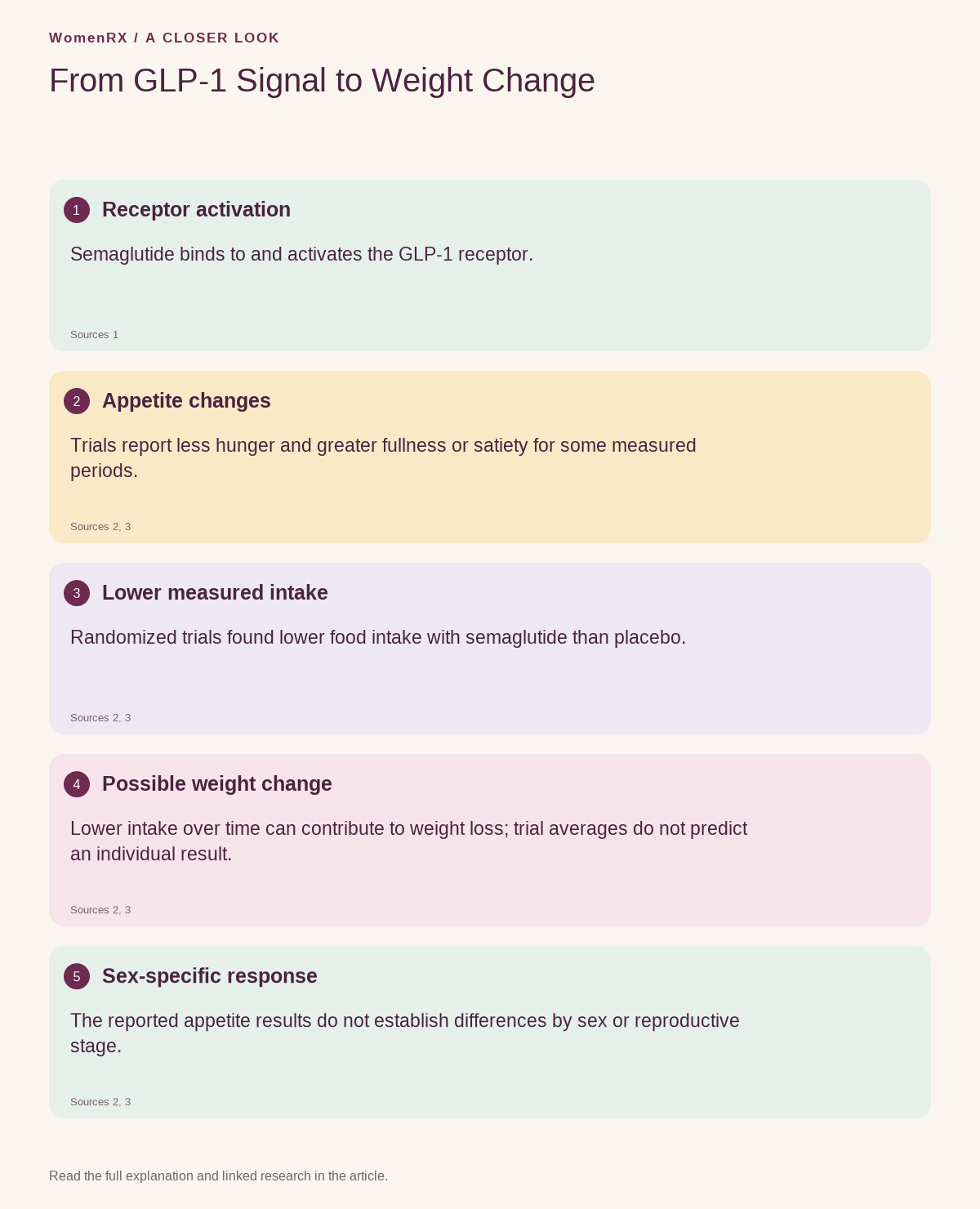
From GLP-1 Signal to Weight Change
Receptor activation: Semaglutide binds to and activates the GLP-1 receptor.1
Appetite changes: Trials report less hunger and greater fullness or satiety for some measured periods.23
Lower measured intake: Randomized trials found lower food intake with semaglutide than placebo.23
Possible weight change: Lower intake over time can contribute to weight loss; trial averages do not predict an individual result.23
Sex-specific response: The reported appetite results do not establish differences by sex or reproductive stage.23
Read the figure as text
The path from receptor activity to weight change runs through observed appetite and eating outcomes; it is not a claim that one pathway explains every response.- Receptor activation: Semaglutide binds to and activates the GLP-1 receptor.1
- Appetite changes: Trials report less hunger and greater fullness or satiety for some measured periods.23
- Lower measured intake: Randomized trials found lower food intake with semaglutide than placebo.23
- Possible weight change: Lower intake over time can contribute to weight loss; trial averages do not predict an individual result.23
- Sex-specific response: The reported appetite results do not establish differences by sex or reproductive stage.23
Sources you can check
- OZEMPIC (ORAL SEMAGLUTIDE) TABLET RYBELSUS (ORAL SEMAGLUTIDE) TABLET [NOVO NORDISK PHARMACEUTICAL INDUSTRIES, LP] | US prescribing information and patient instructionsAccessed 2026-09-25Return to first citation
- Short- and long-term effects of semaglutide 2.4 mg on energy intake, appetite, and food reward: a 60-week, double-blind randomized controlled trial.Tronieri JS, Allison KC, DeRouen K, Amaro A, Collins KG, Roy A, Watts S, Ananna T, Wadden TA. · The American journal of clinical nutrition · 2026Return to first citation
- Effect of oral semaglutide on energy intake, appetite, control of eating and gastric emptying in adults living with obesity: A randomized controlled trial.Gabe MBN, Breitschaft A, Knop FK, Hansen MR, Kirkeby K, Rathor N, Adrian CL. · Diabetes, obesity & metabolism · 2024Return to first citation