How to Read Spironolactone Acne Reviews
Personal stories can show what treatment felt like, but a randomized trial gives a better sense of how outcomes compare over time.
A review can help you spot experiences worth asking about, but it can’t tell you how likely you are to improve or have a side effect. Look for the dose, how long the person took spironolactone, other acne treatments, and what “better” meant to them. Then compare those details with research in adult women, which found clearer differences from placebo by 24 weeks. 2
A review is a story, not a forecast
A personal account can make treatment feel more concrete. Someone might describe whether acne seemed to improve, what changed in their routine, or which effects bothered them. Those details can help you think of questions. But a review usually can’t show whether spironolactone caused the change, how often an experience happens, or how your own skin will respond.
Before weighing a story, look for five details:
- Dose: Was it the same dose throughout, or did it change?
- Time on treatment: How many weeks or months had passed when the person judged the result?
- Other acne treatments: Were they also using topical medicines or another treatment?
- What “better” means: Fewer breakouts, less pain, improved appearance, or a change in confidence are different outcomes.
- Context: How severe and long-lasting was the acne, and what reproductive stage or health circumstances did the person describe?
If those details are missing, the account may still be useful as a description of one person’s experience. It’s just hard to compare with someone else’s, or with your own situation.
What a controlled study adds
The SAFA trial compared spironolactone with placebo in 410 adult women in England and Wales who had facial acne for at least six months that might warrant an oral antibiotic. Participants could continue their usual topical treatment. The trial began with 50 mg daily and increased to 100 mg daily at week six; that was the study regimen, not a personal dosing recommendation. 2
Researchers measured both participants’ reports and an investigator’s assessment. At 12 weeks, participants taking spironolactone reported a modestly higher average score on an acne-related quality-of-life symptom scale than participants taking placebo. The difference was larger at week 24. More participants in the spironolactone group also reported overall improvement by week 24, while the groups’ reports at week 12 were not significantly different. 2
That timing matters when reading reviews. A story about early treatment and a story about several months in may describe different points in the process. It also matters what the person counts as success: the trial used a quality-of-life scale, self-reported improvement, and an investigator’s assessment, and those measures did not all answer exactly the same question. 2
Who the results describe, and who they don’t
The trial offers evidence about adult women with persistent facial acne, not every woman with acne or every life stage. The average participant was about 29, and only 7% of participants with reported ethnicity data were from ethnicities other than White. The researchers identified age, body mass index, and ethnicity as areas where more subgroup evidence would be useful. The results therefore can’t tell you with confidence whether effects differ across those groups. 2
The study also allowed topical treatments, so its results reflect spironolactone compared with placebo alongside usual topical care, not spironolactone as the only acne treatment. Someone’s review may involve a very different combination. 2
Women’s reproductive circumstances can matter when discussing treatment. U.S. prescribing information advises avoiding spironolactone during pregnancy or discussing potential fetal risk, based on its anti-androgenic effects and animal findings; limited published human reports did not establish an association with major birth defects or other adverse pregnancy outcomes. The information about breastfeeding is also limited. These are topics to raise if pregnancy is possible, planned, or relevant to your current stage of life. 1
Read side-effect stories with the same care
A post about a headache or another unwanted effect can alert you to something worth discussing, but one person’s report cannot establish how common an effect is or prove what caused it. In SAFA, headaches were reported by 20% of participants taking spironolactone and 12% taking placebo. No serious adverse reactions were reported during the trial. Those findings describe this study’s participants and timeframe; they don’t guarantee what an individual will experience. 2
Spironolactone can increase potassium, according to U.S. prescribing information. Whether and how that matters depends on your medical context and other medicines, so include those details in a conversation with your prescriber rather than relying on a review from someone whose circumstances may differ. 1
Turn a review into a useful question
Instead of asking, “Will I have the same result?”, try questions that make the comparison clearer: “What would count as meaningful improvement for me?”, “When would we assess whether it’s helping?”, and “Which of my other treatments or health circumstances affect the plan?” If a review describes a side effect you’re worried about, ask how that concern fits with your own health and medicines.
Anecdotes can help you imagine possibilities. Research can compare outcomes across groups. Neither gives a guarantee about one person, but knowing the dose, duration, co-treatments, outcome, and population behind a claim makes it much easier to judge what applies to you.
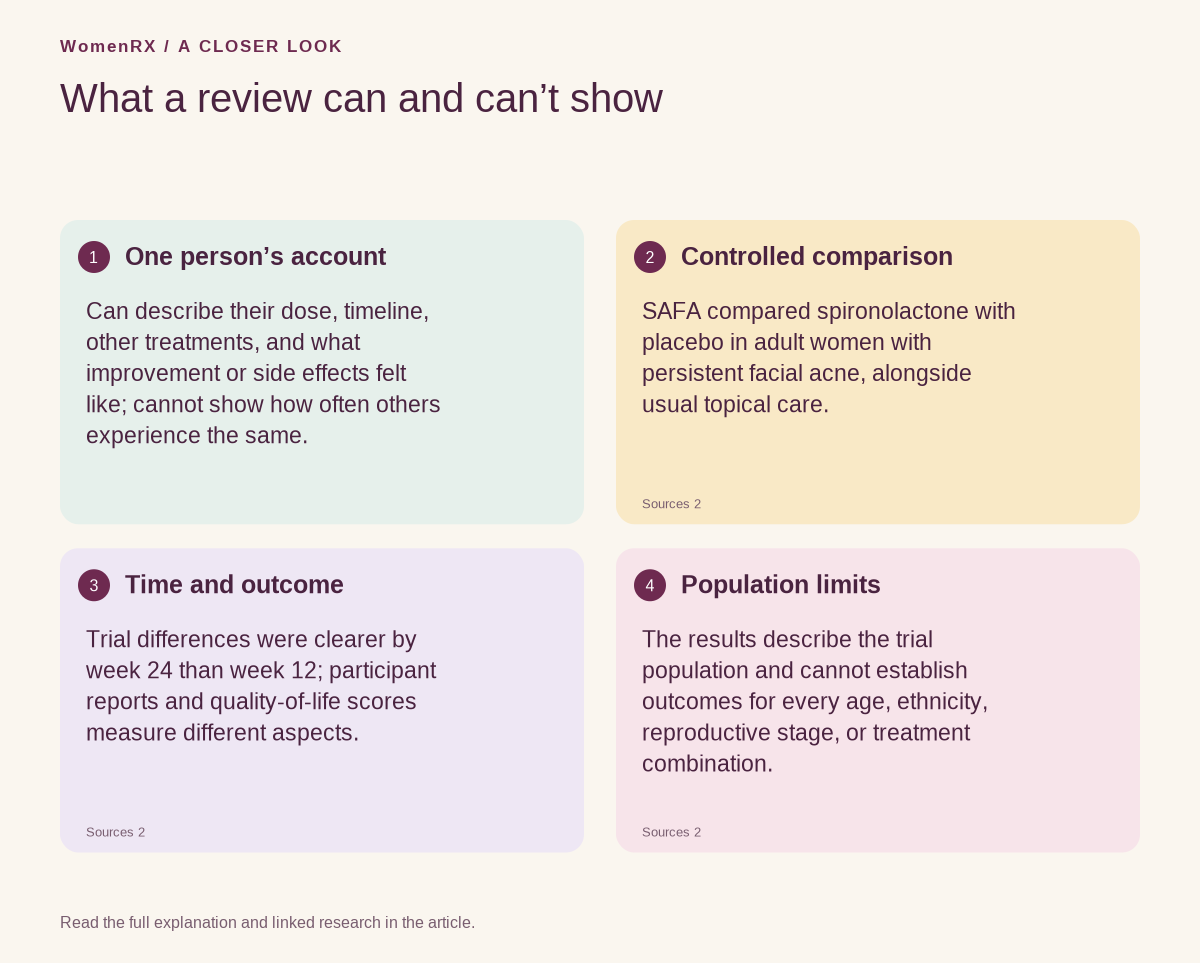
What a review can and can’t show
One person’s account: Can describe their dose, timeline, other treatments, and what improvement or side effects felt like; cannot show how often others experience the same.
Controlled comparison: SAFA compared spironolactone with placebo in adult women with persistent facial acne, alongside usual topical care.2
Time and outcome: Trial differences were clearer by week 24 than week 12; participant reports and quality-of-life scores measure different aspects.2
Population limits: The results describe the trial population and cannot establish outcomes for every age, ethnicity, reproductive stage, or treatment combination.2
Read the figure as text
Use the type of evidence to match a claim to what it can actually tell you.- One person’s account: Can describe their dose, timeline, other treatments, and what improvement or side effects felt like; cannot show how often others experience the same.
- Controlled comparison: SAFA compared spironolactone with placebo in adult women with persistent facial acne, alongside usual topical care.2
- Time and outcome: Trial differences were clearer by week 24 than week 12; participant reports and quality-of-life scores measure different aspects.2
- Population limits: The results describe the trial population and cannot establish outcomes for every age, ethnicity, reproductive stage, or treatment combination.2
More questions, answered
Why do some people say spironolactone worked quickly while others describe a longer wait?
They may be describing different points in treatment or different definitions of improvement. In the SAFA trial, the difference between spironolactone and placebo on the main quality-of-life measure was larger at 24 weeks than at 12 weeks, and participants’ overall improvement reports differed significantly between groups at 24 weeks but not at 12 weeks. 2
Can acne reviews tell me how common a side effect is?
No. Reviews describe individual experiences, not the frequency of an effect in a defined group. For example, SAFA reported headaches in 20% of participants taking spironolactone and 12% taking placebo; those figures apply to that trial, not necessarily every patient or treatment setting. 2
Sources you can check
- SPIRONOLACTONE TABLET, FILM COATED [REMEDYREPACK INC.] | US prescribing information and patient instructionsAccessed 2026-09-25Return to first citation
- Effectiveness of spironolactone for women with acne vulgaris (SAFA) in England and Wales: pragmatic, multicentre, phase 3, double blind, randomised controlled trial.Santer M, Lawrence M, Renz S, Eminton Z, Stuart B, Sach TH, Pyne S, Ridd MJ, Francis N, Soulsby I, Thomas K, Permyakova N, Little P, Muller I, Nuttall J, Griffiths G, Thomas KS, La... · BMJ (Clinical research ed.) · 2023Return to first citation