Spironolactone for Acne: When Changes May Show
Improvement can be gradual: in a large trial of adult women, differences from placebo were clearer at 24 weeks than at 12.
There isn’t one date when spironolactone should work for everyone. In a randomized trial of adult women with persistent facial acne, some measures favored spironolactone at 12 weeks, and the difference was clearer by 24 weeks. A review around six weeks may be part of your prescriber’s plan, but it’s not a deadline for clear skin or a reason to change your dose on your own. 14
What the first few months can tell you
It’s understandable to look for a quick sign that treatment is working. With spironolactone, a few new spots or a brief stretch without improvement doesn’t, by itself, tell you whether treatment will help. The clearest timing evidence comes from a randomized trial of adult women with facial acne that had lasted at least six months. Participants could continue their usual topical treatments, so the results reflect treatment as it was used in that setting. 4
At 12 weeks, acne-related quality-of-life scores favored spironolactone over placebo, but the difference was modest. Investigators rated treatment as successful for 19% of participants assigned spironolactone and 6% assigned placebo. By 24 weeks, more participants taking spironolactone reported that their acne had improved: 82%, compared with 63% taking placebo. The larger difference at 24 weeks is a reason to assess the trend over time, not to expect clear skin on a particular date. 4
Around six weeks: check how treatment is going
Six weeks is a useful point to review how you’re tolerating treatment and whether the plan still fits. In the trial, participants started at a lower study dose and could increase it at or after week six if they tolerated treatment. That was the trial’s protocol, not a schedule to copy. If you’re having trouble with the medicine or wondering about a dose change, ask your prescriber rather than changing it yourself. 14
A new spot isn’t proof that spironolactone causes an expected “purge.” The trial doesn’t establish a predictable early flare that you need to wait out. If acne is noticeably worsening, especially with painful nodules or cysts, contact your prescriber instead of assuming it’s part of the process. Deep acne lesions can scar. 34
Around 12 weeks: look for a pattern
At a follow-up, consider whether you’re getting fewer new inflamed spots, whether existing breakouts are less troublesome, and whether the treatment is manageable. These practical observations can make a gradual change easier to discuss than relying on one especially good or bad day. In the trial, participants’ reported overall improvement at week 12 was 72% with spironolactone and 68% with placebo, a difference that was not statistically significant. Other measures, including investigator-rated treatment success, favored spironolactone at this point. 4
That mix of results matters when you’re assessing your own skin. Improvement may not be obvious on every measure at the same time. Tell your prescriber what has changed, what hasn’t, and whether side effects are making the plan hard to follow.
Around 24 weeks: reassess the overall benefit
By 24 weeks, the trial found a clearer difference between groups on several outcomes. That makes a longer review window useful when deciding with your prescriber whether treatment is helping enough to continue or whether the plan needs reconsidering. 4
Breakouts and side effects aren’t the same thing
Separate the skin trend from how you feel while taking the medicine. In the trial, headaches were reported more often with spironolactone than placebo: 20% versus 12%. No serious adverse reactions were reported in that trial. 4
Contact your prescriber about side effects that bother you or don’t go away. For example, breast pain or enlargement are possible effects. Mention any other medicines you take, too: nonsteroidal anti-inflammatory drugs such as ibuprofen are among the medicines that may not mix well with spironolactone. 1
Spironolactone is generally avoided during pregnancy because of a potential risk to development of a male fetus, based on its anti-androgen effects and animal findings. If you’re pregnant while taking spironolactone, contact your prescriber promptly to discuss the medicine and next steps. If you’re planning pregnancy, raise this in advance so you can discuss your acne treatment; the labeling does not establish a specific stop interval. 2
A simple way to make follow-up useful
If you want a clearer comparison, take a photo in similar lighting before treatment and again at follow-up, and note whether new painful spots are becoming less frequent. Photos and personal notes aren’t a diagnostic test, but they can help you and your prescriber compare the overall direction instead of judging from memory. The trial used participant self-assessments and investigator ratings at follow-up points, rather than treating one day’s skin as the whole result. 4
What acne follow-up can show
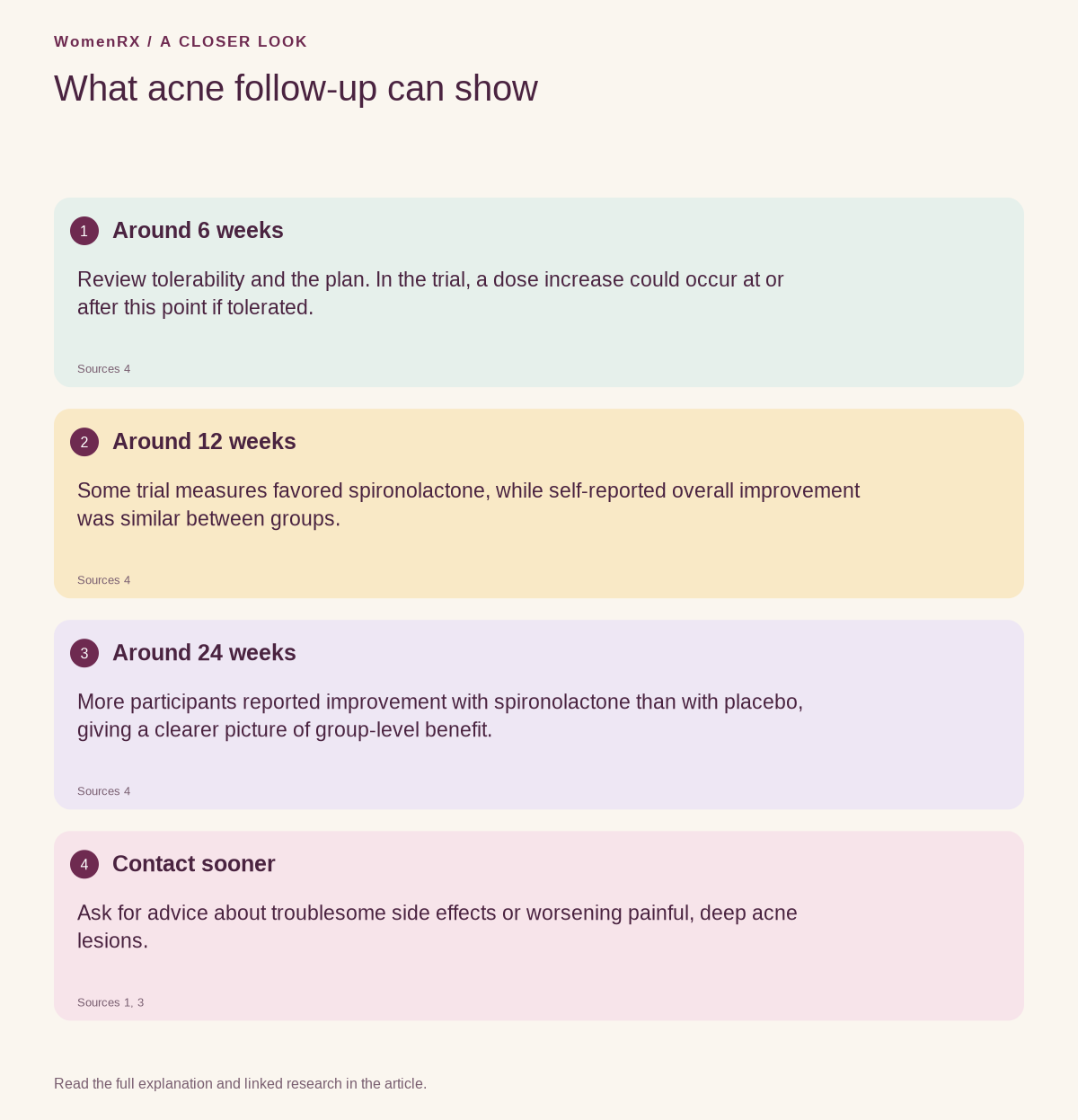
Around 6 weeks: Review tolerability and the plan. In the trial, a dose increase could occur at or after this point if tolerated.4
Around 12 weeks: Some trial measures favored spironolactone, while self-reported overall improvement was similar between groups.4
Around 24 weeks: More participants reported improvement with spironolactone than with placebo, giving a clearer picture of group-level benefit.4
Contact sooner: Ask for advice about troublesome side effects or worsening painful, deep acne lesions.13
Read the figure as text
Use the trial’s review points to separate an early tolerability check from a longer look at acne response.- Around 6 weeks: Review tolerability and the plan. In the trial, a dose increase could occur at or after this point if tolerated.4
- Around 12 weeks: Some trial measures favored spironolactone, while self-reported overall improvement was similar between groups.4
- Around 24 weeks: More participants reported improvement with spironolactone than with placebo, giving a clearer picture of group-level benefit.4
- Contact sooner: Ask for advice about troublesome side effects or worsening painful, deep acne lesions.13
More questions, answered
Does everyone need the same follow-up schedule or lab tests?
No single acne follow-up schedule applies to everyone. The six-week dose review was part of a trial protocol. Potassium monitoring is a separate decision that depends in part on health conditions and other medicines; ask your prescriber what monitoring is planned for you. 245
Sources you can check
- Spironolactone - NHSAccessed 2026-09-25Return to first citation
- SPIRONOLACTONE TABLET, FILM COATED [REMEDYREPACK INC.] | US prescribing information and patient instructionsAccessed 2026-09-25Return to first citation
- Acne - NHSAccessed 2026-09-25Return to first citation
- Effectiveness of spironolactone for women with acne vulgaris (SAFA) in England and Wales: pragmatic, multicentre, phase 3, double blind, randomised controlled trial.Santer M, Lawrence M, Renz S, Eminton Z, Stuart B, Sach TH, Pyne S, Ridd MJ, Francis N, Soulsby I, Thomas K, Permyakova N, Little P, Muller I, Nuttall J, Griffiths G, Thomas KS, La... · BMJ (Clinical research ed.) · 2023Return to first citation
- Efficacy and Safety of Oral Spironolactone for Women With Acne Vulgaris: A Systematic Review and Meta-Analysis of Randomized Placebo-Controlled Trials With Trial Sequential Analysis.Ghanem L, Kirmani N, De León Fernández N, Palacios-Ortiz MP, Rodríguez-Parra JD, Rusu CA. · Journal of cosmetic dermatology · 2025Return to first citation