How to Read Low-Dose Naltrexone Reviews
A personal account can show what someone experienced, but a comparison group helps show whether the treatment caused the change.
Read a low-dose naltrexone review as a report of one person’s experience, not proof that the medicine caused a benefit or will work for you. Check the diagnosis, dose and time on treatment, what else changed, and whether there was a comparison group. Those details matter: controlled fibromyalgia trials have not shown a clear advantage over placebo, while long-COVID reports are observational and less certain. 123
“I felt better after starting it” can be a sincere and useful account of someone’s experience. It cannot, by itself, tell you whether low-dose naltrexone (LDN) caused the improvement, how much it contributed, or whether another person with a different condition would have the same result.
A review is easiest to interpret when you separate what the person noticed from what the evidence can establish. Here are the details that help make that distinction.
Start with the diagnosis and the outcome
LDN is discussed for more than one condition. A report about fibromyalgia pain, for example, doesn’t answer whether LDN helps long-COVID fatigue. Even within one diagnosis, “better” may mean less pain, more energy, improved sleep, or being able to do a particular activity. Those are different outcomes.
Look for a specific description: What changed, and how was it assessed? A clear account of a personal outcome can help you understand what improvement might look like in everyday life. It still describes one person, not a typical result.
Check the treatment details
Try to find the dose, how it changed over time, and how long the person took it before describing a result. If those details are missing, it’s hard to compare the account with a study or another person’s experience.
A useful contrast is research on long COVID. A 2026 review found four observational before-and-after studies, including 155 people in total. Doses varied from 1 to 6 mg a day, and treatment and follow-up details differed. The review found no randomized controlled trials in its search through May 2026, so the reported changes can’t establish that LDN itself caused them. The review judged the evidence to be low certainty. 2
Ask what else changed
A person may start LDN while also changing another treatment, daily routine, or care plan. If more than one thing changes, an improvement afterward can’t cleanly be attributed to LDN alone. Some long-COVID studies, for instance, were before-and-after studies; one also used NAD+ alongside LDN. 2
This doesn’t make the person’s report untrue. It means the account leaves open which change mattered, whether several contributed, or whether symptoms would have shifted anyway.
Look for a comparison, not just a before-and-after
Symptoms can improve during a treatment period without improving more than they would have with an inactive comparison. A placebo-controlled study is designed to test that difference; a personal review usually has no comparison group.
In a 12-month randomized, double-blind trial of 98 women with fibromyalgia, participants received LDN or placebo as an add-on treatment. At the three-month primary assessment, pain scores changed by an average of −0.33 points with LDN and −0.64 with placebo. The adjusted difference between groups was not statistically significant, and the trial did not demonstrate a clinically meaningful advantage over placebo in pain-related outcomes. 1
A 2025 systematic review of eight fibromyalgia trials likewise found that improvements from baseline were not significantly greater with LDN than with placebo for pain or symptom severity. 3 That doesn’t prove no one can feel better while taking LDN. It does mean that a positive testimonial shouldn’t be treated as evidence of a reliably greater treatment effect.
Notice whose experiences are represented
If you’re looking for accounts from women, check whether a study actually enrolled women and whether it reported results by sex or gender. The fibromyalgia trial above enrolled women, so its findings apply to that study population, but they still don’t establish that LDN works differently in women than in men. 1
In the long-COVID review, the proportion of women varied across the four study groups, from 34% to 77%. Those figures describe who was enrolled, not whether women benefited more or less; the review’s reported findings do not establish a women-specific effect. 2
Anecdotes may leave out life stage or other context that matters to the person, such as menstrual cycles, pregnancy, postpartum recovery, or menopause. Without a comparison and appropriately reported subgroup results, a review can’t tell you whether any of those contexts change the treatment’s effect.
A quick way to weigh a review
Before treating an account as evidence of a treatment effect, see whether it answers these questions:
- What diagnosis and outcome? Is it the same condition and change you care about?
- What treatment details? Does it state the dose and time on treatment?
- What else changed? Were other treatments or interventions started at the same time?
- What’s the comparison? Is it only a before-and-after story, or is there a control group?
- Who is represented? Are sex, gender, or life-stage details actually reported, and are outcomes analyzed for those groups?
When details are missing, you don’t have to dismiss someone’s experience. Just keep it in the right category: a clue about what one person noticed, not a reliable prediction of what LDN will do for you.
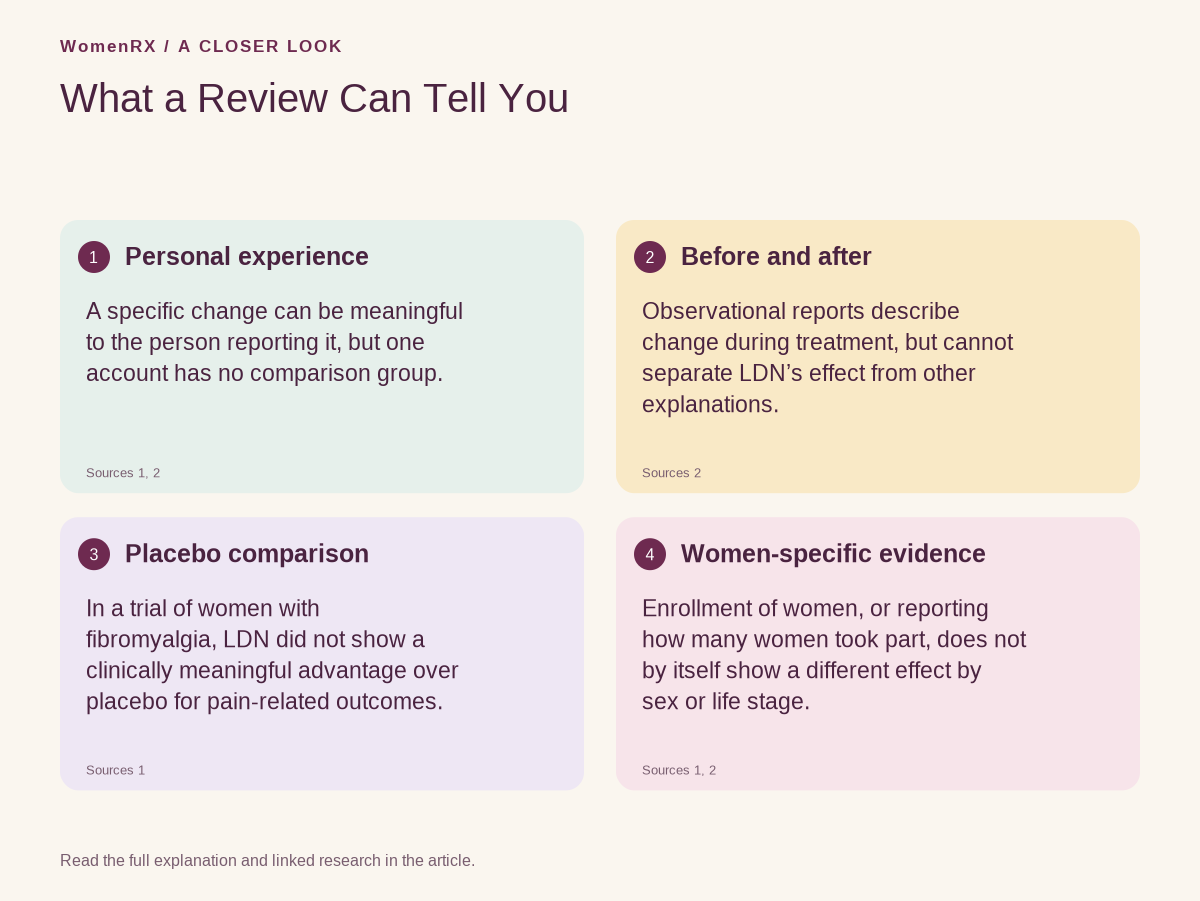
What a Review Can Tell You
Personal experience: A specific change can be meaningful to the person reporting it, but one account has no comparison group.12
Before and after: Observational reports describe change during treatment, but cannot separate LDN’s effect from other explanations.2
Placebo comparison: In a trial of women with fibromyalgia, LDN did not show a clinically meaningful advantage over placebo for pain-related outcomes.1
Women-specific evidence: Enrollment of women, or reporting how many women took part, does not by itself show a different effect by sex or life stage.12
Read the figure as text
A personal account can describe experience; the design and details determine how much it can tell you about treatment effects.- Personal experience: A specific change can be meaningful to the person reporting it, but one account has no comparison group.12
- Before and after: Observational reports describe change during treatment, but cannot separate LDN’s effect from other explanations.2
- Placebo comparison: In a trial of women with fibromyalgia, LDN did not show a clinically meaningful advantage over placebo for pain-related outcomes.1
- Women-specific evidence: Enrollment of women, or reporting how many women took part, does not by itself show a different effect by sex or life stage.12
More questions, answered
Does a positive review mean LDN worked for that person?
It means the person reports improvement while taking LDN. Without a comparison, the account can’t separate the medicine’s effect from other changes or symptom shifts over time.
Do studies show a women-specific benefit?
A randomized fibromyalgia trial studied women, but that alone doesn’t show LDN works differently in women than in men. The long-COVID review reported different proportions of women across study groups, but not a women-specific treatment effect. 12
Sources you can check
- Efficacy of Low-Dose Naltrexone in Women With Fibromyalgia Syndrome: A 12-Month Randomised, Double-Blind, Placebo-Controlled Single-Centre Clinical Trial (INNOVA Study).Rodríguez-Freire C, Navarrete J, Rozadilla-Sacanell A, Sanabria-Mazo JP, Del Pino-Gaya B, Borràs X, Feliu-Soler A, Luciano JV. · European journal of pain (London, England) · 2026Return to first citation
- Effect of low-dose naltrexone for long COVID: a systematic review and meta-analysis.Byambasuren O, Atkins T, Baptista S, Glasziou P, Chakraborty S. · BMJ open · 2026Return to first citation
- Efficacy of Low-Dose Naltrexone in Treating Patients with Fibromyalgia: systematic Review and Meta-Analysis.Ologunowa A, Otoo MN, Caffrey AR, Buchanan A, Eze UJ, Vyas A. · Journal of pain & palliative care pharmacotherapy · 2025Return to first citation