How Long Tretinoin Takes to Work, and What Changes First
With acne, think in months rather than days; early redness or peeling tells you about skin tolerance, not whether treatment is working.
For acne, treatments often take about 2 to 3 months to start working, though that’s a general acne-treatment estimate, not a promise for tretinoin. Redness or peeling can show up before you can judge results, and irritation isn’t proof of improvement. Photoaging studies assessed changes at 12 or 24 weeks, but those time points aren’t a guaranteed personal timeline. 1 3 4
First, separate irritation from improvement
Topical tretinoin helps acne by changing how skin cells shed, which can keep them from building up inside hair follicles. But that process takes time, and applying more won’t make the treatment work faster. 1 3
Redness and peeling can happen where tretinoin is applied. They’re signs of how your skin is tolerating treatment, not evidence that acne is responding. A breakout on its own also can’t tell you whether the treatment is working. Don’t assume everyone will have an initial “purge,” or that worsening is always harmless. If irritation is pronounced or persistent, contact your prescriber; product information says use may need to be adjusted or paused when irritation warrants it. 1
Keep other sources of irritation in mind, too. Tretinoin cream guidance advises minimizing sun exposure and notes that wind and cold can irritate treated skin. Gentle cleansing, avoiding harsh scrubbing, and using sunscreen and protective clothing when outside can help limit avoidable irritation. 1
For acne, give the overall pattern time
A reasonable first checkpoint for acne is around 2 to 3 months. That estimate comes from guidance about acne treatments generally, not a tretinoin-only study or guarantee. The tretinoin cream instructions say the treatment takes time but don’t give a fixed date when each person should see results. 1 3
At that checkpoint, look at the trend rather than one bad skin day: are breakouts becoming less frequent or less bothersome, or does the acne seem unchanged? If it hasn’t improved after several months, or irritation makes it difficult to continue, review the plan with your prescriber. Acne treatment may involve a combination of topical treatments, depending on severity. 2 3
If your acne tends to flare around your period, that can make the pattern feel uneven. Hormonal changes during the menstrual cycle can be associated with acne episodes, so one cycle-related flare doesn’t settle whether treatment is helping overall. Consider the broader pattern over time rather than judging by a single week. 2
For photoaging, look over a longer window
Fine lines and uneven pigmentation aren’t changes to judge from day to day. In a study summarized in a 2025 review, 86 women with photoaged skin used tretinoin cream or adapalene gel, and both groups had improvements in several signs after 24 weeks. Another study described in the review reported changes in fine lines, uneven pigmentation, and redness after 12 weeks. Those are study assessment points, not promises about when you’ll see a change. 4
The photoaging findings come from specific studies, including one in women; they don’t establish a different tretinoin response timetable based on sex. For acne, the 2-to-3-month estimate is for acne treatments generally. In either case, irritation and visible results are separate things to assess. 3 4
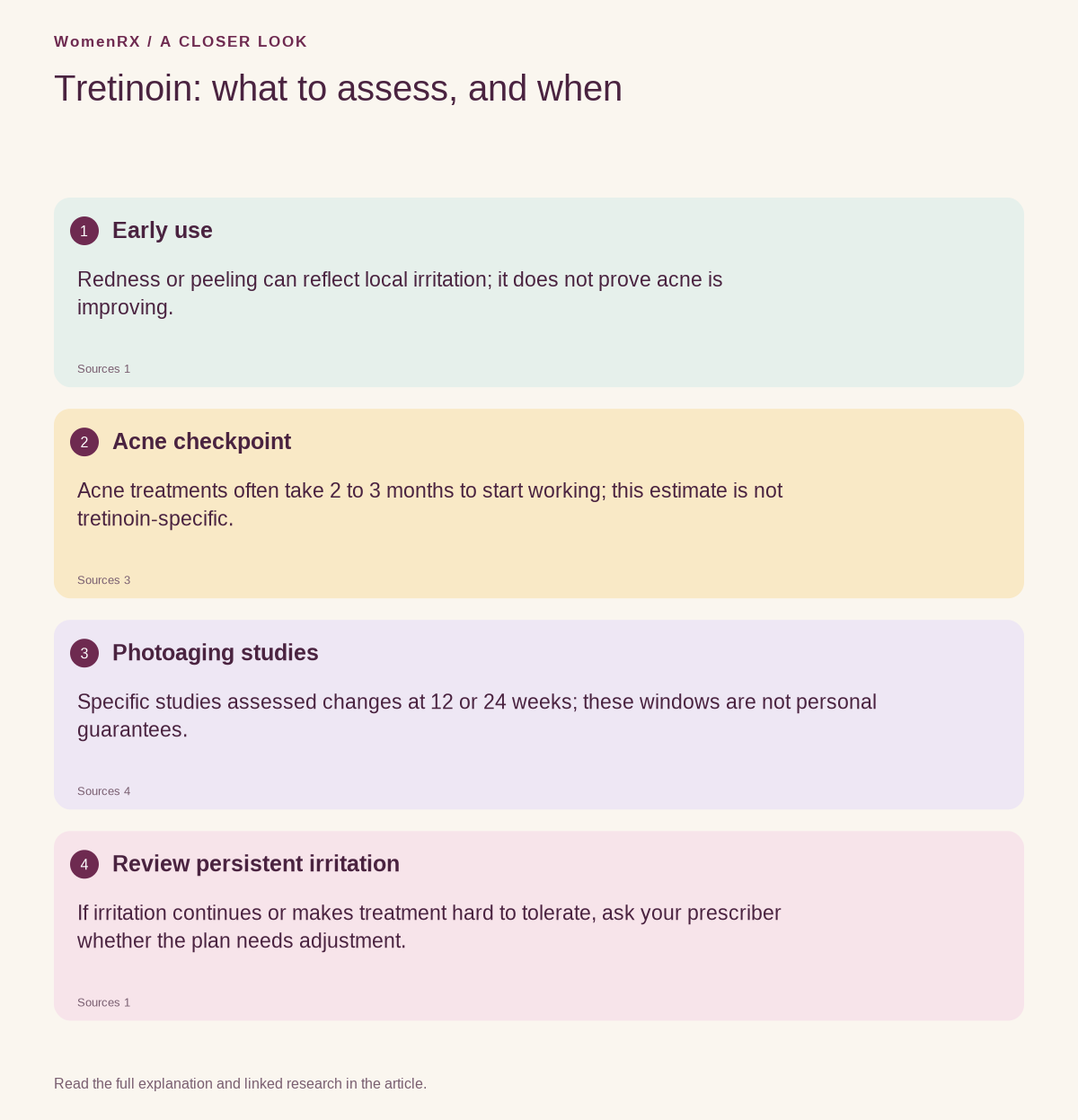
Tretinoin: what to assess, and when
Early use: Redness or peeling can reflect local irritation; it does not prove acne is improving.1
Acne checkpoint: Acne treatments often take 2 to 3 months to start working; this estimate is not tretinoin-specific.3
Photoaging studies: Specific studies assessed changes at 12 or 24 weeks; these windows are not personal guarantees.4
Review persistent irritation: If irritation continues or makes treatment hard to tolerate, ask your prescriber whether the plan needs adjustment.1
Read the figure as text
These are useful reference points, not a guaranteed week-by-week forecast. Skin tolerance and treatment response are different measures.- Early use: Redness or peeling can reflect local irritation; it does not prove acne is improving.1
- Acne checkpoint: Acne treatments often take 2 to 3 months to start working; this estimate is not tretinoin-specific.3
- Photoaging studies: Specific studies assessed changes at 12 or 24 weeks; these windows are not personal guarantees.4
- Review persistent irritation: If irritation continues or makes treatment hard to tolerate, ask your prescriber whether the plan needs adjustment.1
More questions, answered
Does a breakout mean tretinoin is working?
Not by itself. A breakout alone can’t confirm that treatment is helping, and an initial flare isn’t inevitable for everyone. Look at the broader pattern over time, and raise persistent worsening or significant irritation with your prescriber. 1
Can acne flare around my period while I’m using tretinoin?
Yes. Hormonal changes during the menstrual cycle can be associated with acne episodes. One flare around your period doesn’t, by itself, show whether tretinoin is helping overall. 2
Sources you can check
- TRETINOIN CREAM [REDPHARM DRUG] | US prescribing information and patient instructionsAccessed 2026-09-25Return to first citation
- Acne - NHSAccessed 2026-09-25Return to first citation
- Acne - Treatment - NHSAccessed 2026-09-25Return to first citation
- An Updated Review of Topical Tretinoin in Dermatology: From Acne and Photoaging to Skin Cancer.Balado-Simó P, Morgado-Carrasco D, Gómez-Armayones S, López-Ferrer A, Barco D, Ferrándiz-Pulido C, Podlipnik S. · Journal of clinical medicine · 2025Return to first citation