How Long Magnesium Takes Depends on Your Goal
A lab result, a symptom, and a study outcome can change on different schedules, so there’s no single wait time that fits every reason for taking magnesium.
Magnesium doesn’t have one standard time to work. In studies, measured changes have appeared at different assessment points: from 30 days in one diabetes trial to 16 weeks in another, while a trial in older adults with prediabetes measured improvements at four months. These are study endpoints, not personal deadlines or proof of when you’ll feel better. 1 3
First, decide what “working” means
Magnesium may be taken to correct a documented low level, address a risk linked to a health condition, or try to ease a symptom. Those goals aren’t interchangeable. A blood test can change without a noticeable difference in how you feel, and a symptom may have causes that magnesium won’t address.
There’s also a measurement wrinkle: less than 1% of the body’s magnesium is in the blood. A serum magnesium test is commonly used, but it doesn’t closely reflect total magnesium stored in the body. That makes it hard to use a single blood result as a complete measure of magnesium status or recovery. 1
If you’re treating a diagnosed low level
The time to recheck a lab value or review symptoms depends on the reason the level is low and the treatment plan. These studies don’t establish when an individual’s low magnesium level will normalize. For example, a four-month trial in older adults with prediabetes and low plasma magnesium found higher plasma magnesium by the end of the trial. It didn’t report when during those four months the change first occurred. 3
If magnesium is low because of ongoing diarrhea or absorption problems, diabetes-related urinary losses, or a medicine that affects magnesium, the underlying cause can matter too. Some diuretics can increase magnesium loss in urine; prolonged proton pump inhibitor use can cause low magnesium. 1
Symptom relief and study timelines
A study’s assessment point tells you when researchers measured an outcome, not necessarily when a person first noticed a change. Magnesium studies have used different timeframes and measured different things, so their results don’t create one general countdown. 1
For example, the NIH Office of Dietary Supplements summarizes diabetes trials that assessed outcomes after 30 days, 16 weeks, and three months. One 30-day trial in people with poorly controlled diabetes found higher magnesium levels and improved glucose control in the group receiving the larger supplement amount. A 16-week trial in people with diabetes and low magnesium reported lower fasting glucose and HbA1c compared with placebo. But a three-month trial in people using insulin did not find improved glucose control. These findings don’t establish a women-specific timetable; separate results for women weren’t reported in the summary. 1
For migraine prevention, the NIH Office of Dietary Supplements describes small, short-term trials with mixed results: three of four found modest reductions in migraine frequency, while one did not. The summary doesn’t give a dependable onset date, and the findings don’t guarantee that magnesium will help a particular person. 1
For menstrual symptoms, the findings discussed here don’t establish a reliable time to relief. A study about correcting a low level or changing migraine frequency can’t be used to promise when cramps or other cycle-related symptoms will change.
Pregnancy, breastfeeding, and menstrual years
Pregnancy and breastfeeding affect how much magnesium is recommended from all sources, but those intake recommendations do not say how long a supplement takes to work. For adults ages 19-30, the recommended dietary allowance is 350 mg a day during pregnancy and 310 mg during lactation; for ages 31-50, it’s 360 mg during pregnancy and 320 mg during lactation. These are total daily intake recommendations, not supplement doses. 1
A randomized trial of 318 low-income pregnant women compared oral magnesium citrate with placebo from around 12-20 weeks of pregnancy until delivery. Preeclampsia occurred in 18.1% of the magnesium group and 19.7% of the placebo group. The trial did not find a reduction in preeclampsia, and it does not establish a general supplement timeline or benefit for pregnancy. 2
If you’re pregnant or breastfeeding, the reason for taking magnesium and your total intake matter more than choosing a general “time to work.” The adult upper limit of 350 mg per day applies to magnesium from supplements and medicines, not magnesium naturally present in food; it is separate from the higher total-intake recommendations for pregnancy and lactation. 1
Form and medicines can change the picture
Magnesium forms aren’t absorbed equally. NIH notes that forms that dissolve more readily tend to be better absorbed; citrate, chloride, lactate, and aspartate generally have higher bioavailability than oxide or sulfate. Better absorption does not, by itself, tell you how soon a symptom will improve. 1
Magnesium can also interfere with absorption of some oral antibiotics and osteoporosis medicines called bisphosphonates. For example, NIH guidance describes spacing magnesium-containing products from tetracycline or quinolone antibiotics and oral bisphosphonates. Ask a pharmacist how to time magnesium around your specific medicines, rather than guessing. Some diuretics increase magnesium loss in urine, while prolonged proton pump inhibitor use can cause low magnesium. 1
A practical way to judge progress is to name the intended outcome before starting: a clinician-ordered lab check, a particular symptom, or another measured health marker. Then use the follow-up interval and measure that match your goal. A study’s final measurement is a reference point for that study, not a countdown for your body.
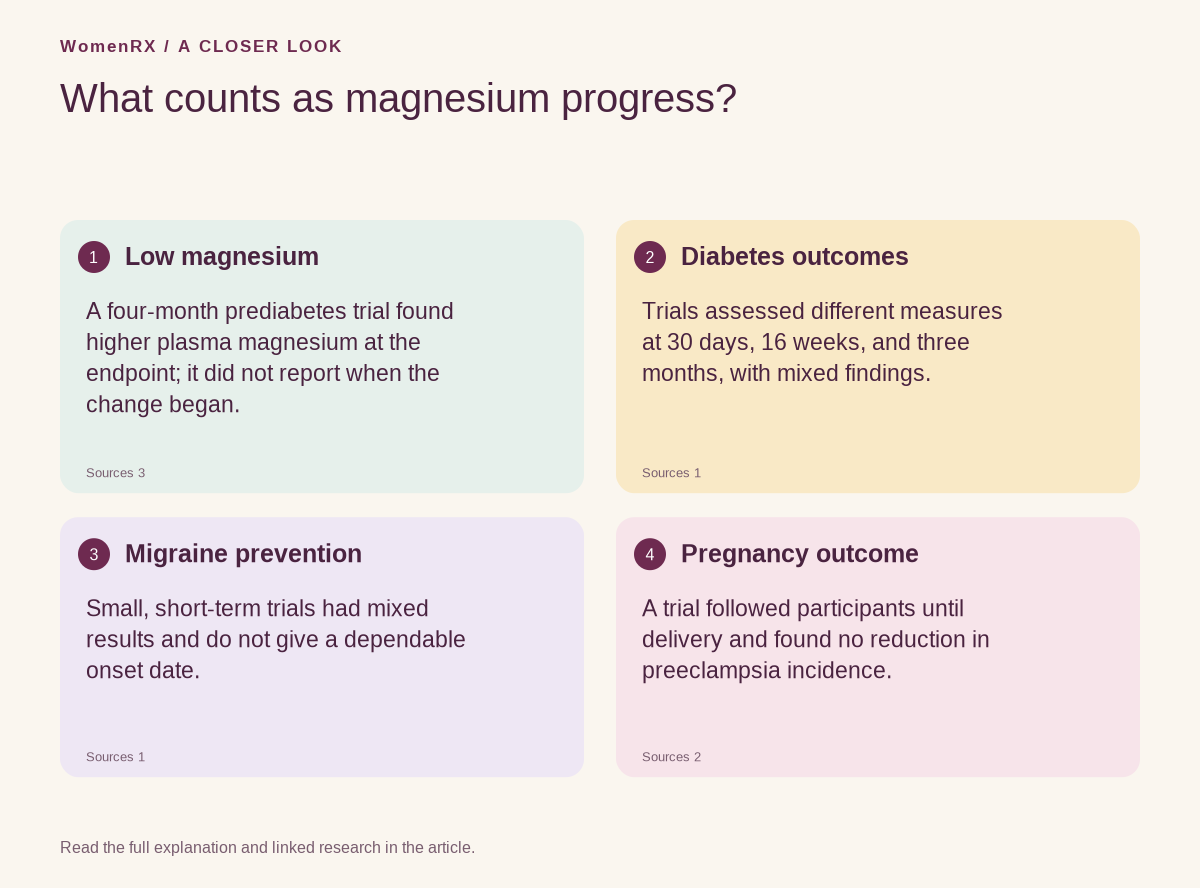
What counts as magnesium progress?
Low magnesium: A four-month prediabetes trial found higher plasma magnesium at the endpoint; it did not report when the change began.3
Diabetes outcomes: Trials assessed different measures at 30 days, 16 weeks, and three months, with mixed findings.1
Migraine prevention: Small, short-term trials had mixed results and do not give a dependable onset date.1
Pregnancy outcome: A trial followed participants until delivery and found no reduction in preeclampsia incidence.2
Read the figure as text
Study timeframes depend on the outcome and population. These assessment points are not promises about when you’ll notice a change.- Low magnesium: A four-month prediabetes trial found higher plasma magnesium at the endpoint; it did not report when the change began.3
- Diabetes outcomes: Trials assessed different measures at 30 days, 16 weeks, and three months, with mixed findings.1
- Migraine prevention: Small, short-term trials had mixed results and do not give a dependable onset date.1
- Pregnancy outcome: A trial followed participants until delivery and found no reduction in preeclampsia incidence.2
More questions, answered
Does a normal blood magnesium result rule out low magnesium stores?
No. Most magnesium is inside cells or in bone, and a serum test does not closely reflect total body magnesium. A clinician may interpret a result alongside your health history and other findings. 1
Can I take magnesium at the same time as an antibiotic?
Magnesium can reduce absorption of tetracycline and quinolone antibiotics, as well as oral bisphosphonates used for osteoporosis. The appropriate spacing depends on the medicine; check with a pharmacist for a schedule that fits your prescription. 1
Sources you can check
- Magnesium - Health Professional Fact SheetAccessed 2026-09-25Return to first citation
- Magnesium supplementation and preeclampsia in low-income pregnant women - a randomized double-blind clinical trial.de Araújo CAL, de Sousa Oliveira L, de Gusmão IMB, Guimarães A, Ribeiro M, Alves JGB. · BMC pregnancy and childbirth · 2020Return to first citation
- Oral magnesium supplementation improves glycemic control in older Chinese adults with pre-diabetes and hypomagnesemia: a randomized controlled trial.Yang J, Zhang H, Li Y, Wu W, Pan M, Wang J, Li G, Wu Y, Guo C, Yang L, Ding J, Ding G. · Frontiers in nutrition · 2026Return to first citation