Postpartum Weight Changes: What to Focus on First
After birth, recovery, nourishment, feeding, and mental well-being are more useful starting points than a target weight or deadline.
You don’t need to set a weight-loss goal or timetable to take care of yourself after birth. Recovery and feeding needs vary, and weight alone can’t show how your body is doing. 2 Breastfeeding is not a dependable weight-loss plan: studies show mixed results, including a trial where added breastfeeding support increased exclusive breastfeeding prevalence at four months but did not change maternal weight loss. 3 4
Start with how you’re recovering
In the weeks after birth, your body is healing and adjusting while your days may revolve around feeding and caring for a new baby. It’s reasonable to make recovery, regular nourishment, rest where possible, and support for feeding your priorities before deciding whether intentional weight loss belongs in the picture. Follow the activity guidance you were given for recovery rather than treating exercise as a way to hurry weight change. 1
A number on the scale can’t tell the whole story: body weight includes water, muscle, bone, and fat. Everyday factors can also affect it. A change in weight, by itself, isn’t a measure of how well you’re recovering or caring for your baby. 2
Breastfeeding isn’t a weight-loss promise
It’s common to hear that breastfeeding will make weight come off. The evidence doesn’t support relying on that outcome. A large Norwegian cohort found an association between longer breastfeeding and lower increases in BMI over adulthood, but an observational study can’t show that breastfeeding caused the difference. The authors also describe research on short-term postpartum weight retention as inconclusive. 4
A randomized trial in 90 pregnant women with overweight or obesity in Colombia tested extra, individualized breastfeeding counseling. At four months, the counseling group had higher exclusive breastfeeding prevalence than the standard-support group, but the intervention did not affect maternal weight loss or infant growth velocity. That study tested a specific support program in a small group, not a weight-loss plan, and its short follow-up limits what it can tell us about longer-term weight change. 3
If feeding is difficult, you’re worried about your baby’s growth, or you’ve had a complication that may affect feeding, focus the conversation on feeding support and your health rather than changing your weight. In a retrospective study of 1,904 first-time mothers after vaginal birth, postpartum hemorrhage was associated with fewer breastfeeding sessions and greater newborn weight loss in the first two to three days. The study’s authors say further research is needed to understand the reasons, but note that additional breastfeeding support may be needed. 6
Decide whether weight loss belongs on your list now
There’s no need to decide once and for all. You might choose to put weight goals aside while you recover, or to talk about longer-term weight management if it matters to you for health or a future pregnancy. A 2025 European position statement recommends postpartum weight-management counseling for women with obesity, including behavioral support for healthy eating and activity. That’s a reason to seek care that fits your circumstances, not a reason to impose a deadline or treat weight as the only measure of health. 5
If weighing, restricting food, or pressure to “bounce back” is pulling you toward distress or patterns you’ve worked hard to leave behind, you can tell your care team or therapist what’s happening and discuss whether to put weight-loss efforts on hold. You can ask for help that centers nourishment and mental well-being. A small UK pilot study of 11 mothers described postpartum body dissatisfaction alongside challenges with self-care; it offers a window into possible experiences, not a measure of how all women feel. 7
A conversation that puts your needs first
If you want personalized advice, you don’t have to arrive with a goal weight. You could ask:
- Is there anything about my recovery that should shape my activity or nutrition right now?
- I’m breastfeeding, pumping, or having feeding concerns. What support would help with that?
- I’ve had bariatric surgery or have concerns about nutrition. What follow-up do I need?
- Weight or food thoughts are affecting my mood or eating. What support can I access?
- If I have an unexpected weight change, could it be related to a health issue?
The last question is worth raising if a change is sudden or unexplained; MedlinePlus advises discussing unexpected weight gain or loss with a provider. 2 If you feel extremely sad or can’t care for yourself or your baby, reach out for help promptly. These can be signs of a serious postpartum mental health condition. 1
A useful next step may be no weight-loss plan at all. It may be asking for feeding help, following recovery guidance, or getting support for distress around food or body changes. Those are meaningful forms of postpartum care.
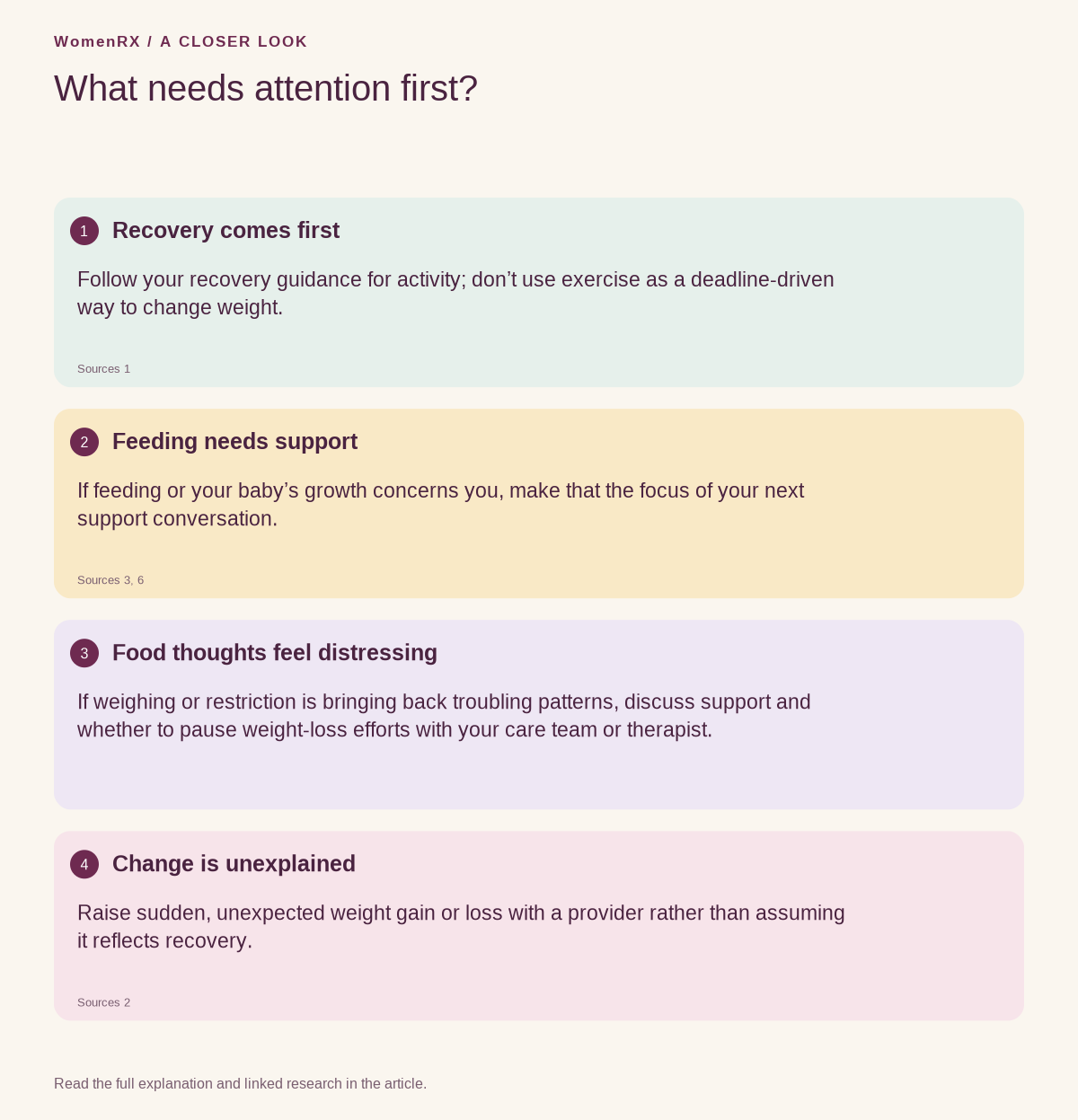
What needs attention first?
Recovery comes first: Follow your recovery guidance for activity; don’t use exercise as a deadline-driven way to change weight.1
Feeding needs support: If feeding or your baby’s growth concerns you, make that the focus of your next support conversation.36
Food thoughts feel distressing: If weighing or restriction is bringing back troubling patterns, discuss support and whether to pause weight-loss efforts with your care team or therapist.
Change is unexplained: Raise sudden, unexpected weight gain or loss with a provider rather than assuming it reflects recovery.2
Read the figure as text
Use these prompts to separate recovery and feeding needs from pressure to pursue weight loss. They’re conversation starters, not a validated readiness score.- Recovery comes first: Follow your recovery guidance for activity; don’t use exercise as a deadline-driven way to change weight.1
- Feeding needs support: If feeding or your baby’s growth concerns you, make that the focus of your next support conversation.36
- Food thoughts feel distressing: If weighing or restriction is bringing back troubling patterns, discuss support and whether to pause weight-loss efforts with your care team or therapist.
- Change is unexplained: Raise sudden, unexpected weight gain or loss with a provider rather than assuming it reflects recovery.2
More questions, answered
Does breastfeeding make postpartum weight loss happen?
Not reliably. A large cohort found an association between longer breastfeeding and lower increases in BMI over adulthood, but that doesn’t prove breastfeeding caused the difference. In a small randomized trial, extra breastfeeding counseling increased exclusive breastfeeding prevalence at four months but did not change maternal weight loss at four months. 3 4
What if I’m worried about weight or food because of a past eating disorder?
Tell your care team or therapist if weighing, restriction, or pressure about your body is affecting you. You can ask for support centered on nourishment and mental well-being, and discuss whether putting weight-loss efforts on hold makes sense for you.
Sources you can check
- Postpartum Care: MedlinePlusAccessed 2026-09-25Return to first citation
- Body Weight: MedlinePlusAccessed 2026-09-25Return to first citation
- Effectiveness of a new breastfeeding counselling intervention on breastfeeding prevalence, infant growth velocity and postpartum weight loss in overweight women: a randomized controlled trial.Aldana-Parra F, Olaya Vega G, Fewtrell M. · International breastfeeding journal · 2025Return to first citation
- Breastfeeding duration and maternal weight change through adulthood in a population-based cohort study.Skammelsrud TB, Hjartåker A, Klingberg S, Brekke HK. · The American journal of clinical nutrition · 2026Return to first citation
- EASO Position Statement: Women with Obesity across the Reproductive Life - Fertility, Preconception, Pregnancy, Postpartum, and Breastfeeding.Filippi-Arriaga F, Agarwal N, Rodrigues-Martins D, Monteiro MP, Huvinen E, Suliman SGI, McGowan B, Ciudin A. · Obesity facts · 2025Return to first citation
- Postpartum Hemorrhage after Vaginal Delivery Is Associated with a Decrease in Immediate Breastfeeding Success.Roig J, Rekawek P, Doctor T, Naert MN, Cadet J, Monro J, Stone JL, Liu LY. · American journal of perinatology · 2024Return to first citation
- A pilot study to explore postpartum body image and resumed menstruation.Hussain A, Nalivaikaite A, Warren J, Jackson L. · Journal of reproductive and infant psychology · 2026Return to first citation