Preparing for Postpartum: A Plan to Make Before Birth
A useful postpartum plan names who can help you rest, recover, feed your baby, and get care when something isn’t right.
Before birth, write down who can handle meals and household tasks, how you’ll get to appointments, whom you’ll contact about feeding, and who will check in on you. Leave room to change the plan after you know how birth went. Include warning signs and an after-hours contact so you and your helpers know when to seek care immediately.1346
The most useful postpartum plan isn’t a promise that everything will go smoothly. It’s a short set of decisions you won’t have to make from scratch while you’re recovering. Share it with the people you choose to help, and keep your own copy somewhere easy to find.
Give each helper a job, not a vague invitation
Start with the work that still needs doing when you’re resting or feeding your baby. Instead of writing “friends can help,” fill in a name, a task, and a way to reach them. A helper might bring a meal you’ve chosen, take care of laundry, pick up groceries, or handle a household chore. Another might drive you to an appointment or sit with you while you make a call. Rest and help with baby care and household chores are practical parts of postpartum support.16
Use these prompts as a plan you can share:
- Food and household tasks: Who is doing what? When should they check with you before coming over? Are there foods, customs, or visitor boundaries you want them to respect?
- Appointments and transportation: Where will you keep appointment details? Who can take you, and whom can you call if that person isn’t available?
- Feeding support: What’s your current plan, whether that’s breastfeeding, formula feeding, or both? Whom will you contact if feeding becomes difficult or your plans change?
- Your recovery: Who can take over a task when you need rest? Who will help with errands or lifting if your birth or recovery makes those harder?
- Emotional support: Who can ask how you’re doing, listen without taking over, and help you get care if you need it?
Write names and phone numbers beside the answers. If you don’t have a nearby helper for every job, leave that gap visible rather than assigning it to yourself by default. You can ask your care team what support is available for a need you can’t cover.
Plan for recovery without guessing how birth will go
Some changes are common after birth regardless of the delivery you expected. Bleeding or spotting can come and go for weeks; cramping, constipation, breast fullness, and swelling in the feet or legs can also happen. Your discharge instructions should guide how much activity is right for you.1 Having someone handle chores gives you room to follow those instructions rather than push through them.
If you give birth vaginally, soreness from a tear or stitches may make sitting, using the bathroom, or moving around uncomfortable. Trouble peeing, marked soreness, or an unpleasant smell are reasons to contact your care team.5 If you have a cesarean birth, you’ll also be recovering from an abdominal wound. Discomfort can last for weeks, and activities such as driving or carrying more than your baby may need to wait while you recover.4 That makes a ride home, appointment transportation, and help with heavier household tasks worth arranging before you know whether you’ll need them.
Your feeding plan can stay flexible, too. Put one contact in the plan for feeding questions and tell helpers what support you actually want. For example, you might want someone to bring you food while you feed the baby, or to take on another chore so you can rest. Help should make space for your decisions, not turn into pressure about how to feed or recover. In a cross-sectional study of first-time mothers in a Chinese postpartum-confinement setting, support and participation in decisions showed distinct associations with well-being; the findings don’t establish that any one family arrangement works best.2
Put urgent signs where everyone can see them
Normal bleeding after birth is different from soaking through one or more pads in an hour, passing clots bigger than an egg, or passing tissue. The CDC says to seek medical care immediately for those symptoms. Other urgent signs include a headache that won’t go away or gets worse, vision changes, a fever of 100.4°F (38°C) or higher, chest pain, trouble breathing, severe belly pain that doesn’t go away, or severe swelling, redness, or pain in a leg or arm. Tell the person caring for you that you’ve given birth, even if birth was months ago; urgent maternal warning signs can occur during the year after delivery.3
After a cesarean birth, a wound that becomes more red, painful, or swollen, or drains pus or foul-smelling fluid, also needs prompt medical attention.4 Before you go home, add your care team’s daytime and after-hours numbers to the plan. A helper can make the call or arrange transportation, but a concerning symptom shouldn’t wait for the next planned appointment.3
Make room for your mood, too
It’s common to have mood swings or crying spells shortly after birth. These often ease within days to a week. Feelings that are more severe and last longer than two weeks may be postpartum depression, which can begin at any point in the first year.6 If you’re worried before then, you don’t have to wait to ask for help. Tell someone and reach out for care rather than assuming you have to manage it alone. You could ask a chosen friend, relative, or other trusted person to check in with a direct question, such as “How are you feeling, and is there anything I can take off your plate?”
Thoughts of harming yourself or your baby need help right away. Call 911 or go to an emergency department; in the US, you can also call or text 988 for crisis support. Confusion, seeing or hearing things that aren’t there, or dangerous behavior after birth is also an emergency.6
Once your baby arrives, change the names, tasks, or boundaries as needed. The plan has done its job if the people around you know what help you want and how to respond when your needs change.
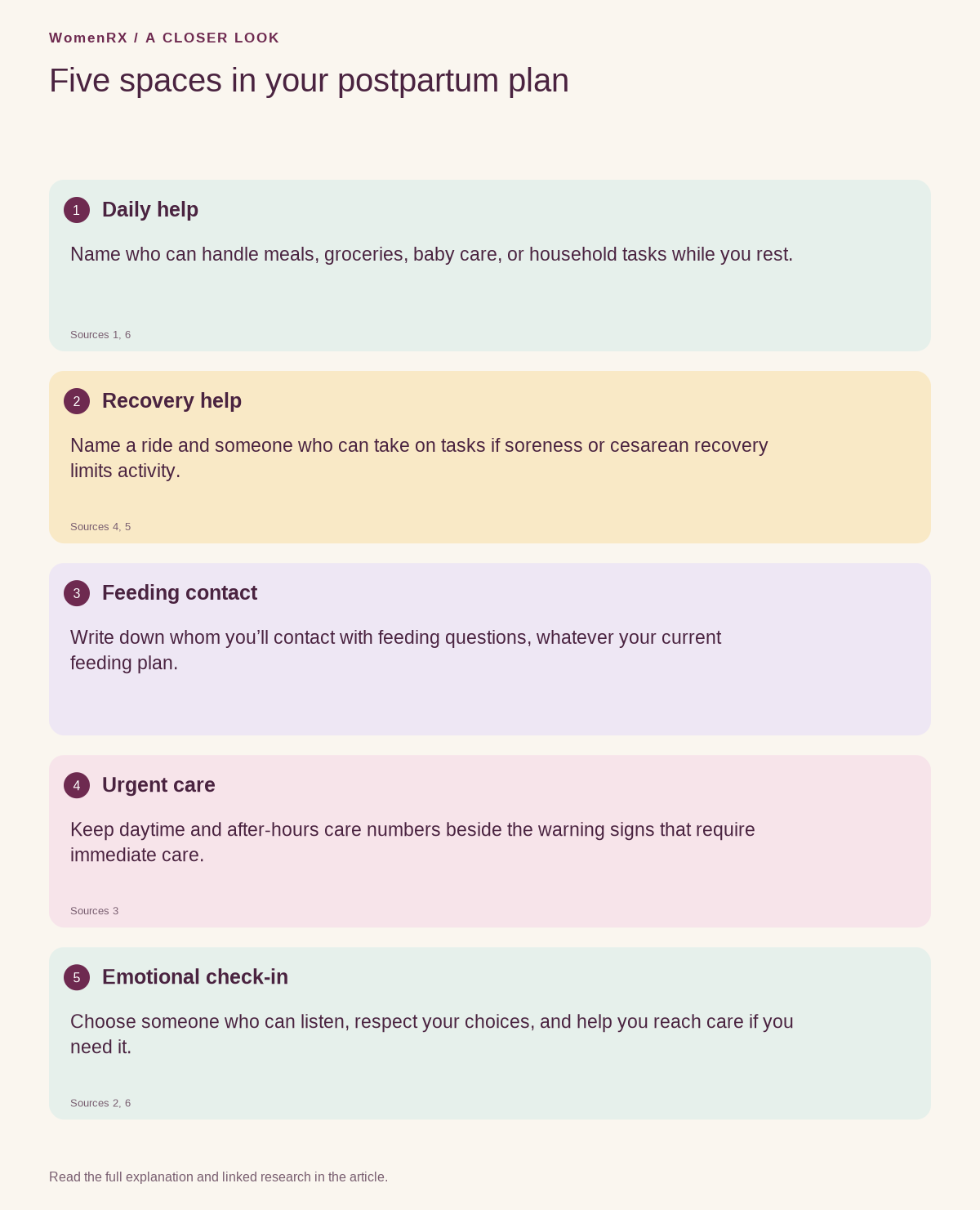
Five spaces in your postpartum plan
Daily help: Name who can handle meals, groceries, baby care, or household tasks while you rest.16
Recovery help: Name a ride and someone who can take on tasks if soreness or cesarean recovery limits activity.45
Feeding contact: Write down whom you’ll contact with feeding questions, whatever your current feeding plan.
Urgent care: Keep daytime and after-hours care numbers beside the warning signs that require immediate care.3
Emotional check-in: Choose someone who can listen, respect your choices, and help you reach care if you need it.26
Read the figure as text
Fill in each space with a name or contact, then share the plan with the people you choose.- Daily help: Name who can handle meals, groceries, baby care, or household tasks while you rest.16
- Recovery help: Name a ride and someone who can take on tasks if soreness or cesarean recovery limits activity.45
- Feeding contact: Write down whom you’ll contact with feeding questions, whatever your current feeding plan.
- Urgent care: Keep daytime and after-hours care numbers beside the warning signs that require immediate care.3
- Emotional check-in: Choose someone who can listen, respect your choices, and help you reach care if you need it.26
Sources you can check
- Postpartum Care: MedlinePlusAccessed 2026-09-25Return to first citation
- Association Between Maternal Autonomy and Maternal Well-Being During Postpartum Confinement Among Primiparous Women: A Cross-Sectional Study.Lu Y, Li H, Tian Y, Wang X. · Journal of multidisciplinary healthcare · 2026Return to first citation
- Urgent Maternal Warning Signs and Symptoms | HEAR HER Campaign | CDCAccessed 2026-09-25Return to first citation
- Caesarean section - Recovery - NHSAccessed 2026-09-25Return to first citation
- Your body after the birth - NHSAccessed 2026-09-25Return to first citation
- Postpartum Depression: MedlinePlusAccessed 2026-09-25Return to first citation