What does estradiol treat, and how does it work?
Estradiol can treat menopause-related hot flashes and vaginal or urinary symptoms, but the treatment goal helps determine which route makes sense.
Estradiol is an estrogen that acts through estrogen receptors, and its effects depend partly on how it’s absorbed and where it acts. Menopausal hormone therapy is the most effective treatment for bothersome hot flashes and can help prevent bone loss. For symptoms focused in the vagina or urinary tract, low-dose vaginal estrogen is a separate option; it isn’t a general treatment for every menopause concern. 4 6
Estradiol is one type of estrogen used in menopausal hormone therapy. It can help with specific symptoms and treatment goals, but it isn’t a way to restore a younger hormone state or prevent every condition associated with aging. The useful question is not just “Does estradiol work?” It’s “Which symptom is being treated, and does the route match that symptom?”
From receptor to everyday effect
At a basic level, estradiol’s effects begin when it acts through estrogen receptors. Estrogens differ in receptor affinity and in how the body handles them, and those differences contribute to their clinical effects. Receptor action helps explain why estrogen can affect more than one tissue, but it doesn’t mean every estrogen treatment has the same purpose or outcome. 6
During the menopausal transition, the ovaries make less estrogen and progesterone. For some women, those changes bring hot flashes or other symptoms; declining estrogen after menopause is also associated with bone loss. 1
When the goal is fewer hot flashes
Menopausal hormone therapy is the most effective treatment for vasomotor symptoms, including hot flashes. It can also help prevent bone loss and fractures. These are specific treatment benefits, not proof that estradiol prevents heart disease or is a general-purpose way to improve long-term health. Estrogen is not currently used to prevent cardiovascular disease. 4 6
Whether systemic hormone therapy’s benefits outweigh its risks depends on factors that include age, time since menopause, dose, route, duration, and whether a progestogen is used. The Menopause Society’s 2022 position statement describes a more favorable benefit-risk balance for women younger than 60 or within 10 years of menopause onset who have no contraindications, when the goal is bothersome hot flashes or prevention of bone loss. It describes a less favorable balance when treatment starts later. That’s a reason to make the decision around your health and treatment goal, not a promise that the same choice suits everyone. 4
Estradiol isn’t the only option for hot flashes. The Menopause Society’s nonhormone position statement identifies several evidence-supported nonhormonal treatments, including certain prescription medicines and cognitive behavioral therapy. These may matter if hormone therapy isn’t a fit or isn’t your preference. 5
When symptoms are mainly vaginal or urinary
Genitourinary syndrome of menopause can include vaginal dryness, irritation, pain with sex, and urinary symptoms. For bothersome symptoms not relieved by over-the-counter treatments, the Menopause Society’s position statement recommends considering low-dose vaginal estrogen or other therapies for women who don’t have a reason to use systemic hormone therapy. This is a different treatment question from hot flashes: local treatment is aimed at genitourinary symptoms, while systemic hormone therapy is used for symptoms such as hot flashes. 4
Evidence for sexual benefits is clearest for pain with sex related to vaginal symptoms. A review of vaginal estrogen studies found less information about broader aspects of sexual experience, such as desire or satisfaction. So improvement in dryness or pain shouldn’t be taken as a guarantee that every part of sexual function will change. 2
If you’re being treated with an aromatase inhibitor for estrogen-sensitive breast cancer, vaginal estrogen calls for a more individualized discussion. One review describes nonhormonal vaginal treatments as a first-line approach and says decisions about vaginal hormone treatment should be made jointly with the patient and oncologist. 3
What estradiol isn’t established to do
Estradiol can address particular symptoms and, in menopausal hormone therapy, help prevent bone loss. That doesn’t establish it as a way to prevent heart disease. Estrogens may show potential cardiovascular effects in research, but they aren’t used for that purpose. 6
Nor should one benefit be assumed to cover every menopause symptom. For example, evidence that vaginal estrogen can ease pain with sex doesn’t establish that it treats hot flashes, and evidence that systemic therapy treats hot flashes doesn’t mean it is automatically the right choice for isolated vaginal symptoms. The treatment route and the goal need to line up. 2 4
A practical way to frame the choice
Start with the main problem you want treated: hot flashes, vaginal or urinary symptoms, or both. Then consider whether the discussion is about systemic therapy or local treatment, and how your medical history and timing since menopause affect the balance of benefits and risks. Estradiol has established roles, but the right role depends on the symptom and the person, not on a general idea of “balancing hormones.” 4
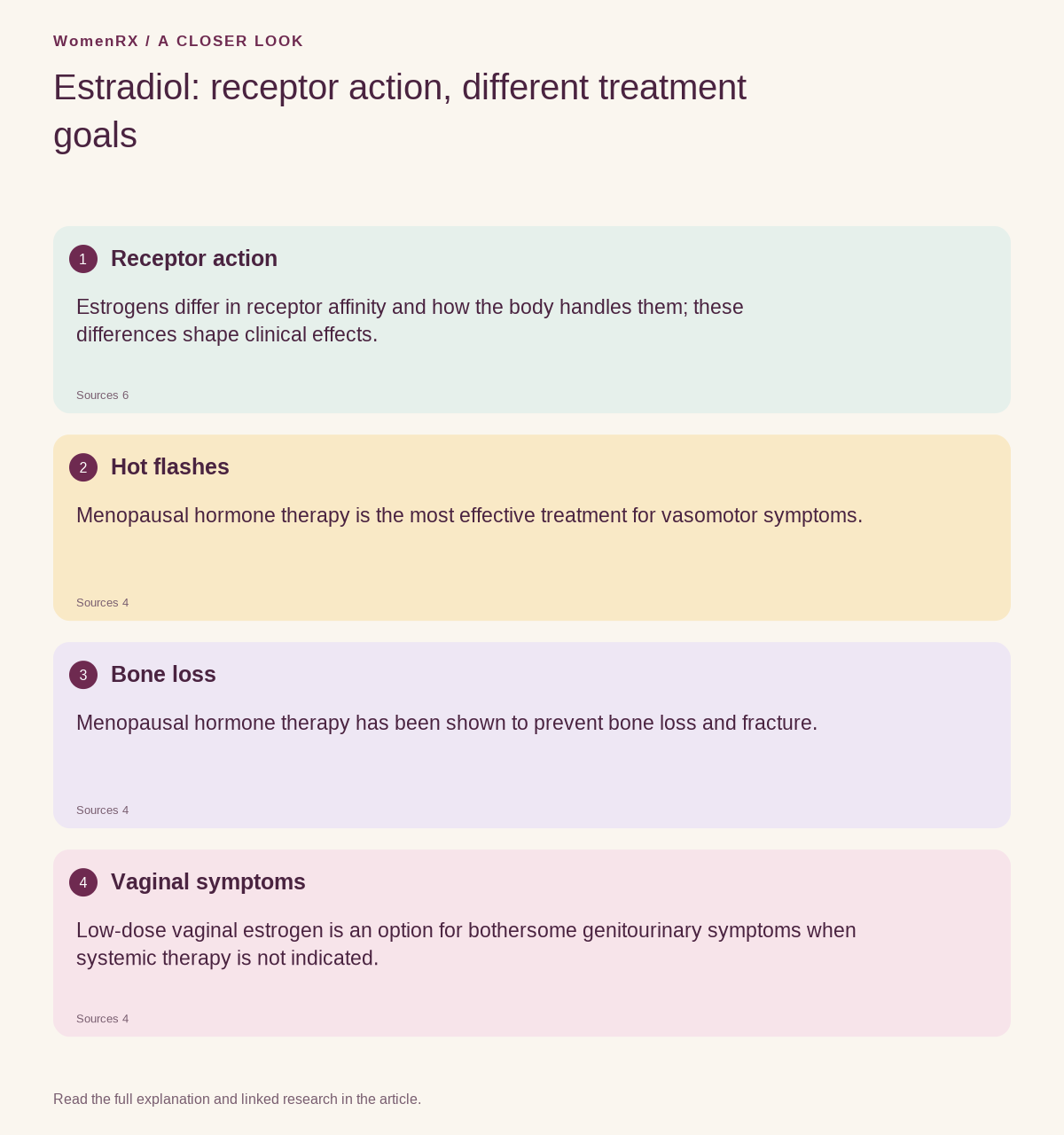
Estradiol: receptor action, different treatment goals
Receptor action: Estrogens differ in receptor affinity and how the body handles them; these differences shape clinical effects.6
Hot flashes: Menopausal hormone therapy is the most effective treatment for vasomotor symptoms.4
Bone loss: Menopausal hormone therapy has been shown to prevent bone loss and fracture.4
Vaginal symptoms: Low-dose vaginal estrogen is an option for bothersome genitourinary symptoms when systemic therapy is not indicated.4
Read the figure as text
This figure links estradiol’s broad receptor-related action to the distinct goals of systemic menopausal therapy and low-dose vaginal treatment.- Receptor action: Estrogens differ in receptor affinity and how the body handles them; these differences shape clinical effects.6
- Hot flashes: Menopausal hormone therapy is the most effective treatment for vasomotor symptoms.4
- Bone loss: Menopausal hormone therapy has been shown to prevent bone loss and fracture.4
- Vaginal symptoms: Low-dose vaginal estrogen is an option for bothersome genitourinary symptoms when systemic therapy is not indicated.4
More questions, answered
Does vaginal estradiol treat hot flashes?
The Menopause Society describes low-dose vaginal estrogen as an option for genitourinary symptoms, while hormone therapy is the most effective treatment for hot flashes. These are different treatment goals, so local vaginal treatment shouldn’t be assumed to address hot flashes. 4
Does estradiol prevent heart disease?
No. Although research has suggested possible cardiovascular effects in some settings, estrogen is not used to prevent cardiovascular disease. 6
Sources you can check
- Menopause | Menopause Symptoms | MedlinePlusAccessed 2026-09-25Return to first citation
- Sexual function after menopause: the role of vaginal estrogens.Cucinella L, Cassani C, Martini E, Parrotta GE, Monne G, Colombo GM, Morteo V, Nappi RE. · Maturitas · 2025Return to first citation
- Managing Genitourinary Syndrome of Menopause in Breast Cancer Survivors Receiving Endocrine Therapy.Sussman TA, Kruse ML, Thacker HL, Abraham J. · Journal of oncology practice · 2019Return to first citation
- The 2022 hormone therapy position statement of The North American Menopause Society.“The 2022 Hormone Therapy Position Statement of The North American Menopause Society” Advisory Panel. · Menopause (New York, N.Y.) · 2022Return to first citation
- The 2023 nonhormone therapy position statement of The North American Menopause Society.Menopause (New York, N.Y.) · 2023Return to first citation
- Comparison of estrogens and selective estrogen receptor modulators (SERMs) used for menopausal hormone therapy.Stanczyk FZ, Yang JL, Coelingh Bennink HJT, Sriprasert I, Winer S, Foidart JM, Archer DF. · Menopause (New York, N.Y.) · 2025Return to first citation