What Does an Estradiol Patch Treat, and What Should You Weigh?
An estradiol patch can relieve menopause-related hot flashes and night sweats, but the right plan depends on your treatment goal and health history.
An estradiol patch delivers estrogen through the skin. Its clearest use during menopause is relief of bothersome hot flashes and night sweats. Hormone therapy can also prevent bone loss, but it shouldn’t be used to prevent heart disease or dementia. Before deciding, weigh your symptoms, health history, timing, proposed dose, and whether you need a progestogen to protect your uterine lining. 2 3 1
Start with the symptom you want to treat
An estradiol patch is systemic hormone therapy: estradiol passes through the skin into the bloodstream. Its clearest role is treating bothersome hot flashes and night sweats, also called vasomotor symptoms. The North American Menopause Society identifies hormone therapy as the most effective treatment for these symptoms. In a placebo-controlled trial described in the Climara prescribing information, postmenopausal women using an estradiol-only patch had greater hot-flash relief than those using placebo. That result supports the treatment goal, not a promise about how much relief any one person will get. 2 3
The patch route bypasses the liver’s first-pass metabolism. Reviews suggest transdermal estradiol may carry a lower risk of venous blood clots than oral estrogen, but lower risk doesn’t mean no risk. Your medical history and the rest of the hormone plan still matter. 2 6
Keep the other possible benefits in perspective
Bone health: Hormone therapy has been shown to prevent bone loss and fractures. That can be part of the discussion, especially if you’re also seeking symptom relief. It doesn’t mean a patch is automatically the right choice for your bone health or that it prevents other chronic diseases. Estrogen products shouldn’t be used to prevent heart disease or dementia. 3 1
Vaginal or urinary symptoms: Systemic hormone therapy can help genitourinary symptoms of menopause. But if these are your only symptoms, a treatment directed at that area may make more sense than a systemic patch. For bothersome symptoms that haven’t improved with over-the-counter options, the menopause position statement recommends considering low-dose vaginal estrogen or other therapies when there’s no separate reason to use systemic hormone therapy. 3
Mood or sleep changes: If night sweats keep waking you, relief from those sweats may be relevant to your sleep concerns. Mood symptoms also deserve their own discussion. Hormone therapy may help some menopause-related mood changes, but an estradiol patch shouldn’t be presented as a general treatment for depression. 5
Having a uterus changes the hormone plan
If you have a uterus, systemic estrogen without adequate progestogen increases the risk of endometrial cancer. Adding a progestogen has been shown to reduce the risk of endometrial hyperplasia, a change in the uterine lining that can precede cancer. Ask whether the proposed patch contains estradiol alone and, if so, how the plan addresses uterine protection. 1
For example, Climara contains estradiol alone, while Climara Pro contains estradiol and the progestogen levonorgestrel. Those product names illustrate a distinction to check; they don’t describe every patch. 1 2
Persistent or recurring abnormal bleeding after menopause needs evaluation rather than an assumption that it’s simply part of treatment. 1
Timing and follow-up are part of the trade-off
For women younger than 60 or within 10 years of menopause onset who have no contraindications, the North American Menopause Society describes the benefit-risk balance of hormone therapy as generally favorable for treating bothersome hot flashes and preventing bone loss. Starting more than 10 years after menopause onset or after age 60 tends to have a less favorable balance because the absolute risks of coronary heart disease, stroke, venous blood clots, and dementia are higher. These groups help frame a conversation; they don’t calculate your personal risk. 3
A few specific questions can make that conversation more useful:
- Which symptom are we treating? If hot flashes are the main problem, how will you judge whether they’ve improved? If vaginal symptoms are the only problem, would a local option better match the goal? 3
- What exactly is in this patch? If you have a uterus, how will the uterine lining be protected? 1
- What strength and change schedule are proposed? Patches aren’t all the same. For example, Climara comes in several estradiol delivery strengths and its prescribing information describes a seven-day wear period. Confirm the details for the specific product being discussed rather than assuming every patch follows that schedule. 2
- How does my history affect this choice? Age, time since menopause, and individual health risks can change the balance between relief and potential harms. 3
- When will we review whether to continue? Periodic reassessment of benefits and risks is recommended. For postmenopausal women using Climara for moderate to severe vasomotor symptoms, its prescribing information says FSH and estradiol blood levels haven’t been shown useful for managing those symptoms. A follow-up discussion can focus on symptom relief and any new concerns. 3 2
The useful comparison isn’t simply patch versus no patch. It’s whether systemic estradiol fits your main concern, and whether the particular product and plan fit your uterus status, timing, and health history.
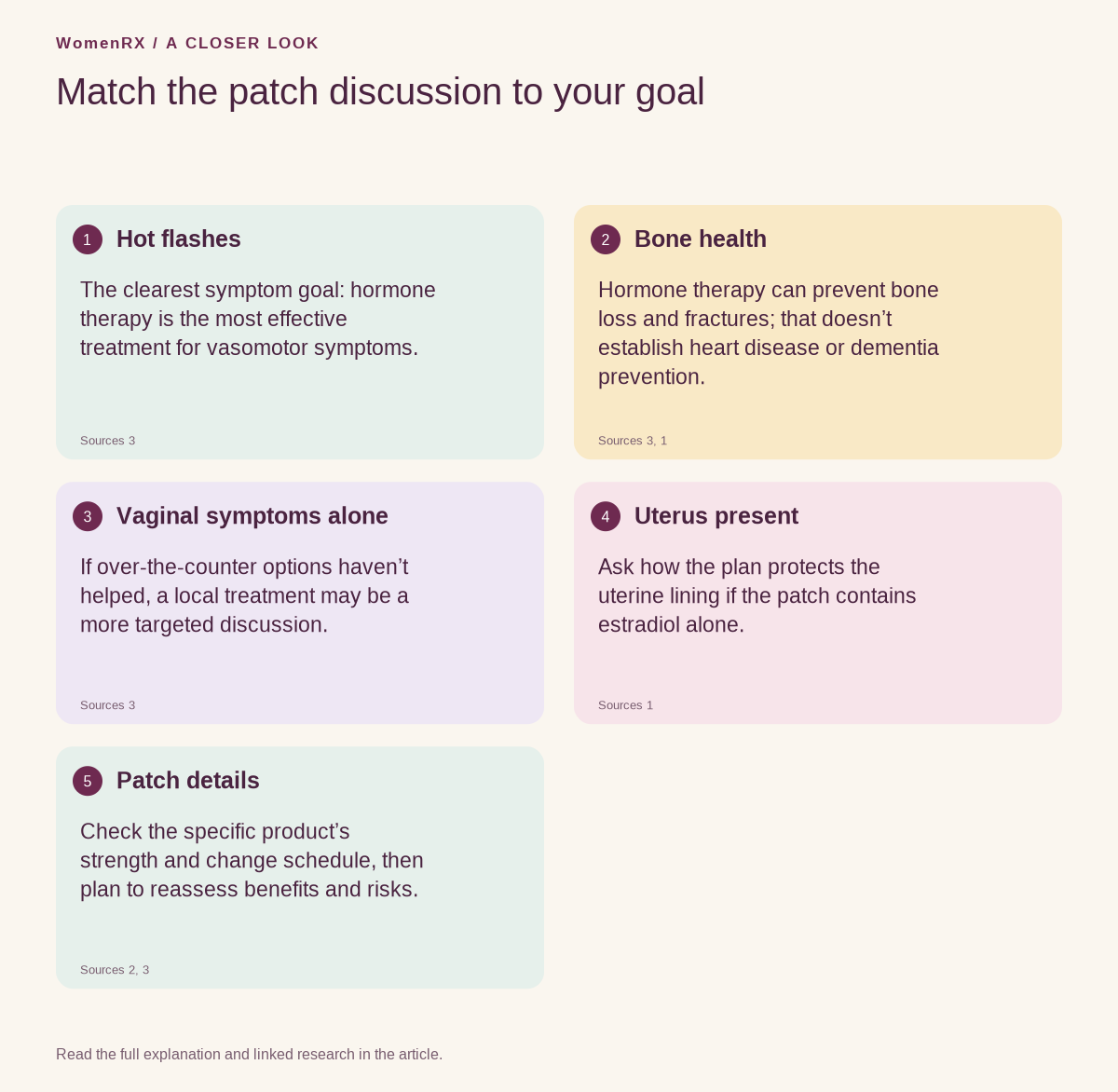
Match the patch discussion to your goal
Hot flashes: The clearest symptom goal: hormone therapy is the most effective treatment for vasomotor symptoms.3
Bone health: Hormone therapy can prevent bone loss and fractures; that doesn’t establish heart disease or dementia prevention.31
Vaginal symptoms alone: If over-the-counter options haven’t helped, a local treatment may be a more targeted discussion.3
Uterus present: Ask how the plan protects the uterine lining if the patch contains estradiol alone.1
Patch details: Check the specific product’s strength and change schedule, then plan to reassess benefits and risks.23
Read the figure as text
These distinctions show where systemic estradiol may fit and which questions can change the plan.- Hot flashes: The clearest symptom goal: hormone therapy is the most effective treatment for vasomotor symptoms.3
- Bone health: Hormone therapy can prevent bone loss and fractures; that doesn’t establish heart disease or dementia prevention.31
- Vaginal symptoms alone: If over-the-counter options haven’t helped, a local treatment may be a more targeted discussion.3
- Uterus present: Ask how the plan protects the uterine lining if the patch contains estradiol alone.1
- Patch details: Check the specific product’s strength and change schedule, then plan to reassess benefits and risks.23
More questions, answered
What if I don’t want to use hormone therapy for hot flashes?
There are evidence-supported nonhormonal options. The North American Menopause Society recommends several, including cognitive behavioral therapy, clinical hypnosis, and certain prescription medicines. Which option fits depends on your symptoms and preferences. 4
Does an estradiol patch prevent heart disease or dementia?
No. Estrogen products shouldn’t be used for either purpose. Relief of menopause symptoms and prevention of bone loss are separate treatment considerations, not evidence that a patch prevents heart disease or dementia. 1 3
Sources you can check
- CLIMARA PRO (ESTRADIOL AND LEVONORGESTREL) PATCH [BAYER HEALTHCARE PHARMACEUTICALS INC.] | US prescribing information and patient instructionsAccessed 2026-09-25Return to first citation
- CLIMARA (ESTRADIOL) PATCH [BAYER HEALTHCARE PHARMACEUTICALS INC.] | US prescribing information and patient instructionsAccessed 2026-09-25Return to first citation
- The 2022 hormone therapy position statement of The North American Menopause Society.“The 2022 Hormone Therapy Position Statement of The North American Menopause Society” Advisory Panel. · Menopause (New York, N.Y.) · 2022Return to first citation
- The 2023 nonhormone therapy position statement of The North American Menopause Society.Menopause (New York, N.Y.) · 2023Return to first citation
- FIGO best practice recommendations for the mental health of women at menopausal age.Khadilkar S, Divakar H, Benedetto C, Genazzani A, Ramos D, Argale E, Deshpande G, Hicky M, Filho ALDS, Herrera E, Balkrishnan M. · International journal of gynaecology and obstetrics: the official organ of the International Federation of Gynaecology and Obstetrics · 2026Return to first citation
- Management of menopausal hormone therapy.Switzer J, Vignali L, Vignali J, Jackson R. · Current opinion in obstetrics & gynecology · 2026Return to first citation