Is an Estrogen Patch an Option for Menopause Symptoms?
A patch can be an option for hot flashes and night sweats, but the right choice depends on your symptoms, health history, and whether you need a progestogen too.
Yes. A transdermal estrogen patch is one form of systemic hormone therapy and may help with bothersome hot flashes and night sweats. Whether it makes sense depends on your health history, age and timing, treatment goals, and route preference. If you have a uterus, a patch does not remove the need to address the risks of estrogen without a progestogen. 2 4
Start with what you want treatment to change
A patch delivers estrogen through the skin into the bloodstream. It may be worth discussing if your main problem is hot flashes or night sweats: hormone therapy is the most effective treatment for these vasomotor symptoms, and the benefits and risks vary with the route, dose, duration, timing, and whether a progestogen is used. 4
If vaginal dryness, discomfort with sex, or urinary symptoms are your main concern, a systemic patch may not be the most targeted starting point. NAMS recommends considering low-dose vaginal estrogen or other therapies for bothersome genitourinary symptoms when systemic hormone therapy is not otherwise indicated. 4 7
Hormone therapy can also prevent bone loss and fracture, but it should not be used to prevent heart disease or dementia. 1 4
What a patch changes, and what it doesn’t
A patch is a non-oral route, which may matter for some people. For example, an EMAS clinical guide recommends transdermal rather than oral estrogen for women with hypertriglyceridemia. That is a reason to discuss the route, not proof that patches are best for everyone or free of risk. 6
The risks of hormone therapy depend on more than whether estrogen comes as a patch or a pill. Age, time since menopause, dose, duration, personal health history, and the use of a progestogen all matter. NAMS describes the benefit-risk balance as generally favorable for treating bothersome symptoms in healthy women younger than 60 or within 10 years of menopause onset who have no contraindications. It appears less favorable when treatment starts after age 60 or more than 10 years after menopause began. These are decision-making guideposts, not a personal risk calculation. 4
Some risks commonly discussed in estrogen product information come from the Women’s Health Initiative, which studied specific oral hormone regimens in postmenopausal women. Those findings should not be treated as a direct risk estimate for every patch, dose, or hormone combination. At the same time, a different route does not make systemic estrogen risk-free. 1 2 4
If you have a uterus, ask about the lining
Estrogen alone can increase the risk of endometrial cancer in someone with a uterus. Adding a progestogen has been shown to reduce endometrial hyperplasia, a possible precursor to cancer. This concern applies to estrogen therapy even when estrogen is delivered through the skin; the patch does not protect the uterine lining. 2
If you have had a hysterectomy, the usual uterus-related reason for adding a progestogen may not apply. But history can change the conversation: an EMAS guide advises against estrogen-only menopausal therapy for women with endometriosis, even after hysterectomy, because of concern about recurrence or malignant transformation of residual disease. 3
A practical way to weigh the choice
Before deciding, consider these four questions:
- Which symptoms matter most to you? A patch may be relevant for hot flashes and night sweats. If symptoms are mainly vaginal or urinary, ask whether a local treatment is a closer fit. 4 7
- Does the route fit your preferences and health context? If you prefer not to take a pill, or have hypertriglyceridemia, ask whether transdermal estrogen is appropriate for you. 6
- Do you need a progestogen? If you have a uterus, ask how the plan will protect the uterine lining. If you have a history of endometriosis, mention it even if you have had a hysterectomy. 2 3
- How does your health history affect the balance? Mention relevant conditions, including cardiovascular disease or an estrogen-dependent cancer history. NAMS lists these as examples of reasons someone may not be a good candidate for hormone therapy, and nonhormonal options are available for vasomotor symptoms. 5
A useful discussion is not simply “patch or no patch.” It is whether systemic estrogen matches your symptom goal, whether the transdermal route suits your circumstances, and what else your treatment plan needs to account for. The decision should be individualized and revisited over time. 4
Is a patch the right fit?
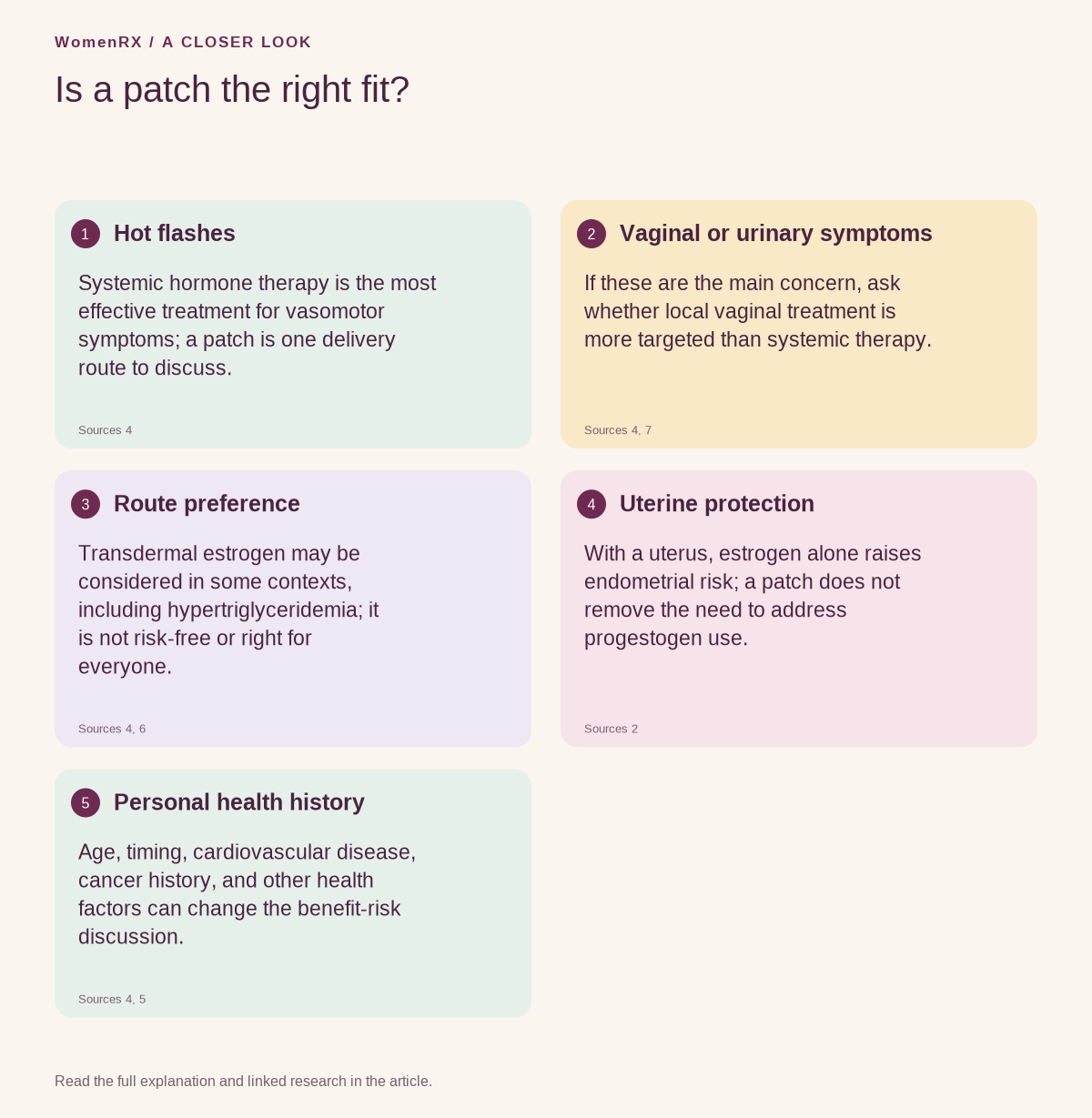
Hot flashes: Systemic hormone therapy is the most effective treatment for vasomotor symptoms; a patch is one delivery route to discuss.4
Vaginal or urinary symptoms: If these are the main concern, ask whether local vaginal treatment is more targeted than systemic therapy.47
Route preference: Transdermal estrogen may be considered in some contexts, including hypertriglyceridemia; it is not risk-free or right for everyone.46
Uterine protection: With a uterus, estrogen alone raises endometrial risk; a patch does not remove the need to address progestogen use.2
Personal health history: Age, timing, cardiovascular disease, cancer history, and other health factors can change the benefit-risk discussion.45
Read the figure as text
Compare the treatment goal and personal factors that can shape a discussion about transdermal estrogen.- Hot flashes: Systemic hormone therapy is the most effective treatment for vasomotor symptoms; a patch is one delivery route to discuss.4
- Vaginal or urinary symptoms: If these are the main concern, ask whether local vaginal treatment is more targeted than systemic therapy.47
- Route preference: Transdermal estrogen may be considered in some contexts, including hypertriglyceridemia; it is not risk-free or right for everyone.46
- Uterine protection: With a uterus, estrogen alone raises endometrial risk; a patch does not remove the need to address progestogen use.2
- Personal health history: Age, timing, cardiovascular disease, cancer history, and other health factors can change the benefit-risk discussion.45
More questions, answered
Can an estrogen patch prevent heart disease?
No. Estrogen therapy should not be used to prevent heart disease or dementia. Its role is treatment of menopausal symptoms and, in some cases, prevention of bone loss, with the balance of benefits and risks considered for the individual. 1 4
Sources you can check
- CLIMARA PRO (ESTRADIOL AND LEVONORGESTREL) PATCH [BAYER HEALTHCARE PHARMACEUTICALS INC.] | US prescribing information and patient instructionsAccessed 2026-09-25Return to first citation
- CLIMARA (ESTRADIOL) PATCH [BAYER HEALTHCARE PHARMACEUTICALS INC.] | US prescribing information and patient instructionsAccessed 2026-09-25Return to first citation
- Endometriosis and menopausal health: An EMAS clinical guide.Erel CT, Nigdelis MP, Ozcivit Erkan IB, Goulis DG, Chedraui P, Giannini A, Kiesel L, Phillips N, Simoncini T, Armeni E, Boban J, Ceausu I, Hillard T, Lambrinoudaki I, Smetnik A, Go... · Maturitas · 2025Return to first citation
- The 2022 hormone therapy position statement of The North American Menopause Society.“The 2022 Hormone Therapy Position Statement of The North American Menopause Society” Advisory Panel. · Menopause (New York, N.Y.) · 2022Return to first citation
- The 2023 nonhormone therapy position statement of The North American Menopause Society.Menopause (New York, N.Y.) · 2023Return to first citation
- Menopause symptom management in women with dyslipidemias: An EMAS clinical guide.Anagnostis P, Bitzer J, Cano A, Ceausu I, Chedraui P, Durmusoglu F, Erkkola R, Goulis DG, Hirschberg AL, Kiesel L, Lopes P, Pines A, van Trotsenburg M, Lambrinoudaki I, Rees M. · Maturitas · 2020Return to first citation
- [Genitourinary menopause syndrome. Postmenopausal women management: CNGOF and GEMVi clinical practice guidelines].Hocké C, Diaz M, Bernard V, Frantz S, Lambert M, Mathieu C, Grellety-Cherbero M. · Gynecologie, obstetrique, fertilite & senologie · 2021Return to first citation