What Does “Low-Dose” Mean for an Estrogen Patch?
A lower patch dose may be a starting point, but the number alone can’t tell you whether you’ll get relief or what your risks will be.
For an estrogen patch, “low-dose” describes a lower amount of estradiol delivered through the skin relative to other patch strengths. It isn’t a promise of symptom relief or a safety rating. The useful question is whether the dose meets your treatment goal, given your response, health history, and the rest of your hormone therapy plan. 2 3
What the number on the patch means
An estradiol patch is designed to release a stated amount of hormone through the skin over time. That number describes the patch’s delivery rate, not the amount your body will absorb or the relief you’ll feel. The US prescribing information for one estradiol patch calls for dose adjustments based on clinical response. It’s an example of how dose is used in practice, not a dose recommendation for every patch. 2
There’s a reason to look beyond the label. In a cross-sectional study at a UK specialist menopause clinic, blood estradiol levels varied substantially among 1,508 perimenopausal and postmenopausal women using transdermal estradiol. The study included patch and gel users. It measured hormone levels, not whether a particular level relieved each woman’s symptoms, so it doesn’t provide a blood-test target for judging your own treatment. 4
Relief depends on the goal, not just the strength
If hot flashes are the reason you’re considering a patch, the meaningful question is whether they’ve become less bothersome. Menopause hormone therapy is the most effective treatment for vasomotor symptoms, including hot flashes, but a particular patch strength won’t work equally well for everyone. 3 If you’re already using a patch and relief is incomplete, that’s a reason to review the plan, not to assume you need a higher dose. Product information describes adjusting an estradiol patch according to clinical response, while menopause guidance calls for considering the treatment’s benefits and risks together. 2 3
The word low-dose can also refer to a different kind of treatment. Low-dose vaginal estrogen is an option for bothersome vaginal or urinary menopause symptoms when over-the-counter approaches haven’t helped and systemic hormone therapy isn’t otherwise indicated. It isn’t the same treatment as a systemic estradiol patch, even though both contain estrogen. 3
Lower dose doesn’t mean no risk
Dose matters, but so do the formulation, route, duration of use, timing of treatment, and whether a progestogen is included. Menopause guidance recommends weighing those factors together and reviewing the balance periodically. For women who start hormone therapy after age 60 or more than 10 years after menopause begins, that balance appears less favorable than for eligible women who start earlier. 3
The route matters too. Transdermal estrogen has less effect on certain blood-clotting markers than oral estrogen, and observational studies suggest a lower risk of blood clots with transdermal treatment. That doesn’t establish that a low-dose patch is clot-free or predict an individual woman’s risk; long-term trials comparing clinical outcomes across regimens are limited. 5
If you have a uterus, the rest of the regimen is particularly relevant. Estrogen used without a progestogen can increase the risk of endometrial cancer, and adding a progestogen reduces the risk of endometrial hyperplasia, a change that can precede cancer. A lower estradiol dose isn’t, by itself, an answer to how your uterine lining is protected. 1
Make the follow-up about what’s actually happening
If the patch isn’t helping enough or you’re noticing unwanted effects, bring the discussion back to your original goal. For example, if you started it for hot flashes, describe whether those episodes still interrupt sleep or daily activities. Then ask:
- Is the symptom I’m still having one this patch is meant to treat?
- Should we reconsider the dose, the formulation, or the overall treatment approach in light of my response?
- How do my age, time since menopause, and health history affect the benefits and risks for me?
- If I have a uterus, how does this regimen protect its lining?
- When should we review whether treatment is still meeting my needs?
Those questions leave room for a dose adjustment without treating it as the automatic answer. Hormone therapy decisions are meant to be individualized and revisited over time. 2 3 If you have unusual vaginal bleeding after menopause while using an estradiol patch, report it promptly so the cause can be checked. 2
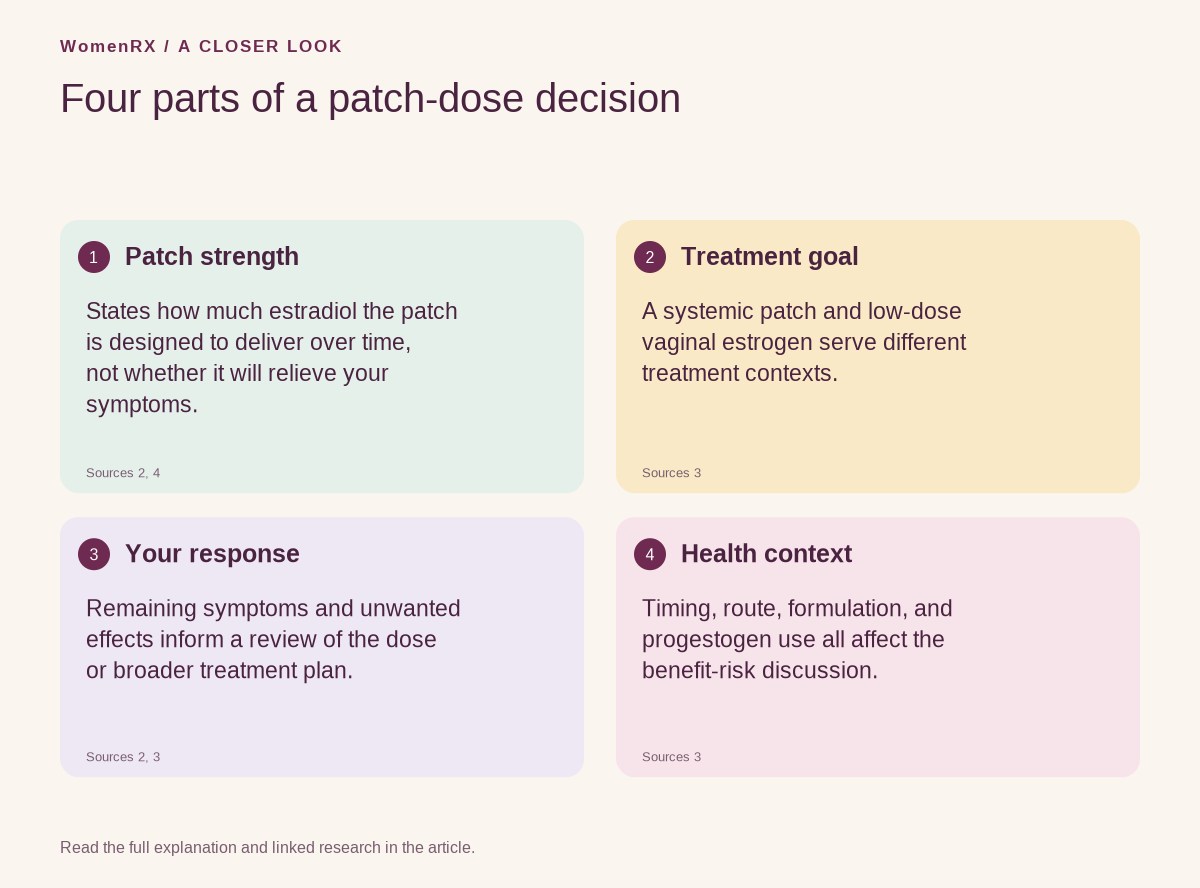
Four parts of a patch-dose decision
Patch strength: States how much estradiol the patch is designed to deliver over time, not whether it will relieve your symptoms.24
Treatment goal: A systemic patch and low-dose vaginal estrogen serve different treatment contexts.3
Your response: Remaining symptoms and unwanted effects inform a review of the dose or broader treatment plan.23
Health context: Timing, route, formulation, and progestogen use all affect the benefit-risk discussion.3
Read the figure as text
The labeled delivery rate answers one question. These other considerations help determine whether treatment is a good fit.- Patch strength: States how much estradiol the patch is designed to deliver over time, not whether it will relieve your symptoms.24
- Treatment goal: A systemic patch and low-dose vaginal estrogen serve different treatment contexts.3
- Your response: Remaining symptoms and unwanted effects inform a review of the dose or broader treatment plan.23
- Health context: Timing, route, formulation, and progestogen use all affect the benefit-risk discussion.3
Sources you can check
- CLIMARA PRO (ESTRADIOL AND LEVONORGESTREL) PATCH [BAYER HEALTHCARE PHARMACEUTICALS INC.] | US prescribing information and patient instructionsAccessed 2026-09-25Return to first citation
- CLIMARA (ESTRADIOL) PATCH [BAYER HEALTHCARE PHARMACEUTICALS INC.] | US prescribing information and patient instructionsAccessed 2026-09-25Return to first citation
- The 2022 hormone therapy position statement of The North American Menopause Society.“The 2022 Hormone Therapy Position Statement of The North American Menopause Society” Advisory Panel. · Menopause (New York, N.Y.) · 2022Return to first citation
- The range and variation in serum estradiol concentration in perimenopausal and postmenopausal women treated with transdermal estradiol in a real-world setting: a cross-sectional study.Glynne S, Reisel D, Kamal A, Neville A, McColl L, Lewis R, Newson L. · Menopause (New York, N.Y.) · 2025Return to first citation
- Menopausal Hormone Therapy and Cardiovascular Disease: The Role of Formulation, Dose, and Route of Delivery.Shufelt CL, Manson JE. · The Journal of clinical endocrinology and metabolism · 2021Return to first citation