What Does “Over-the-Counter Estrogen” Actually Mean?
An “estrogen support” label may describe a supplement, not an estrogen medicine, so the ingredient list and product category matter more than the front-of-package claim.
“Over-the-counter” means a drug can be bought without a prescription; it doesn’t mean that every product sold in the same aisle is a drug. 1 A prescription estradiol patch contains an estrogen hormone, while a supplement marketed for “estrogen support” may list ingredients such as soy extract instead. Check the label before assuming the products contain the same thing or have the same evidence behind them. 346
You might see “estrogen support” on a bottle beside a menopause symptom claim and reasonably wonder whether it’s an alternative to hormone therapy. The quickest way to sort it out is to separate what the product contains, what kind of product it is, and what it has actually been shown to do.
Start with the label, not the word “estrogen”
In the United States, an over-the-counter (OTC) medicine is a drug sold without a prescription. That is a different category from a dietary supplement. A supplement label has a Supplement Facts panel; an OTC medicine has drug labeling and directions for its use. The phrase “estrogen support” on the front of a package does not, by itself, tell you which category you’re holding. 14
Look for the named ingredients. Estradiol is an estrogen hormone: for example, the prescription Climara patch is labeled as an estradiol medicine. Climara Pro is a different prescription patch containing estradiol and a progestogen, levonorgestrel. These examples show why “estrogen” isn’t a complete description even within hormone therapy. 23
A supplement may instead list a plant ingredient such as soy extract. If its marketing uses words like “phytoestrogens” or “hormone balance,” read the Supplement Facts panel for what is actually in the product. Don’t treat those phrases as another name for the estradiol in a prescription patch. And if a listing appears to claim that a product contains estradiol while calling it a supplement, don’t guess from the advertising: verify the product’s drug or supplement labeling before buying it. 346
Match the evidence to the product and the symptom
Prescription hormone therapy has evidence for treating menopausal hot flashes and genitourinary symptoms, but its benefits and risks vary with the hormone, route, timing, and whether a progestogen is used. Evidence for one formulation should not simply be transferred to another. 5 In particular, the Climara label describes a WHI substudy of a specific oral estrogen-plus-progestin combination, not a trial of the estradiol patch. It separately describes findings for an estrogen-alone product and dose. The label says it is not known how use of Climara affects the chances of the conditions identified in those studies. 3
Supplements need their own evidence. The Menopause Society’s 2023 review does not recommend supplements or herbal remedies to treat menopause-related hot flashes; it also does not recommend soy foods, soy extracts, or the soy metabolite equol for that purpose. An earlier review described a possible modest improvement with soy products in one systematic review. That difference is a reason to look at the overall evidence, not to read “estrogen support” as a proven hot-flash treatment. 67
The symptom matters, too. A nonhormonal vaginal moisturizer is neither estradiol nor an “estrogen support” supplement; it is an option for vaginal dryness. For bothersome genitourinary symptoms that are not relieved by OTC therapies, the Menopause Society lists low-dose vaginal estrogen among the treatment options for women who do not otherwise need systemic hormone therapy. Neither approach should be confused with a supplement promoted for hot flashes. 57
A practical claim check
For example, imagine two packages that both mention menopause. One has a Supplement Facts panel and lists soy extract. The other is a prescribed patch whose labeling names estradiol as an active ingredient. The shared menopause language doesn’t make them interchangeable: one calls for evidence about that supplement and its proposed use; the other is a hormone medicine with its own indications and risks. 346
Finally, “natural” doesn’t settle a safety question. Dietary supplements are not approved by the FDA before sale in the way drugs are, and some herbal products can interact with medicines. If you take medication and are considering an herbal menopause product, bring its ingredient list to your health care provider so you can discuss that specific combination. 8
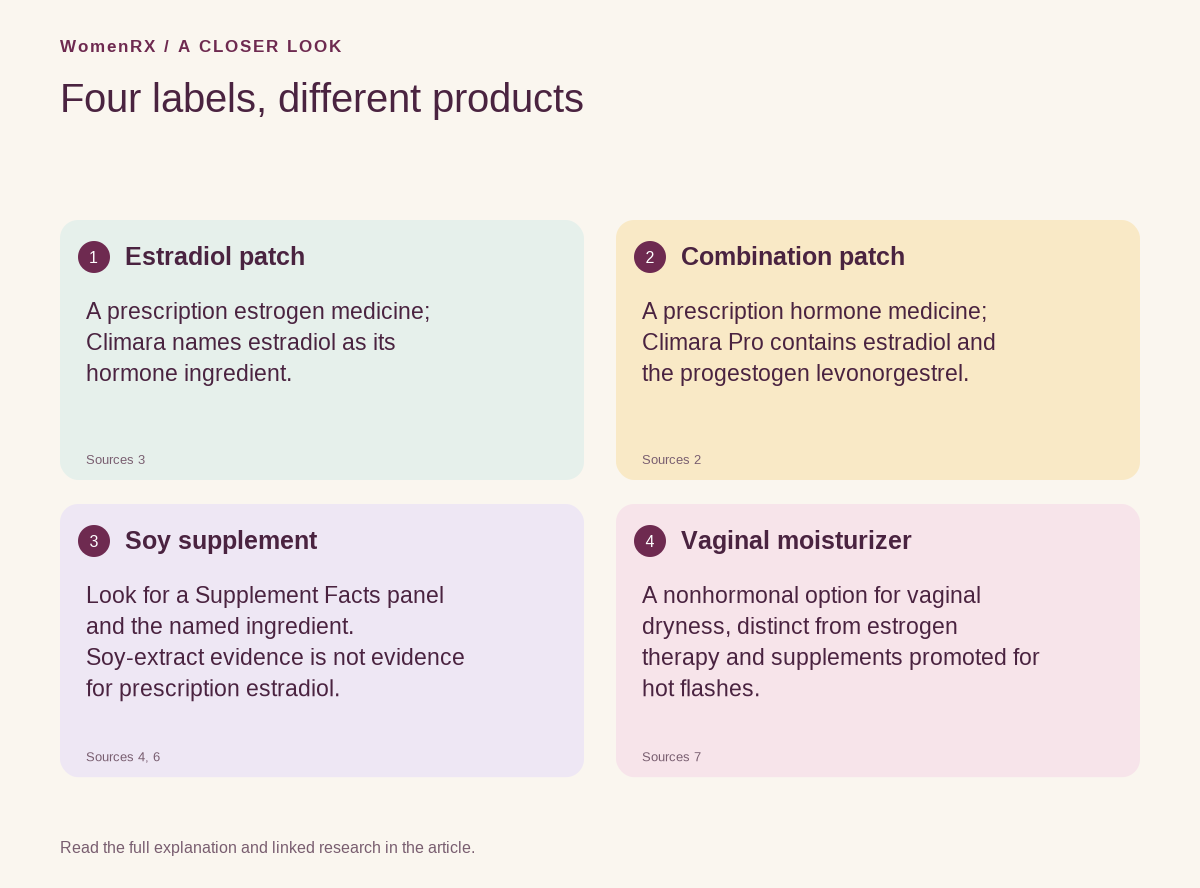
Four labels, different products
Estradiol patch: A prescription estrogen medicine; Climara names estradiol as its hormone ingredient.3
Combination patch: A prescription hormone medicine; Climara Pro contains estradiol and the progestogen levonorgestrel.2
Soy supplement: Look for a Supplement Facts panel and the named ingredient. Soy-extract evidence is not evidence for prescription estradiol.46
Vaginal moisturizer: A nonhormonal option for vaginal dryness, distinct from estrogen therapy and supplements promoted for hot flashes.7
Read the figure as text
The product’s named ingredients and labeling give a clearer answer than a menopause claim on the front.- Estradiol patch: A prescription estrogen medicine; Climara names estradiol as its hormone ingredient.3
- Combination patch: A prescription hormone medicine; Climara Pro contains estradiol and the progestogen levonorgestrel.2
- Soy supplement: Look for a Supplement Facts panel and the named ingredient. Soy-extract evidence is not evidence for prescription estradiol.46
- Vaginal moisturizer: A nonhormonal option for vaginal dryness, distinct from estrogen therapy and supplements promoted for hot flashes.7
Sources you can check
- Over-the-Counter Medicines: MedlinePlusAccessed 2026-09-25Return to first citation
- CLIMARA PRO (ESTRADIOL AND LEVONORGESTREL) PATCH [BAYER HEALTHCARE PHARMACEUTICALS INC.] | US prescribing information and patient instructionsAccessed 2026-09-25Return to first citation
- CLIMARA (ESTRADIOL) PATCH [BAYER HEALTHCARE PHARMACEUTICALS INC.] | US prescribing information and patient instructionsAccessed 2026-09-25Return to first citation
- Food and Dietary Supplement Package Labeling-Guidance from FDA's Warning Letters and Title 21 of the Code of Federal Regulations.Brody T. · Comprehensive reviews in food science and food safety · 2016Return to first citation
- The 2022 hormone therapy position statement of The North American Menopause Society.“The 2022 Hormone Therapy Position Statement of The North American Menopause Society” Advisory Panel. · Menopause (New York, N.Y.) · 2022Return to first citation
- The 2023 nonhormone therapy position statement of The North American Menopause Society.Menopause (New York, N.Y.) · 2023Return to first citation
- Hormone Therapy and Other Treatments for Symptoms of Menopause.Hill DA, Crider M, Hill SR. · American family physician · 2016Return to first citation
- Acai: Usefulness and Safety | NCCIHAccessed 2026-09-25Return to first citation