Do Nonprescription Estrogen Pills Help Menopause Symptoms?
A pill labeled “estrogen support” may contain plant ingredients, but that wording doesn’t tell you whether it relieves hot flashes.
Don’t assume a nonprescription pill marketed for “estrogen support” works like estrogen therapy. Hormone therapy is the most effective treatment for menopause-related hot flashes and night sweats. Plant-derived supplements have produced mixed results, and a 2023 menopause society statement does not recommend supplements or herbal remedies as treatments for those symptoms. Check the actual ingredients before judging any product claim. 34
Start with what’s in the pill
“Estrogen support” describes a promise, not an ingredient. If you’re comparing pills, look past the large print on the front and read the ingredient list. Does it name an estrogen medicine, or does it name soy, red clover, or another plant ingredient? Those are different categories, and research on one cannot establish what another will do. 12
Estrogen hormone therapy has substantial evidence for treating menopause-related hot flashes and night sweats. It comes in forms besides pills, including patches, gels, and sprays. Its benefits and risks depend in part on the type of therapy, how it’s taken, when it’s started, and the person using it. A supplement advertised with estrogen-related language shouldn’t be treated as an equivalent simply because the names sound similar. 13
Plant ingredients raise a narrower question: Has this ingredient, in a comparable preparation, helped women with the symptom I want to treat? Soy-derived isoflavones and red clover are examples of ingredients studied for menopausal symptoms. That makes them recognizable on a label, not interchangeable with estradiol or with one another. 26
Why a promising study doesn’t settle the choice
A 2024 review pooled randomized, placebo-controlled trials of plant-derived supplements in perimenopausal and postmenopausal women. Across a varied collection of products, it found improvements in hot-flash frequency and symptom-questionnaire scores compared with placebo. The authors also cautioned that study quality and differences among the products limited firm conclusions. The reported pooled results do not show whether effects differed between perimenopausal and postmenopausal women. 2
An individual trial shows why the product matters. In a randomized study of 252 symptomatic menopausal women, two red-clover supplements were compared with placebo over 12 weeks. Mean daily hot-flash counts fell by 5.1 with one supplement, 5.4 with the other, and 5.0 with placebo. Neither supplement produced a clinically important improvement in hot flashes or other menopause symptoms. A noticeable change while taking a pill, in other words, doesn’t by itself show that the pill caused it. 6
These findings aren’t a simple contradiction. The review combines many different plant products and symptom measures; the trial tests two specific red-clover preparations. Neither result proves that an unfamiliar “estrogen support” blend will work. After assessing nonhormonal options for hot flashes and night sweats, The North American Menopause Society’s 2023 statement did not recommend supplements, herbal remedies, soy foods, or soy extracts as treatments for those symptoms. It did identify other evidence-supported nonhormonal options, including cognitive-behavioral therapy, clinical hypnosis, and several prescription medicines. 246
A practical way to read the label
Before buying or bringing a product to an appointment, note four things:
- The named ingredients. “Soy isoflavones” or “red clover” is more informative than “hormone balance.” If the label names several plants, a study of one ingredient won’t tell you how that blend performs. 26
- The amount and form of each ingredient, if stated. A recognizable plant name alone doesn’t show that a product matches a preparation used in a clinical trial. The red-clover trial, for example, tested two distinct supplements and found that neither had a clinically important symptom benefit. 6
- The symptom being promised relief. Research on hot flashes doesn’t establish that a pill treats vaginal dryness, painful sex, or every other menopause-related concern. For bothersome vaginal symptoms not relieved by over-the-counter measures in people without an indication for systemic hormone therapy, the menopause society’s hormone-therapy statement recommends options including low-dose vaginal estrogen. 34
- Any other medicines or supplements you use. Ask about the specific ingredients rather than assuming that everything described as natural has the same safety profile. Research on supplement effectiveness doesn’t establish the safety or interactions of every product sold under an estrogen-support claim. 27
If hot flashes are disrupting sleep or daily life, a more useful question than “Which estrogen supplement is best?” is “Which treatments fit my symptoms and health history?” Hormone therapy and evidence-supported nonhormonal treatments offer different paths. The right comparison is between those options and the actual ingredients in the pill you’re considering, not between a prescription medicine and a marketing phrase. 345
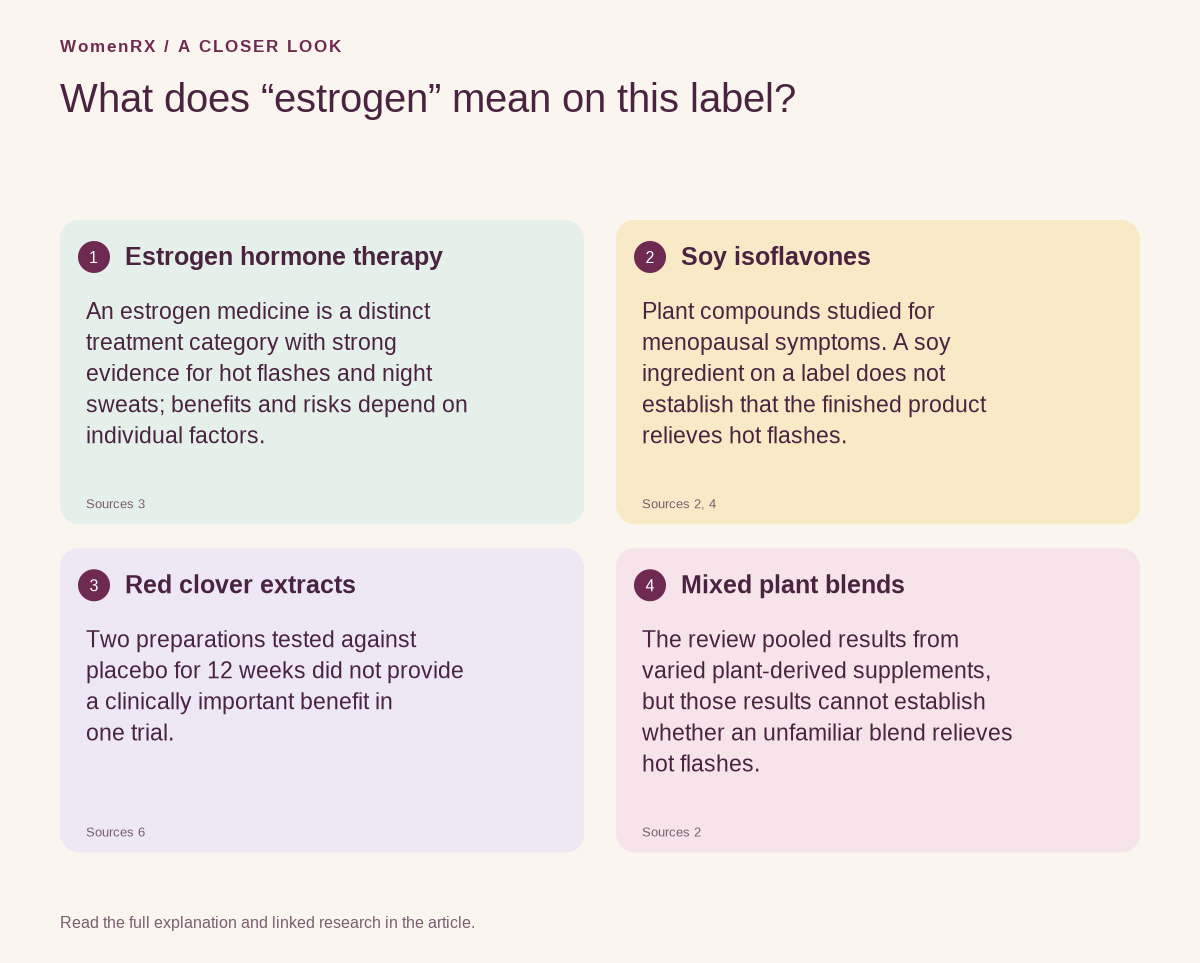
What does “estrogen” mean on this label?
Estrogen hormone therapy: An estrogen medicine is a distinct treatment category with strong evidence for hot flashes and night sweats; benefits and risks depend on individual factors.3
Soy isoflavones: Plant compounds studied for menopausal symptoms. A soy ingredient on a label does not establish that the finished product relieves hot flashes.24
Red clover extracts: Two preparations tested against placebo for 12 weeks did not provide a clinically important benefit in one trial.6
Mixed plant blends: The review pooled results from varied plant-derived supplements, but those results cannot establish whether an unfamiliar blend relieves hot flashes.2
Read the figure as text
Use the named ingredient and the symptom studied, not the product’s front-of-package promise, to make a meaningful comparison.- Estrogen hormone therapy: An estrogen medicine is a distinct treatment category with strong evidence for hot flashes and night sweats; benefits and risks depend on individual factors.3
- Soy isoflavones: Plant compounds studied for menopausal symptoms. A soy ingredient on a label does not establish that the finished product relieves hot flashes.24
- Red clover extracts: Two preparations tested against placebo for 12 weeks did not provide a clinically important benefit in one trial.6
- Mixed plant blends: The review pooled results from varied plant-derived supplements, but those results cannot establish whether an unfamiliar blend relieves hot flashes.2
More questions, answered
Are phytoestrogens the same as prescription estrogen?
No. Phytoestrogens are plant-derived compounds, including isoflavones studied in soy and red-clover supplements. Their presence on a label doesn’t establish that a product has the clinical effects of prescription estrogen therapy. 2356
Sources you can check
- Oestrogen: an HRT medicine to treat menopause symptoms - NHSAccessed 2026-09-25Return to first citation
- Efficacy of plant-derived dietary supplements in improving overall menopausal symptoms in women: An updated systematic review and meta-analysis.Oh MR, Park JH, Park SK, Park SH. · Phytotherapy research : PTR · 2024Return to first citation
- The 2022 hormone therapy position statement of The North American Menopause Society.“The 2022 Hormone Therapy Position Statement of The North American Menopause Society” Advisory Panel. · Menopause (New York, N.Y.) · 2022Return to first citation
- The 2023 nonhormone therapy position statement of The North American Menopause Society.Menopause (New York, N.Y.) · 2023Return to first citation
- Treatment of menopause-associated vasomotor symptoms: position statement of The North American Menopause Society.North American Menopause Society. · Menopause (New York, N.Y.) · 2004Return to first citation
- Phytoestrogen supplements for the treatment of hot flashes: the Isoflavone Clover Extract (ICE) Study: a randomized controlled trial.Tice JA, Ettinger B, Ensrud K, Wallace R, Blackwell T, Cummings SR. · JAMA · 2003Return to first citation
- Nonhormonal management of menopause-associated vasomotor symptoms: 2015 position statement of The North American Menopause Society.Menopause (New York, N.Y.) · 2015Return to first citation