Do Over-the-Counter Menopause Pills Contain Estrogen?
An “estrogen support” pill may contain plant compounds, not the estrogen found in prescription hormone therapy.
If you mean an estrogen medicine for menopause, don’t treat a nonprescription “estrogen support” pill as its equivalent. U.S. conjugated-estrogen tablets are prescription medicine; an oral supplement may instead contain plant compounds called phytoestrogens, such as soy isoflavones. Read the named ingredients, not just the claim on the front of the bottle. 86
The ingredient tells you more than the word “estrogen”
A pill can be sold for “estrogen support” without being an estrogen medicine. That wording describes a marketing promise, not necessarily what’s inside. Start with the named ingredients: are they identified as estrogens, or are they plant extracts such as soy isoflavones or red clover? Researchers group compounds in those plants under the term phytoestrogens. That term doesn’t make an oral phytoestrogen supplement interchangeable with prescription estrogen therapy. 6
For a concrete U.S. comparison, Premarin tablets contain conjugated estrogens and are prescribed as a medicine. Estradiol is also an estrogen hormone; the Climara estradiol patch is another prescription product, though it isn’t a pill. These examples show what it means for a product to actually name an estrogen as its drug ingredient. They don’t establish the status of every product you might find for sale online. 83
“Over the counter” also has a specific meaning for a medicine: it’s a drug that can be bought without a prescription after the FDA has determined it is appropriate for OTC sale. Seeing a menopause supplement on a store shelf doesn’t, by itself, tell you that it has been evaluated as an OTC estrogen medicine. 1
What can plant compounds do for hot flashes?
There is some human evidence worth taking seriously, but it answers a narrower question than “Does this replace estrogen?” A 2015 systematic review pooled randomized trials of oral phytoestrogens in perimenopausal and postmenopausal women with symptoms. Across the trials reporting hot-flash frequency, the review found a greater reduction with phytoestrogens than with placebo. Its analysis of a broader menopause-symptom measure did not find a statistically significant difference. The trials studied different preparations over three to twelve months, so that result isn’t a promise about any particular bottle. 6
The review primarily evaluated phytoestrogens against placebo, not prescription hormone therapy. A supplement that might help some women with hot flashes therefore hasn’t been shown by that comparison to deliver the same benefits or have the same risks as an estrogen medicine. 6 Prescription hormone therapies have approved uses for symptoms including moderate-to-severe hot flashes and vaginal discomfort; the choice of treatment depends on the symptom being treated, not simply whether a package says “menopause.” 7
Match the product to the problem
For example, if your main concern is vaginal dryness, an oral pill marketed for hot flashes may be answering the wrong question. Nonprescription vaginal moisturizers and lubricants are options for dryness, while prescription vaginal estrogen is another type of treatment. A menopause-society position statement found that nonhormonal options can provide enough relief for many women with mild vaginal symptoms, whereas estrogen therapy is the most effective treatment for moderate to severe symptoms. 45
If your concern is hot flashes, separate three questions before buying a pill: What are its actual ingredients? Was evidence gathered on that ingredient or on this particular product? And is the claimed benefit relief of hot flashes, rather than a vague promise to “balance hormones”? The phytoestrogen trials can inform the first kind of claim, but they cannot verify an unnamed product’s contents or make it a substitute for prescribed estrogen. 68
One distinction matters especially if you have a uterus and are considering systemic estrogen therapy. Prescription estrogen is not chosen solely by looking for an estrogen ingredient: estrogen used without a progestogen can increase endometrial cancer risk in women with a uterus, and adding a progestogen reduces the risk of endometrial hyperplasia. That’s a reason to discuss the appropriate treatment plan rather than trying to assemble hormone therapy from products marketed online. 23
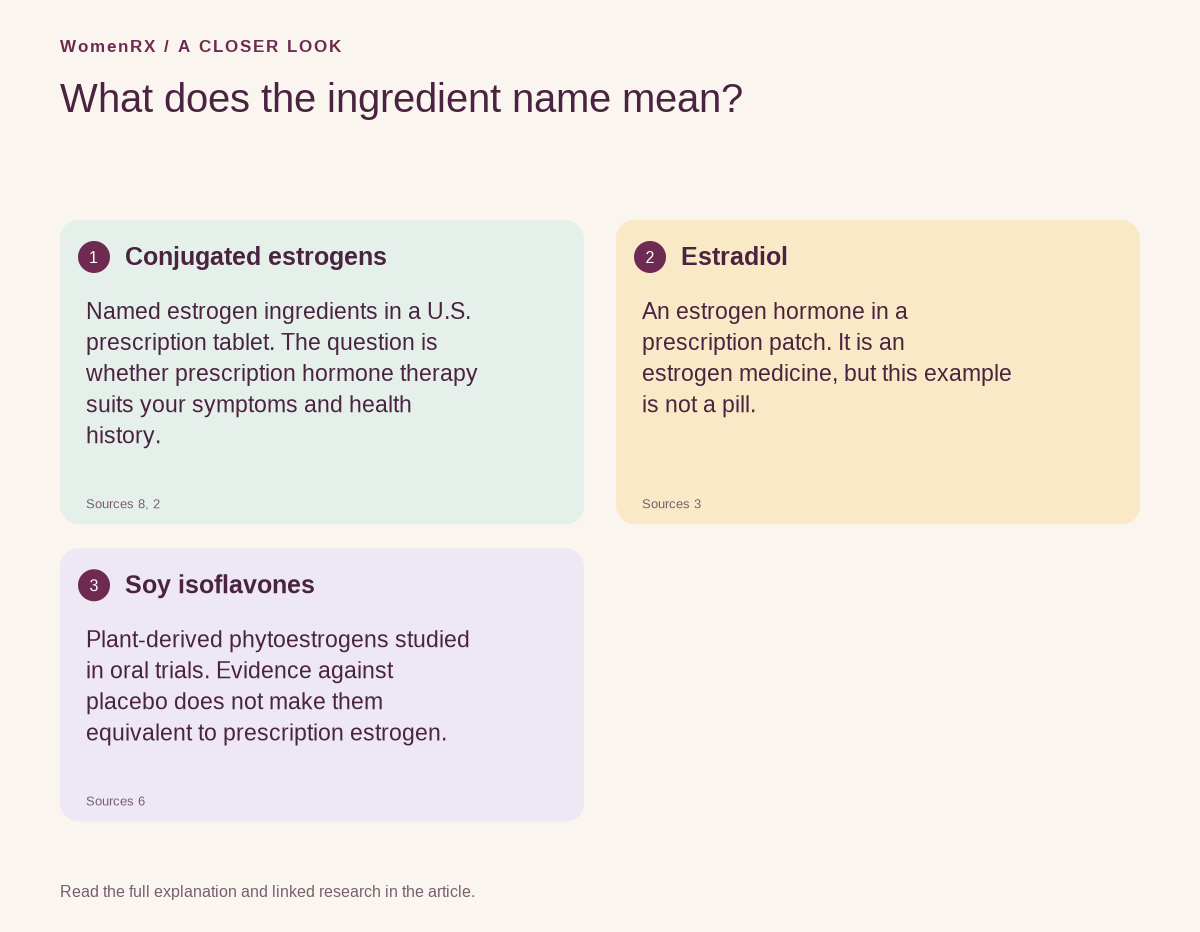
What does the ingredient name mean?
Conjugated estrogens: Named estrogen ingredients in a U.S. prescription tablet. The question is whether prescription hormone therapy suits your symptoms and health history.82
Estradiol: An estrogen hormone in a prescription patch. It is an estrogen medicine, but this example is not a pill.3
Soy isoflavones: Plant-derived phytoestrogens studied in oral trials. Evidence against placebo does not make them equivalent to prescription estrogen.6
Read the figure as text
Three labels that can look related point to different products and different evidence questions.- Conjugated estrogens: Named estrogen ingredients in a U.S. prescription tablet. The question is whether prescription hormone therapy suits your symptoms and health history.82
- Estradiol: An estrogen hormone in a prescription patch. It is an estrogen medicine, but this example is not a pill.3
- Soy isoflavones: Plant-derived phytoestrogens studied in oral trials. Evidence against placebo does not make them equivalent to prescription estrogen.6
More questions, answered
Is a soy isoflavone pill the same as an estradiol pill?
No. Soy isoflavones are studied as oral phytoestrogens, while estradiol is an estrogen hormone used in prescription medicine. A finding about phytoestrogens versus placebo doesn’t establish that the two treatments are interchangeable. 63
Sources you can check
- Over-the-Counter Medicines: MedlinePlusAccessed 2026-09-25Return to first citation
- CLIMARA PRO (ESTRADIOL AND LEVONORGESTREL) PATCH [BAYER HEALTHCARE PHARMACEUTICALS INC.] | US prescribing information and patient instructionsAccessed 2026-09-25Return to first citation
- CLIMARA (ESTRADIOL) PATCH [BAYER HEALTHCARE PHARMACEUTICALS INC.] | US prescribing information and patient instructionsAccessed 2026-09-25Return to first citation
- Genitourinary Syndrome of Menopause.Marino JM. · Journal of midwifery & women's health · 2021Return to first citation
- Management of symptomatic vulvovaginal atrophy: 2013 position statement of The North American Menopause Society.Menopause (New York, N.Y.) · 2013Return to first citation
- Efficacy of phytoestrogens for menopausal symptoms: a meta-analysis and systematic review.Chen MN, Lin CC, Liu CF. · Climacteric : the journal of the International Menopause Society · 2015Return to first citation
- FDA Approves Labeling Changes to Menopausal Hormone Therapy Products | FDAAccessed 2026-09-25Return to first citation
- PREMARIN (ESTROGENS, CONJUGATED) TABLET, FILM COATED [WYETH PHARMACEUTICALS LLC, A SUBSIDIARY OF PFIZER INC.] | US prescribing information and patient instructionsAccessed 2026-09-25Return to first citation