Does chia contain estrogen, or compounds that act like it?
Chia seed analysis has identified a plant compound discussed as a phytoestrogen, but that finding doesn’t show that chia changes estrogen levels or menopause symptoms.
Chia isn’t human estrogen. One chemical analysis of chia seeds identified daidzin, a plant isoflavone sometimes discussed as a phytoestrogen. That label doesn’t mean the compound will act like your body’s estradiol in a predictable way. The analysis measured what was in seeds, not hormone levels or menopause symptoms in women. 2 3 4
A plant compound isn’t the same as your estrogen
Estrogen is a hormone your body produces; estradiol is one form of estrogen used in menopause hormone therapy. A phytoestrogen, by contrast, is a plant compound discussed for its possible effects on estrogen signaling. The similar names can blur an important distinction: finding a plant compound in food doesn’t mean the food contains human estradiol. 2 3
In a chemical analysis of chia seeds, researchers identified several plant compounds, including the isoflavone daidzin. They reported 0.006 milligrams of daidzin per gram of seed. That is a measurement of a compound in the analyzed seed material, not a measurement of estrogen in chia or of what happens in a person’s body after eating it. 4
Why “phytoestrogen” doesn’t predict an effect
Some plant compounds can interact with estrogen signaling, but the word phytoestrogen doesn’t promise a straightforward estrogen-like effect. A review describes phytoestrogens as capable of estrogenic or anti-estrogenic activity, depending on factors such as concentration and receptor affinity. The term identifies a possible kind of biological activity; it doesn’t tell you what a particular food will do in your body. 3
That distinction matters if you’re thinking about chia for menopause. A chemical analysis can show that a compound is present, but it can’t answer whether it is absorbed in a way that affects hormone levels, whether any effect is meaningful, or whether symptoms such as hot flashes improve. The chia composition study didn’t test those questions in women. Its reported daidzin measurement also doesn’t establish how much is present across different chia products. 4
What chia-specific research can tell you
A separate study tested chia in rats with obesity-related ovarian dysfunction. It measured reproductive hormones, including estradiol, but the study was an animal model focused on obesity-related changes, not a trial of chia for menopause symptoms in women. Its findings can’t establish that eating chia changes women’s estrogen levels or relieves menopausal symptoms. 5
So the careful answer is: chia has been found to contain a plant isoflavone, but that alone doesn’t show that chia acts as estrogen or treats menopause symptoms. This isn’t proof that no chia-related human study exists; it’s a limit of what the cited seed analysis and animal study establish.
If menopause symptoms are the reason you’re asking, don’t treat chia’s plant-compound content as evidence that it can replace an established treatment. The North American Menopause Society identifies hormone therapy as the most effective treatment for vasomotor symptoms, with decisions individualized to a woman’s situation and the treatment’s risks and benefits. 1
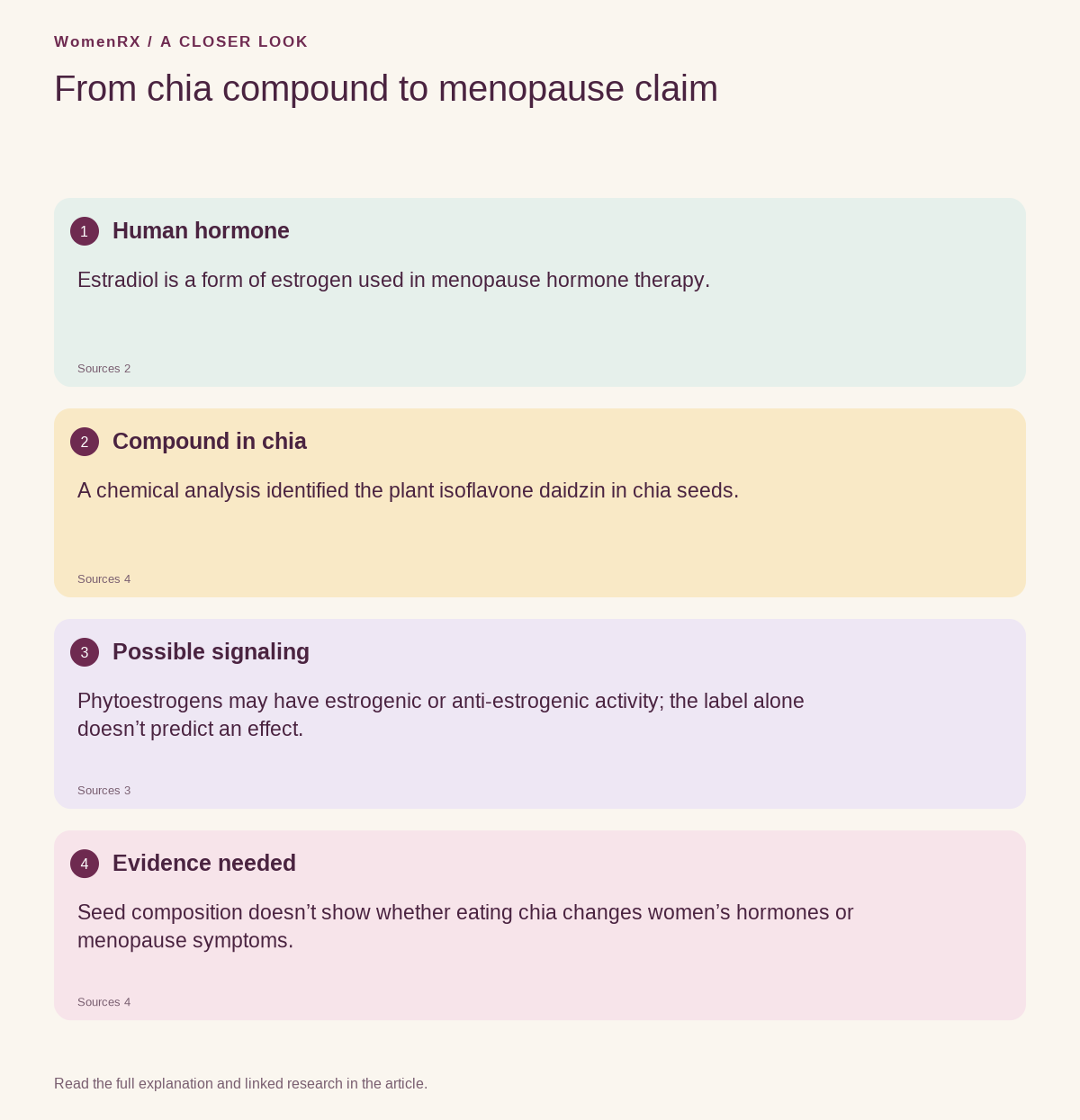
From chia compound to menopause claim
Human hormone: Estradiol is a form of estrogen used in menopause hormone therapy.2
Compound in chia: A chemical analysis identified the plant isoflavone daidzin in chia seeds.4
Possible signaling: Phytoestrogens may have estrogenic or anti-estrogenic activity; the label alone doesn’t predict an effect.3
Evidence needed: Seed composition doesn’t show whether eating chia changes women’s hormones or menopause symptoms.4
Read the figure as text
This comparison separates what seed analysis found from what would be needed to show a hormone or symptom effect.- Human hormone: Estradiol is a form of estrogen used in menopause hormone therapy.2
- Compound in chia: A chemical analysis identified the plant isoflavone daidzin in chia seeds.4
- Possible signaling: Phytoestrogens may have estrogenic or anti-estrogenic activity; the label alone doesn’t predict an effect.3
- Evidence needed: Seed composition doesn’t show whether eating chia changes women’s hormones or menopause symptoms.4
More questions, answered
Does the daidzin measurement tell me how much I get from a serving of chia?
Not reliably. The analysis reported 0.006 milligrams per gram in the seed material it examined, but that result doesn’t establish the amount in every chia product or what your body absorbs from a serving. 4
Sources you can check
- The 2022 hormone therapy position statement of The North American Menopause Society.“The 2022 Hormone Therapy Position Statement of The North American Menopause Society” Advisory Panel. · Menopause (New York, N.Y.) · 2022Return to first citation
- About oestrogen tablets, patches, gel and spray - NHSAccessed 2026-09-25Return to first citation
- Role of Phytoestrogens in Endometriosis.Sulak M, Halici Z. · The journal of obstetrics and gynaecology research · 2025Return to first citation
- Phytochemical profile and nutraceutical potential of chia seeds (Salvia hispanica L.) by ultra high performance liquid chromatography.Martínez-Cruz O, Paredes-López O. · Journal of chromatography. A · 2014Return to first citation
- Protective effect of Salvia hispanica (chia seeds) against obesity induced ovarian disorders in rat model.FaragAllah EM, Algharib SA, Goda NIA, El-Malkey NF, Mahboub HH, El-Fayoumi SH, Al-Hoshani N, Wahid RM, Aref M. · Tissue & cell · 2023Return to first citation