Can Vitamins Raise Estrogen Levels? What the Evidence Can Tell You
Correcting a nutrient deficiency can matter for health, but that’s different from taking a supplement to raise estrogen or ease menopause symptoms.
A vitamin’s role in nutrition doesn’t make it an estrogen booster. Vitamin D supports bone health and normal calcium metabolism, but those roles don’t show that it raises estrogen. Soy isoflavones can interact with estrogen receptors, yet that’s different from a proven increase in blood estrogen or reliable hot-flash relief. Menopause guidance doesn’t recommend supplements or soy products for hot flashes. 2 4 5
A nutrient’s job isn’t the same as a hormone’s job
Vitamins have specific roles in the body, and a low level of a vitamin can contribute to health problems. Correcting a deficiency may be worthwhile for that reason. It doesn’t follow that taking more of the nutrient will raise estrogen or relieve menopause symptoms. 1
Vitamin D is a useful example. It supports bone health and normal calcium metabolism. That makes vitamin D relevant to nutrient and bone health, not a demonstrated way to increase estrogen. 2
When a product is marketed as an “estrogen booster,” look for evidence of the exact effect being promised. A change in a lab measure, a biological effect in cells, and improvement in hot flashes are separate claims. Evidence for one doesn’t establish the others.
Soy compounds can act like estrogens without being estrogen
Soy isoflavones are phytoestrogens, plant compounds that can interact with estrogen receptors. In a laboratory study of human breast cancer cells, soy and licorice compounds affected some of the same genes as estradiol. Their effects also differed from one another and depended on the cells’ estrogen-receptor makeup. That shows activity in cells, not that eating soy or taking an extract raises estrogen in a woman’s bloodstream. 5
The symptom question has a separate answer. The North American Menopause Society’s 2023 position statement does not recommend supplements or herbal remedies, soy foods, or soy extracts for vasomotor symptoms such as hot flashes. This is a judgment about evidence for treating those symptoms; it doesn’t mean plant compounds have no biological activity. 4
A hormone-level change isn’t proof of symptom relief
DHEA offers a useful comparison, though it isn’t a vitamin. A meta-analysis of randomized trials in women found a higher average estradiol level with DHEA supplementation than with control: a weighted mean difference of 7.02 pg/mL across 21 trial arms involving 1,223 participants. The reported outcome was a hormone measurement. It doesn’t, by itself, establish that DHEA improves menopause symptoms or is an appropriate choice for you. 3
For any estrogen claim, ask what the study actually measured: estrogen in blood, a symptom, or something else? Who took part, and what was the comparison? Did the study show a meaningful symptom improvement as well as a lab change? These are different questions, and a product claim that doesn’t answer them can’t tell you whether the supplement fits your needs.
Match the next step to the question
If you’re concerned about a vitamin deficiency, treat that as a nutrient question. Whether testing or supplementation makes sense depends on the nutrient and your circumstances; a general vitamin claim doesn’t establish a need to take it. Some vitamins are available through food, and supplements can be useful in some cases, but high doses of some vitamins can cause problems. 1
A vitamin D question is different from an estrogen question. Considering a supplement, by itself, doesn’t tell you whether an estrogen test would help. If you’re seeking relief from hot flashes, start with the symptom and ask which treatments have evidence for that problem. The menopause position statement identifies hormone therapy as the most effective treatment for vasomotor symptoms and describes evidence-supported nonhormonal options for people who aren’t good candidates for it or prefer not to use it. 4
That’s a more useful discussion than assuming every menopause symptom means your estrogen is low or that an “estrogen booster” will address it.
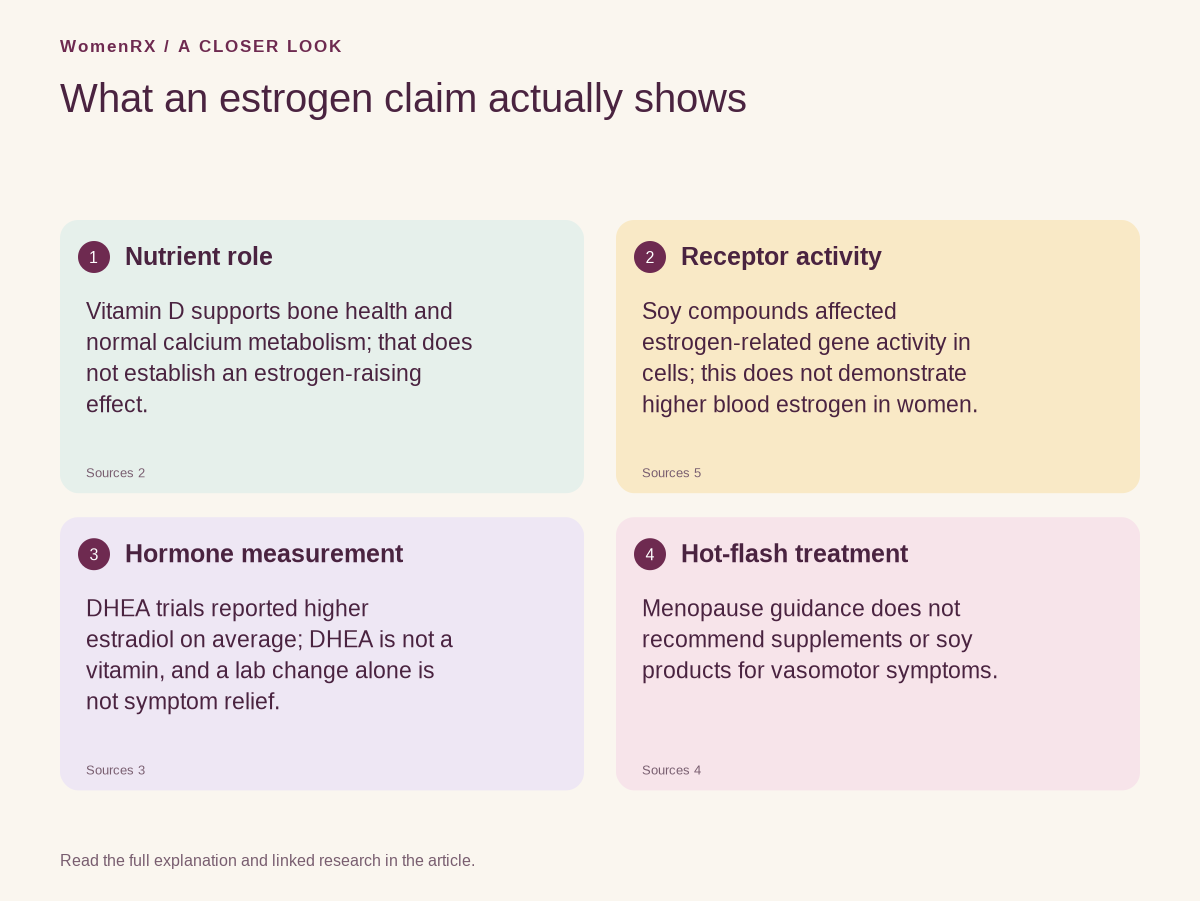
What an estrogen claim actually shows
Nutrient role: Vitamin D supports bone health and normal calcium metabolism; that does not establish an estrogen-raising effect.2
Receptor activity: Soy compounds affected estrogen-related gene activity in cells; this does not demonstrate higher blood estrogen in women.5
Hormone measurement: DHEA trials reported higher estradiol on average; DHEA is not a vitamin, and a lab change alone is not symptom relief.3
Hot-flash treatment: Menopause guidance does not recommend supplements or soy products for vasomotor symptoms.4
Read the figure as text
A nutrient role, a cellular effect, a hormone-level change, and symptom relief are different kinds of evidence.- Nutrient role: Vitamin D supports bone health and normal calcium metabolism; that does not establish an estrogen-raising effect.2
- Receptor activity: Soy compounds affected estrogen-related gene activity in cells; this does not demonstrate higher blood estrogen in women.5
- Hormone measurement: DHEA trials reported higher estradiol on average; DHEA is not a vitamin, and a lab change alone is not symptom relief.3
- Hot-flash treatment: Menopause guidance does not recommend supplements or soy products for vasomotor symptoms.4
More questions, answered
Does soy raise estrogen?
Soy isoflavones can interact with estrogen receptors, but that doesn’t show that soy raises estrogen circulating in the blood. Menopause guidance also doesn’t recommend soy foods or soy extracts as treatment for hot flashes. 4 5
Should I take vitamin D to increase estrogen?
Vitamin D supports bone health and normal calcium metabolism; that is different from raising estrogen. A vitamin D question is a nutrient and bone-health question, and a supplement claim alone doesn’t tell you whether an estrogen test would help. 2
Sources you can check
- Vitamins: MedlinePlusAccessed 2026-09-25Return to first citation
- Vitamin D - Health Professional Fact SheetAccessed 2026-09-25Return to first citation
- The effect of dehydroepiandrosterone (DHEA) supplementation on estradiol levels in women: A dose-response and meta-analysis of randomized clinical trials.Zhu Y, Qiu L, Jiang F, Găman MA, Abudoraehem OS, Okunade KS, Zhang M. · Steroids · 2021Return to first citation
- The 2023 nonhormone therapy position statement of The North American Menopause Society.Menopause (New York, N.Y.) · 2023Return to first citation
- Transcriptomic analysis identifies gene networks regulated by estrogen receptor α (ERα) and ERβ that control distinct effects of different botanical estrogens.Gong P, Madak-Erdogan Z, Li J, Cheng J, Greenlief CM, Helferich W, Katzenellenbogen JA, Katzenellenbogen BS. · Nuclear receptor signaling · 2014Return to first citation