Are Estrogen-Like Menopause Supplements the Same as Estradiol?
A product described as “estrogen-like” isn’t the same thing as estradiol, and the right comparison starts with the symptom you want to relieve.
An “estrogen support” label doesn’t mean a product contains estradiol. The estradiol patch discussed here is a prescription hormone medicine for hot flashes; soy and red-clover isoflavones are different, plant-derived compounds. Over-the-counter vaginal moisturizers are nonhormonal. These examples help you assess the claims, but they don’t establish the availability of every product advertised as estrogen.124
First, find out what the product actually contains
If a package says “estrogen support,” turn it over before judging the promise on the front. Look for the named ingredient. Estradiol is an estrogen hormone found in prescription medicines, including a patch used after menopause to treat moderate to severe hot flashes. Isoflavones, such as genistein and daidzein from soy or red clover, are plant compounds. They can interact with estrogen receptors, but that doesn’t make an isoflavone supplement a version of the estradiol patch.12
That distinction matters more than a claim of “maximum strength.” A larger amount of a plant ingredient on a label doesn’t tell you how its effect compares with an estradiol medicine, or whether it will relieve your symptoms. Even among isoflavones, people may process the compounds differently.2 If a product uses the word estrogen without clearly naming what it contains, the claim needs clarification before you can make a meaningful comparison.
Match the evidence to the symptom
For hot flashes, there is human research on plant-derived supplements, but it doesn’t support a strongest-product list. A 2024 systematic review and meta-analysis examined randomized, placebo-controlled trials in perimenopausal and postmenopausal women. Across varied plant supplements, the pooled results favored supplements over placebo for hot-flash frequency and other menopause-symptom measures. The authors also found that products and studies differed substantially and called for more rigorous research. An average result across different supplements cannot tell you that the bottle in your hand will have the same effect.3
Estradiol has a different evidence base. For example, the prescribing information for an estradiol patch describes a placebo-controlled study of hot flashes in postmenopausal women. That study supports evaluating the patch as a specific hormone medicine, not treating an isoflavone amount as an equivalent dose.1
For vaginal dryness or discomfort, a search for “more estrogen” can miss a simpler distinction. Nonhormonal vaginal moisturizers and lubricants are available without a prescription and can provide sufficient relief for many women with mild symptoms. For moderate to severe symptoms, the North American Menopause Society identifies prescription vaginal estrogen among the effective treatments. A moisturizer helps with dryness; it isn’t an estrogen product.4
A five-question label check
You don’t need to decode every marketing phrase. Use these questions to find out whether a claim answers your question:
- What is the ingredient? Look for a specific name, such as estradiol, soy isoflavones, or red-clover isoflavones. “Hormone balance” describes a promise, not an ingredient. Estradiol and isoflavones are different substances.12
- What symptom does the claim address? Evidence about hot flashes doesn’t automatically establish relief for vaginal dryness. Likewise, an OTC vaginal moisturizer isn’t a hot-flash treatment.34
- Was the ingredient or the finished product studied in women like you? The supplement review included women in perimenopause and postmenopause, but combined results from many different plant-derived products. That’s a reason to be cautious about transferring its average finding to one brand or blend.3
- What was it compared with? A placebo-controlled trial can help answer whether a treatment relieved symptoms beyond placebo. A claim that an ingredient binds an estrogen receptor answers a different, laboratory-level question.23
- Does your health history change the question? Long-term safety of concentrated phytoestrogen supplementation remains uncertain, and a review advises against high-dose supplementation for people with hormone-sensitive cancers.2
The useful next move isn’t to hunt for the highest-strength estrogen-like claim. Name the symptom you want to improve, identify what the product contains, and ask whether the evidence is for that ingredient, that symptom, and that type of product. If hot flashes are disrupting your life, you can also ask about treatments studied specifically for hot flashes instead of relying on a supplement label to stand in for that comparison.13
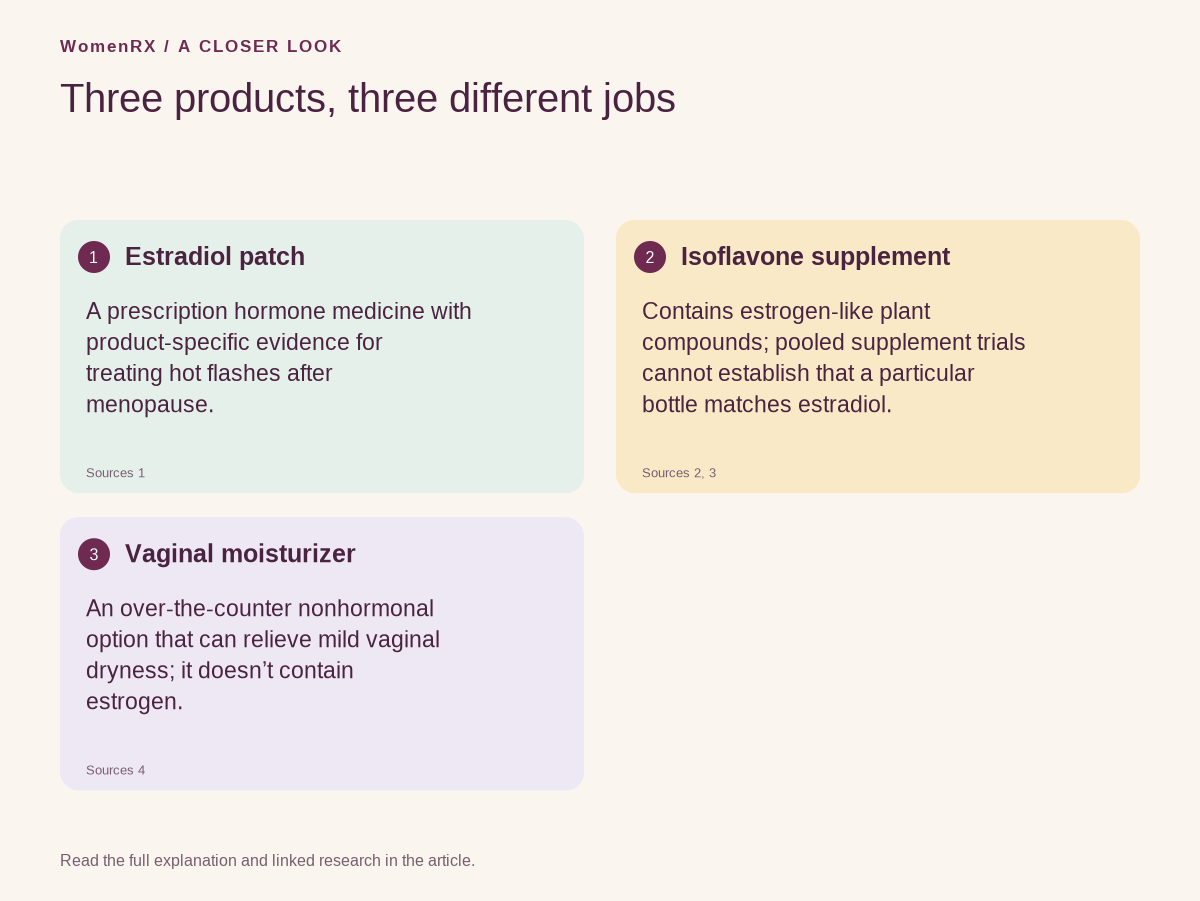
Three products, three different jobs
Estradiol patch: A prescription hormone medicine with product-specific evidence for treating hot flashes after menopause.1
Isoflavone supplement: Contains estrogen-like plant compounds; pooled supplement trials cannot establish that a particular bottle matches estradiol.23
Vaginal moisturizer: An over-the-counter nonhormonal option that can relieve mild vaginal dryness; it doesn’t contain estrogen.4
Read the figure as text
The name of the ingredient and the symptom it’s meant to address are more useful than a “strongest estrogen” claim.- Estradiol patch: A prescription hormone medicine with product-specific evidence for treating hot flashes after menopause.1
- Isoflavone supplement: Contains estrogen-like plant compounds; pooled supplement trials cannot establish that a particular bottle matches estradiol.23
- Vaginal moisturizer: An over-the-counter nonhormonal option that can relieve mild vaginal dryness; it doesn’t contain estrogen.4
More questions, answered
Does “phytoestrogen” mean a supplement contains estrogen?
No. Phytoestrogens are plant compounds, including some soy and red-clover isoflavones, that can interact with estrogen receptors. That interaction isn’t the same as containing estradiol, and it doesn’t establish equivalent symptom relief.12
Is an over-the-counter vaginal moisturizer an estrogen alternative?
It’s a nonhormonal option for a different, specific task: easing vaginal dryness. Moisturizers and lubricants can be enough for many women with mild symptoms; moderate to severe symptoms may call for a discussion of other treatments, including prescription vaginal estrogen.4
Sources you can check
- CLIMARA (ESTRADIOL) PATCH [BAYER HEALTHCARE PHARMACEUTICALS INC.] | US prescribing information and patient instructionsAccessed 2026-09-25Return to first citation
- Daidzein and Genistein: Natural Phytoestrogens with Potential Applications in Hormone Replacement Therapy.Intharuksa A, Arunotayanun W, Na Takuathung M, Chaichit S, Prasansuklab A, Chaikhong K, Sirichanchuen B, Chupradit S, Koonrungsesomboon N. · International journal of molecular sciences · 2025Return to first citation
- Efficacy of plant-derived dietary supplements in improving overall menopausal symptoms in women: An updated systematic review and meta-analysis.Oh MR, Park JH, Park SK, Park SH. · Phytotherapy research : PTR · 2024Return to first citation
- The 2020 genitourinary syndrome of menopause position statement of The North American Menopause Society.The NAMS 2020 GSM Position Statement Editorial Panel. · Menopause (New York, N.Y.) · 2020Return to first citation