DHEA for menopause: supplements and vaginal prasterone are not the same
The evidence for vaginal prasterone is tied to specific genitourinary symptoms, while oral DHEA has not been established as a treatment for general menopause symptoms or wellbeing.
DHEA products differ by route and purpose. Oral DHEA is studied as systemic supplementation, but current guidance does not support it as a treatment for sexual symptoms or general wellbeing. Vaginal prasterone is a prescription medicine approved in the United States for moderate to severe painful sex related to menopause changes; trials also find improvement in vaginal dryness. Its evidence does not automatically apply to oral products. 4 5 7
Start with the route, not the name
DHEA, or dehydroepiandrosterone, is a hormone precursor. The shared name can make very different products sound interchangeable: oral DHEA is studied as systemic supplementation, while vaginal prasterone is a medicine placed locally in the vagina. The evidence for one route cannot be assumed to apply to the other.
In the United States, vaginal prasterone is approved as a prescription treatment for moderate to severe painful sex related to vulvovaginal changes after menopause. It is not an oral product for energy, aging, or broad hormone balance. 7
What vaginal prasterone may help
After menopause, genitourinary syndrome of menopause can involve vaginal dryness, burning or itching, pain with sex, and urinary symptoms. The symptoms and their effects on sex and quality of life can differ from person to person. 2
The evidence for vaginal DHEA is focused on these local symptoms. A 2026 systematic review and meta-analysis included five unique randomized trials, with 1,611 postmenopausal participants. Compared with placebo, vaginal DHEA improved vaginal dryness and painful sex. Those findings support a possible option for these symptoms, not a promise that it will help everyone or address other menopause concerns. 4
A clinical practice guideline also describes prasterone as a local treatment that may be offered for painful sex and sexual function concerns related to genitourinary menopause symptoms. It distinguishes this from oral or transdermal DHEA, for which the guideline says current data are limited. 2
What oral DHEA can and cannot be said to do
Claims that oral DHEA reliably improves libido, energy, mood, or general wellbeing go beyond what current guidance supports. A 2025 position statement advises against oral DHEA as a systemic treatment and says evidence does not support it for sexual symptoms. 5
That conclusion is more cautious than a 2020 expert statement, which described possible benefits for several groups and conditions, including some women with sexual concerns or low bone density. Those broader possibilities should not be treated as proof that oral DHEA works for routine menopause symptoms: the newer position statement does not recommend systemic use, and the clinical guideline describes data for oral DHEA as limited. 1 2 5
So if a product is being considered for low energy, libido, or “anti-aging,” the key point is that evidence for vaginal prasterone does not establish benefits for those goals from oral DHEA. Vaginal trials studied a specific medicine, route, and symptom group. 4 5 7
Local use does not settle every safety question
In one study, researchers measured hormone levels in postmenopausal women using vaginal DHEA and found no biologically significant changes in the measured serum hormones over the first and seventh days. That short-term finding helps describe exposure; it does not establish long-term safety or mean that every person has the same risks. 3
Longer-term evidence has limits. The North American Menopause Society’s position statement noted that endometrial safety data for vaginal DHEA were lacking beyond one year, and that evidence was insufficient to confirm safety in women with breast cancer. 6 A separate guideline likewise says the safety of prasterone in women with a history of breast cancer cannot be established from current data. 2
If you have a history of breast cancer, that uncertainty matters when weighing a vaginal treatment. It is a different question from whether oral DHEA improves general wellbeing, and the evidence for one does not answer the other.
A practical way to sort a product claim
Check the route and the intended symptom first. If the product is oral, evidence about vaginal prasterone does not apply to it. If it is vaginal prasterone, the relevant evidence concerns postmenopausal genitourinary symptoms, especially dryness and painful sex. Then check whether the claim is about a symptom actually studied, rather than a broad promise about energy, libido, or aging. 4 5 7
For mild genitourinary symptoms, a 2020 North American Menopause Society statement says nonhormonal options such as lubricants and moisturizers provide sufficient relief for many women. It lists vaginal DHEA among effective options for moderate to severe symptoms, with treatment choice depending on symptom severity, safety considerations, and preference. 6 That gives you a more useful comparison than treating every product labeled DHEA as the same therapy.
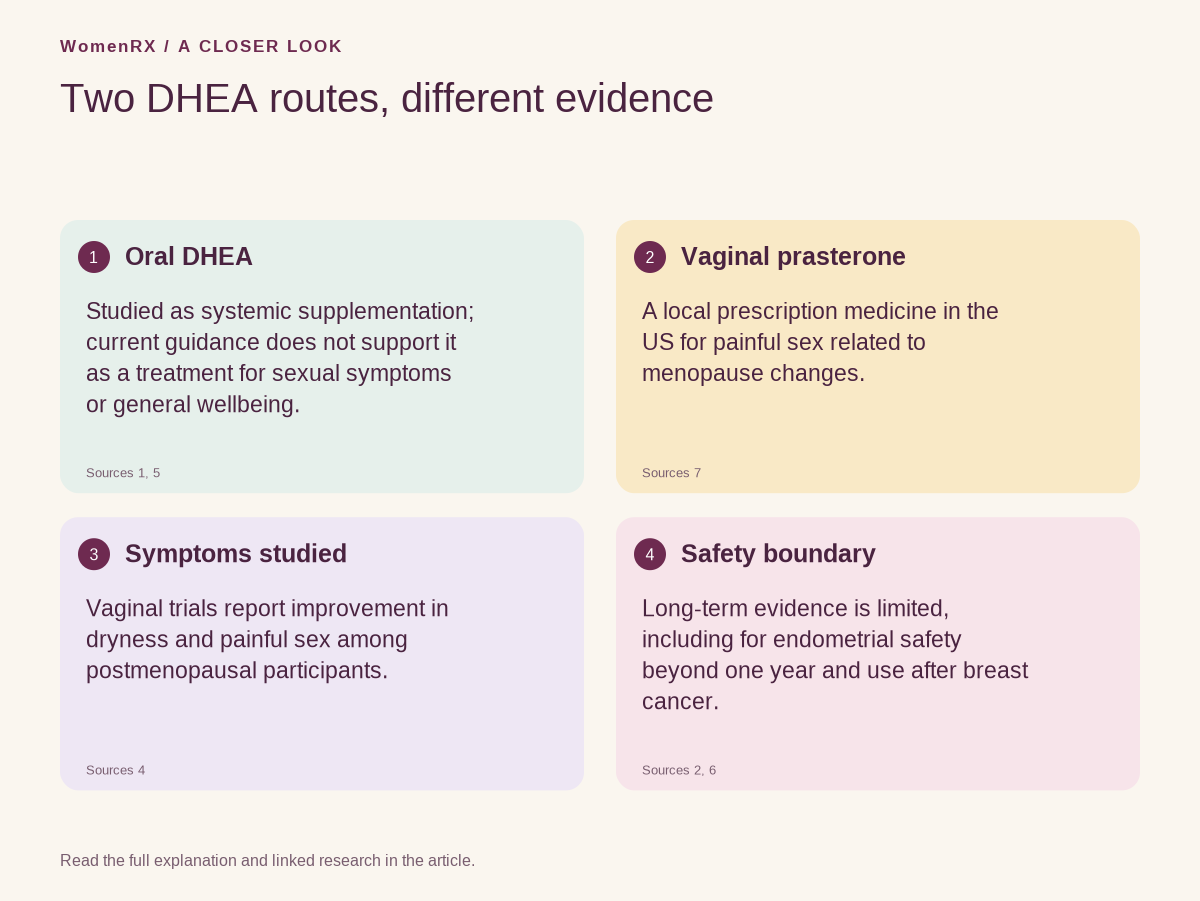
Two DHEA routes, different evidence
Oral DHEA: Studied as systemic supplementation; current guidance does not support it as a treatment for sexual symptoms or general wellbeing.15
Vaginal prasterone: A local prescription medicine in the US for painful sex related to menopause changes.7
Symptoms studied: Vaginal trials report improvement in dryness and painful sex among postmenopausal participants.4
Safety boundary: Long-term evidence is limited, including for endometrial safety beyond one year and use after breast cancer.26
Read the figure as text
The route and intended symptom determine which evidence applies; the products should not be treated as interchangeable.- Oral DHEA: Studied as systemic supplementation; current guidance does not support it as a treatment for sexual symptoms or general wellbeing.15
- Vaginal prasterone: A local prescription medicine in the US for painful sex related to menopause changes.7
- Symptoms studied: Vaginal trials report improvement in dryness and painful sex among postmenopausal participants.4
- Safety boundary: Long-term evidence is limited, including for endometrial safety beyond one year and use after breast cancer.26
More questions, answered
Does vaginal prasterone raise hormone levels throughout the body?
In one study of postmenopausal women using vaginal DHEA, researchers found no biologically significant changes in measured serum hormone levels over the first and seventh days. That short study does not answer every question about long-term exposure or safety. 3
Is vaginal prasterone established as safe after breast cancer?
The available guidance says safety cannot be established for women with a history of breast cancer. This is a specific evidence limitation, not proof that harm will occur. 2 6
Sources you can check
- Supplementation of dehydroepiandrosterone (DHEA) in pre- and postmenopausal women - position statement of expert panel of Polish Menopause and Andropause Society.Rabijewski M, Papierska L, Binkowska M, Maksym R, Jankowska K, Skrzypulec-Plinta W, Zgliczynski W. · Ginekologia polska · 2020Return to first citation
- [Genitourinary menopause syndrome. Postmenopausal women management: CNGOF and GEMVi clinical practice guidelines].Hocké C, Diaz M, Bernard V, Frantz S, Lambert M, Mathieu C, Grellety-Cherbero M. · Gynecologie, obstetrique, fertilite & senologie · 2021Return to first citation
- A low dose (6.5 mg) of intravaginal DHEA permits a strictly local action while maintaining all serum estrogens or androgens as well as their metabolites within normal values.Labrie F, Martel C. · Hormone molecular biology and clinical investigation · 2017Return to first citation
- Intravaginal dehydroepiandrosterone for the treatment of vulvovaginal atrophy: a systematic review and meta-analysis.Lemos MJ, Queiroz LF, Diniz AF, Longo da Silva CM, Dos Santos PL, de Oliveira Gomide P, Ferraz JM, De Marco Novellino AM. · Menopause (New York, N.Y.) · 2026Return to first citation
- Androgen therapy in midlife and older women: a position statement of the Latin American Association of Gynecological Endocrinology (ALEG).Pilnik S, Belardo A, Marchesan LB, Camero-Lascano A, Acuña-San Martín M, Elizalde-Cremonte A, Ojeda E, Manzur A, Chedraui P. · Climacteric : the journal of the International Menopause Society · 2025Return to first citation
- The 2020 genitourinary syndrome of menopause position statement of The North American Menopause Society.The NAMS 2020 GSM Position Statement Editorial Panel. · Menopause (New York, N.Y.) · 2020Return to first citation
- An overview of dehydroepiandrosterone (EM-760) as a treatment option for genitourinary syndrome of menopause.Holton M, Thorne C, Goldstein AT. · Expert opinion on pharmacotherapy · 2020Return to first citation