Does DHEA Affect Progesterone Levels or Menopause Symptoms?
DHEA can be converted into other sex steroids in tissues, but that pathway alone doesn’t show that it raises progesterone or eases menopause symptoms.
DHEA is a precursor that can be converted into sex steroids in body tissues, but that doesn’t establish that taking it predictably raises progesterone or improves menopause symptoms. In a small vaginal-DHEA study, differences in progesterone-receptor staining were not statistically significant. Researchers did not measure blood progesterone, so the study cannot tell us whether it changed. 2
A hormone pathway isn’t proof of a progesterone boost
DHEA is a building block the body can use to make other sex steroids. That makes it plausible that DHEA could affect hormone activity in some tissues. But a plausible pathway doesn’t tell you whether a particular DHEA product changes progesterone levels in your blood, how reliably it does so, or whether you would feel a difference.
The distinction matters because “progesterone activity” can refer to more than one thing. The amount of progesterone circulating in blood is not the same as how many progesterone receptors are present in a tissue, or how those receptors behave. Evidence of a local receptor change can’t, by itself, establish a change in blood progesterone or a symptom benefit.
What a small vaginal-DHEA study found
A prospective study followed 10 women ages 41 to 67 who used vaginal prasterone, a form of DHEA, for eight weeks. Researchers examined vaginal tissue before and after treatment. They reported differences in progesterone-receptor staining, including higher staining in stromal tissue and lower staining in epithelial tissue, but those differences were not statistically significant. The study also reported that blood DHEA-S and estradiol levels showed no statistically significant change. Researchers did not measure blood progesterone, so the study cannot establish whether it changed. 2
The study’s results about quality of life don’t establish symptom relief either: reported changes did not reach statistical significance. And vaginal prasterone acts locally; its findings shouldn’t be treated as proof that oral DHEA supplements have the same effects. 2
Does DHEA improve menopause symptoms?
This study is too small and too focused on tissue changes to show whether DHEA relieves common menopause symptoms such as hot flashes, or to establish a benefit for vaginal or urinary symptoms. It provides a look at possible local tissue effects, not a reliable estimate of how likely a person is to feel better.
Menopause symptoms happen during a period of changing hormone levels, but that doesn’t mean raising one hormone with a supplement will resolve them. Guidance on menopause care describes multiple treatment approaches; it also notes that findings for supplements and herbs are mixed and that long-term safety information is limited. That general caution is not specific evidence for or against DHEA. 1
How to assess a DHEA claim
If a product is described as “balancing progesterone,” look for the specific result behind the claim. Does the evidence measure progesterone in blood, a local tissue marker, or symptoms? Is it about vaginal prasterone or a swallowed supplement? And does it include people at a similar stage of menopause?
Those distinctions help keep a biochemical possibility separate from a useful clinical outcome. The small vaginal study does not establish that DHEA predictably raises progesterone or improves menopause symptoms. If your main concern is a particular symptom, focus on treatments studied for that symptom rather than assuming that a change in a hormone pathway will translate into relief.
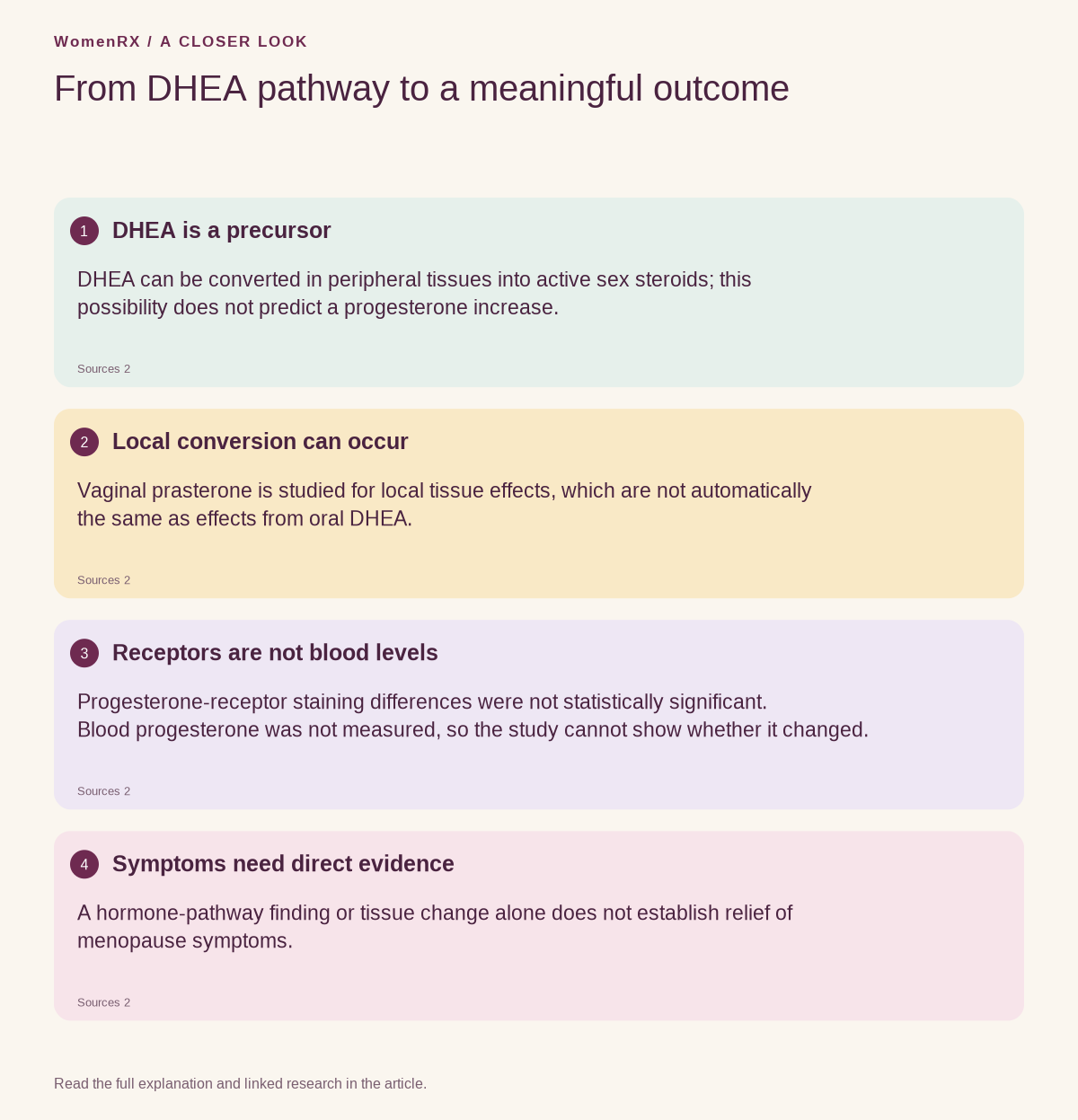
From DHEA pathway to a meaningful outcome
DHEA is a precursor: DHEA can be converted in peripheral tissues into active sex steroids; this possibility does not predict a progesterone increase.2
Local conversion can occur: Vaginal prasterone is studied for local tissue effects, which are not automatically the same as effects from oral DHEA.2
Receptors are not blood levels: Progesterone-receptor staining differences were not statistically significant. Blood progesterone was not measured, so the study cannot show whether it changed.2
Symptoms need direct evidence: A hormone-pathway finding or tissue change alone does not establish relief of menopause symptoms.2
Read the figure as text
The figure separates a proposed local hormone pathway from the measurements needed to show a change in progesterone or symptoms.- DHEA is a precursor: DHEA can be converted in peripheral tissues into active sex steroids; this possibility does not predict a progesterone increase.2
- Local conversion can occur: Vaginal prasterone is studied for local tissue effects, which are not automatically the same as effects from oral DHEA.2
- Receptors are not blood levels: Progesterone-receptor staining differences were not statistically significant. Blood progesterone was not measured, so the study cannot show whether it changed.2
- Symptoms need direct evidence: A hormone-pathway finding or tissue change alone does not establish relief of menopause symptoms.2
Sources you can check
- Menopause | Menopause Symptoms | MedlinePlusAccessed 2026-09-25Return to first citation
- Short-term vaginal prasterone therapy induces steroid receptor modulation and extracellular matrix remodeling in human vaginal mucosa.Tomczyk K, Yang-Jensen KC, Lorentzen LG, Chuang CY, Davies MJ, Kampioni M, Chmaj-Wierzchowska K, Wilczak M, Kędzia M. · Scientific reports · 2026Return to first citation