Can DHEA increase estrogen, and does that matter clinically?
DHEA supplements can raise average estradiol levels in postmenopausal women, but a lab change alone doesn’t show that symptoms will improve.
Yes. A meta-analysis of randomized trials in postmenopausal women found that DHEA supplementation raised average blood estradiol by about 7.9 pg/mL compared with control groups. That result doesn’t predict an individual response or prove a useful symptom benefit. Vaginal prasterone is a different treatment route, studied and recommended for certain vaginal symptoms, not as a general estrogen-raising supplement. 5 1
DHEA can contribute to the body’s production of sex steroids, including estrogen. But three questions often get blurred together: whether DHEA can affect estrogen production, whether a study measured higher estradiol in blood, and whether taking it improves a symptom that matters to you. The answer to the first two is yes, with qualifications. The third depends on the symptom and the product route. 5
A measurable rise isn’t the same as a treatment effect
A 2025 meta-analysis combined results from randomized trials in postmenopausal women. Across 17 trial arms reporting estradiol, DHEA supplementation raised blood estradiol by an average of 7.86 pg/mL compared with control (95% confidence interval 6.33 to 9.40). This is a group average, not a guaranteed change for each person. It also doesn’t establish a target level or show that the increase is large enough to improve symptoms. 5
The practical takeaway: a higher estradiol result is a biological change, not proof that DHEA treats hot flashes, sleep problems, low mood, or vaginal discomfort. The North American Menopause Society’s 2023 statement does not recommend supplements or herbal remedies for menopausal hot flashes. That recommendation is about symptom treatment, rather than whether a supplement can change a hormone measurement. 3
“DHEA” can mean different products
A daily DHEA supplement and vaginal prasterone may share the same underlying hormone, but they aren’t interchangeable treatments. Evidence about blood hormone levels after supplementation doesn’t establish what a vaginal product will do, and evidence for vaginal prasterone doesn’t establish that a supplement will help menopause symptoms.
Vaginal prasterone is considered for genitourinary symptoms of menopause, such as vaginal discomfort, when vaginal estrogen or nonhormonal moisturizers or lubricants haven’t worked or aren’t tolerated, according to NICE. 1 In a randomized, open-label trial of 172 naturally postmenopausal women with moderate or severe pain during sex, both vaginal DHEA and vaginal estradiol groups improved by 12 weeks. The study did not establish that vaginal DHEA is broadly better: estradiol improved several measured signs of vaginal tissue changes more. This trial concerns vaginal treatment for a specific symptom, not oral supplements or whole-body estrogen therapy. 4
Match the evidence to your reason for considering it
If you’re considering DHEA for hot flashes, the available guidance doesn’t support relying on supplements as an evidence-based treatment. Menopause guidance identifies hormone therapy as the most effective treatment for bothersome hot flashes, while other evidence-supported options are available for people who don’t want or can’t use it. 2 3
If vaginal symptoms are the concern, ask specifically about treatments for genitourinary symptoms, including vaginal estrogen, nonhormonal moisturizers or lubricants, and vaginal prasterone. These options have evidence and recommendations tied to that local symptom area. 1 2
If you’re thinking about a DHEA supplement because a blood test showed a low hormone level, ask what decision the test result is meant to guide. The trial meta-analysis tells us that average estradiol can rise; it doesn’t show that raising it improves a particular outcome or that pursuing a specific blood level is beneficial. 5
What about safety?
A hormone-level increase doesn’t by itself establish that a product is safe or appropriate for you. NICE cautions that the safety, quality, and purity of unregulated menopause preparations may be unknown. That makes the exact product and route relevant, especially when a supplement is being treated as a substitute for prescribed menopause care. 1
The clearest evidence-based distinction is this: DHEA supplementation can raise average estradiol in postmenopausal study participants, but that finding alone doesn’t demonstrate a useful menopause outcome. Vaginal prasterone has separate evidence and guidance for certain vaginal symptoms. Choose the question you need answered first, hormone measurement or symptom treatment, and evaluate the product against that goal.
DHEA: from hormone change to symptom question
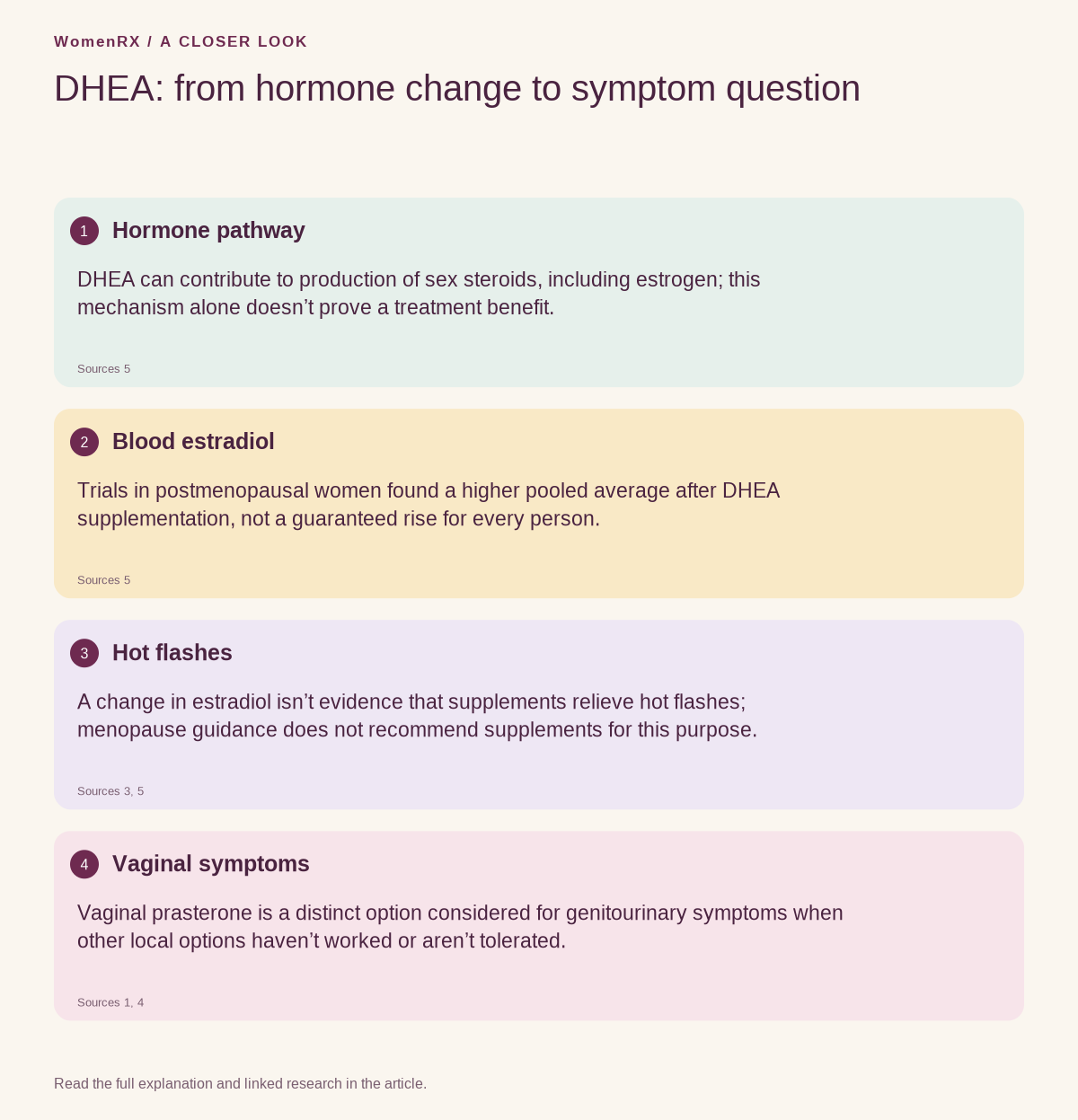
Hormone pathway: DHEA can contribute to production of sex steroids, including estrogen; this mechanism alone doesn’t prove a treatment benefit.5
Blood estradiol: Trials in postmenopausal women found a higher pooled average after DHEA supplementation, not a guaranteed rise for every person.5
Hot flashes: A change in estradiol isn’t evidence that supplements relieve hot flashes; menopause guidance does not recommend supplements for this purpose.35
Vaginal symptoms: Vaginal prasterone is a distinct option considered for genitourinary symptoms when other local options haven’t worked or aren’t tolerated.14
Read the figure as text
The key distinction is between a possible change in estrogen production, an average blood-test result, and evidence that a particular route helps a particular symptom.- Hormone pathway: DHEA can contribute to production of sex steroids, including estrogen; this mechanism alone doesn’t prove a treatment benefit.5
- Blood estradiol: Trials in postmenopausal women found a higher pooled average after DHEA supplementation, not a guaranteed rise for every person.5
- Hot flashes: A change in estradiol isn’t evidence that supplements relieve hot flashes; menopause guidance does not recommend supplements for this purpose.35
- Vaginal symptoms: Vaginal prasterone is a distinct option considered for genitourinary symptoms when other local options haven’t worked or aren’t tolerated.14
More questions, answered
Does a rise in estradiol mean DHEA will relieve hot flashes?
No. The meta-analysis measured hormone levels, not proof that the change relieved hot flashes. The North American Menopause Society does not recommend supplements or herbal remedies as treatment for menopausal hot flashes. 5 3
Is vaginal prasterone the same as taking a DHEA supplement?
No. Vaginal prasterone is used as a local treatment option for genitourinary symptoms of menopause. Evidence about vaginal treatment doesn’t establish the benefits of a daily supplement, or vice versa. 1 4
Sources you can check
- Recommendations | Menopause: identification and management | Guidance | NICEAccessed 2026-09-25Return to first citation
- The 2022 hormone therapy position statement of The North American Menopause Society.“The 2022 Hormone Therapy Position Statement of The North American Menopause Society” Advisory Panel. · Menopause (New York, N.Y.) · 2022Return to first citation
- The 2023 nonhormone therapy position statement of The North American Menopause Society.Menopause (New York, N.Y.) · 2023Return to first citation
- Effects of vaginal dehydroepiandrosterone and estradiol on dyspareunia, a symptom of vulvovaginal atrophy in postmenopausal women - a randomized controlled trial.Strandberg M, Cockin A, Hirschberg AL. · Maturitas · 2026Return to first citation
- Impact of DHEA supplementation on testosterone and estradiol levels in postmenopausal women: a meta-analysis of randomized controlled trials assessing dose and duration effects.He S, Lu K, Zhang L, Cao H, Tang X, Zhang X. · Diabetology & metabolic syndrome · 2025Return to first citation