Do Chia Seeds Change Estrogen or Menopause Symptoms?
A hormone result in rats doesn’t show that chia changes estrogen or eases menopause symptoms in women.
There’s no demonstrated menopause benefit in this research: the reproductive-hormone study was in rats, not women, and its abstract reports no estradiol result or menopause-symptom improvement. A menopause society statement also doesn’t recommend supplements and herbal remedies for hot flashes as a category, but that isn’t a chia-specific test. Treat claims that chia changes estrogen or relieves symptoms as unproven. 2 4
What a hormone result can, and can’t, tell you
A claim that a food “balances estrogen” can sound convincing when a study measured hormones. But three separate questions matter: who was studied, what changed, and whether anyone’s menopause symptoms improved. A hormone measurement in an animal study doesn’t answer all three for women.
The chia study related to female reproductive hormones involved 40 rats in an experiment on obesity-related ovarian dysfunction. One group received ground chia mixed into a high-fat diet for 10 weeks. Researchers measured estradiol along with other hormones. 2
The abstract reports increased luteinizing hormone and progesterone, but it doesn’t provide an estradiol result. It also doesn’t report whether chia changed hot flashes or other menopause symptoms in women. So this study can’t show that chia raises, lowers, or “balances” estrogen in perimenopause or after menopause. 2
What the human evidence does and doesn’t establish
A 2009 systematic review described the human evidence for chia’s effects as limited overall. That review was broad, not a menopause-specific assessment, and it doesn’t establish that chia improves menopause symptoms or changes estrogen in women. Because it’s an older review, it also can’t rule out research published later. 1
The North American Menopause Society’s 2023 nonhormone therapy statement lists supplements and herbal remedies among options not recommended for vasomotor symptoms, including hot flashes. That is a broad category-level recommendation, not a chia-specific clinical finding, and it shouldn’t be mistaken for a direct trial of chia as a food. 4
Taken together, these findings don’t support relying on chia to change estrogen or ease menopause symptoms. That’s different from proving chia has no effect; it means the results described don’t demonstrate a meaningful benefit for women going through menopause.
A quick way to assess the next claim
When you see a claim that chia affects hormones or menopause, check:
- Who was studied? Rats, adults generally, or women specifically in perimenopause or postmenopause?
- What outcome was reported? A hormone measurement, a general health marker, or a change in symptoms such as hot flashes?
- Was the change clinically useful? A lab result alone doesn’t show that someone felt better.
For hot flashes that are bothering you, menopause guidance distinguishes tested treatment options from broad food or supplement claims. The 2023 statement identifies options including cognitive behavioral therapy, clinical hypnosis, and certain prescription medicines; the 2022 statement describes hormone therapy as the most effective treatment for vasomotor symptoms, with benefits and risks depending on individual factors and treatment details. 3 4
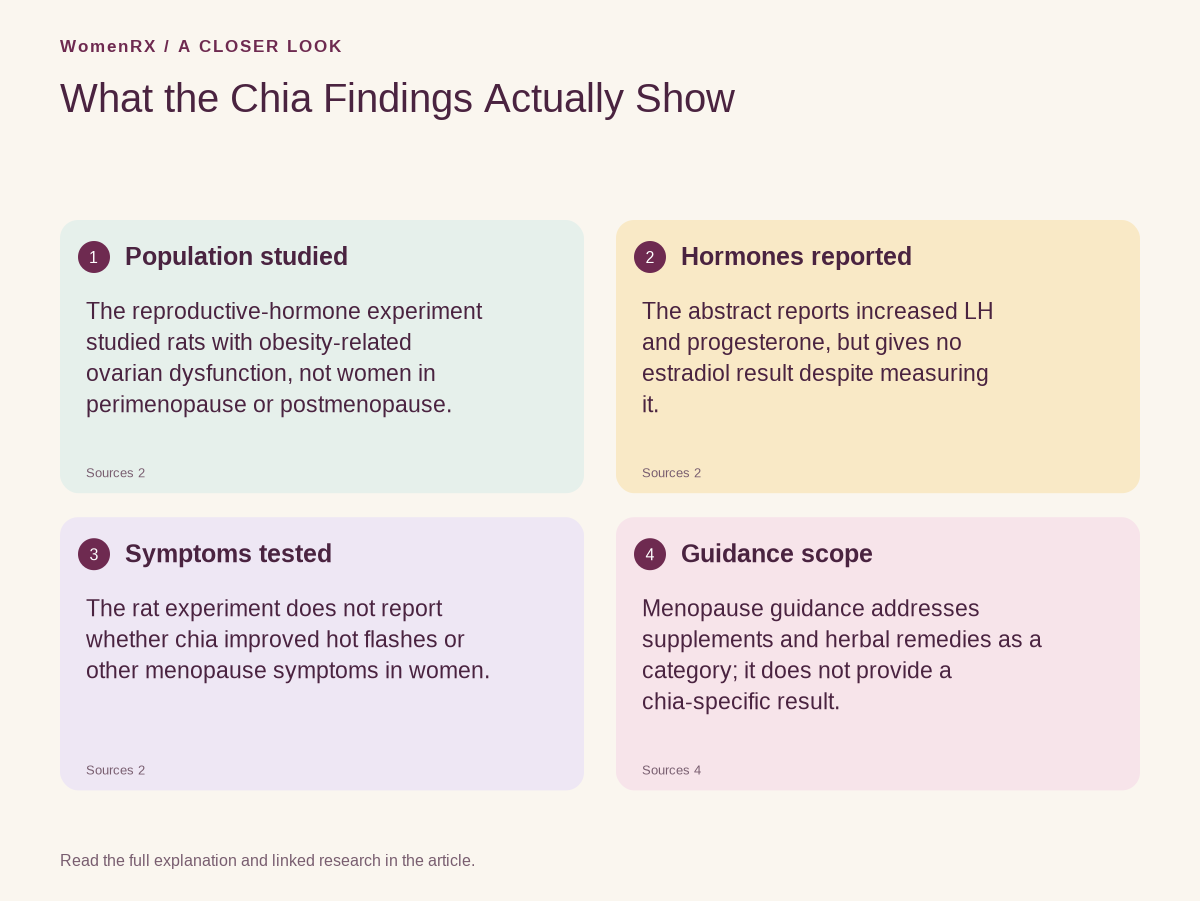
What the Chia Findings Actually Show
Population studied: The reproductive-hormone experiment studied rats with obesity-related ovarian dysfunction, not women in perimenopause or postmenopause.2
Hormones reported: The abstract reports increased LH and progesterone, but gives no estradiol result despite measuring it.2
Symptoms tested: The rat experiment does not report whether chia improved hot flashes or other menopause symptoms in women.2
Guidance scope: Menopause guidance addresses supplements and herbal remedies as a category; it does not provide a chia-specific result.4
Read the figure as text
Compare the study population and outcomes with the broader menopause guidance, without treating an animal hormone measurement as a demonstrated benefit for women.- Population studied: The reproductive-hormone experiment studied rats with obesity-related ovarian dysfunction, not women in perimenopause or postmenopause.2
- Hormones reported: The abstract reports increased LH and progesterone, but gives no estradiol result despite measuring it.2
- Symptoms tested: The rat experiment does not report whether chia improved hot flashes or other menopause symptoms in women.2
- Guidance scope: Menopause guidance addresses supplements and herbal remedies as a category; it does not provide a chia-specific result.4
Sources you can check
- Chia (Salvia hispanica): a systematic review by the natural standard research collaboration.Ulbricht C, Chao W, Nummy K, Rusie E, Tanguay-Colucci S, Iannuzzi CM, Plammoottil JB, Varghese M, Weissner W. · Reviews on recent clinical trials · 2009Return to first citation
- Protective effect of Salvia hispanica (chia seeds) against obesity induced ovarian disorders in rat model.FaragAllah EM, Algharib SA, Goda NIA, El-Malkey NF, Mahboub HH, El-Fayoumi SH, Al-Hoshani N, Wahid RM, Aref M. · Tissue & cell · 2023Return to first citation
- The 2022 hormone therapy position statement of The North American Menopause Society.“The 2022 Hormone Therapy Position Statement of The North American Menopause Society” Advisory Panel. · Menopause (New York, N.Y.) · 2022Return to first citation
- The 2023 nonhormone therapy position statement of The North American Menopause Society.Menopause (New York, N.Y.) · 2023Return to first citation