How Much Chia Seed Is Practical?
A smaller portion is an easier way to add chia’s fiber to meals without making a sudden change to your digestion.
Start with less than a full ounce if chia is new to you, then see how your digestion responds before adding more. An ounce of dried chia provides about 9.8 grams of fiber, 8.7 grams of fat, and 4.7 grams of protein. Mix it into a moist food or liquid, and increase fiber gradually to reduce the chance of gas and bloating.715
Think of chia as a fiber addition, not a protein serving
Chia can be a useful addition to breakfast or a snack, but the amount matters. USDA reference data puts one ounce of dried chia, 28.35 grams, at about 9.8 grams of fiber, 8.7 grams of fat, 4.7 grams of protein, and 138 calories. Half an ounce would provide roughly half those amounts. These are estimates for plain dried seeds, not a measurement of every brand or chia-based food.7
That makes chia more useful as a way to add fiber and fat than as the main protein in a meal. For example, if you stir it into yogurt, count the chia as an addition rather than assuming it supplies all the protein you want from breakfast. Its nutrient profile also doesn’t establish a weight-loss or hormone benefit for women.7
Choose a portion your gut can get used to
If you don’t usually eat much fiber, there’s no need to begin with a full ounce. Try a smaller amount mixed into a food you already eat, and give your digestion time to adjust before adding more. An ounce of chia contains nearly 10 grams of fiber, so it can be a noticeable jump. Increasing fiber too quickly can cause gas, bloating, and cramps.71
You can mix chia into oatmeal, yogurt, or a smoothie, or stir it into a liquid and let it thicken to a texture you like. That thickening happens because material at the seed’s surface forms a gum when it meets water. This explains what chia does in a bowl or glass; it doesn’t establish that a particular preparation treats constipation. Keep drinking fluids as part of your usual routine when you increase fiber.52
If chia leaves you uncomfortably bloated, adding more isn’t the answer. Scale back and consider how much fiber you’re getting from the rest of the meal, too. Persistent bloating, or bloating with blood in your stool or unintended weight loss, deserves medical attention rather than another food adjustment.14
If constipation is why you’re trying it
Eating fiber-rich foods and drinking fluids are general constipation self-care measures. A 2025 evidence-based guideline for adults with chronic constipation made recommendations for specific foods, including kiwifruit, prunes, and rye bread, but made no chia-specific recommendation. That distinction matters if you’re choosing a food because you need relief rather than simply wanting more variety in your diet.26
Also consider whether something else has changed. Medicines, including opioid pain medicines, can contribute to constipation. If your bowel habits change or you think a medicine is involved, ask about the cause before relying on chia or stopping a prescribed medicine. This is a question about the medicine and constipation, not a documented chia-medicine interaction.23
Pregnancy and breastfeeding are separate questions
Constipation is common during pregnancy and after giving birth. General measures such as changes to diet and activity may help, including during pregnancy, but that guidance doesn’t identify chia as a pregnancy-specific treatment or establish a special benefit for it.3
For breastfeeding, chia’s nutrient figures tell you what the seeds contain, not whether larger amounts or concentrated chia products have been studied during lactation. The constipation guidance here doesn’t provide a chia-specific breastfeeding recommendation either. If you’re considering a concentrated product or using chia to manage an ongoing digestive problem while breastfeeding, ask your care team about that specific use rather than treating a food-composition table as safety guidance.76
Adding chia without a sudden fiber jump
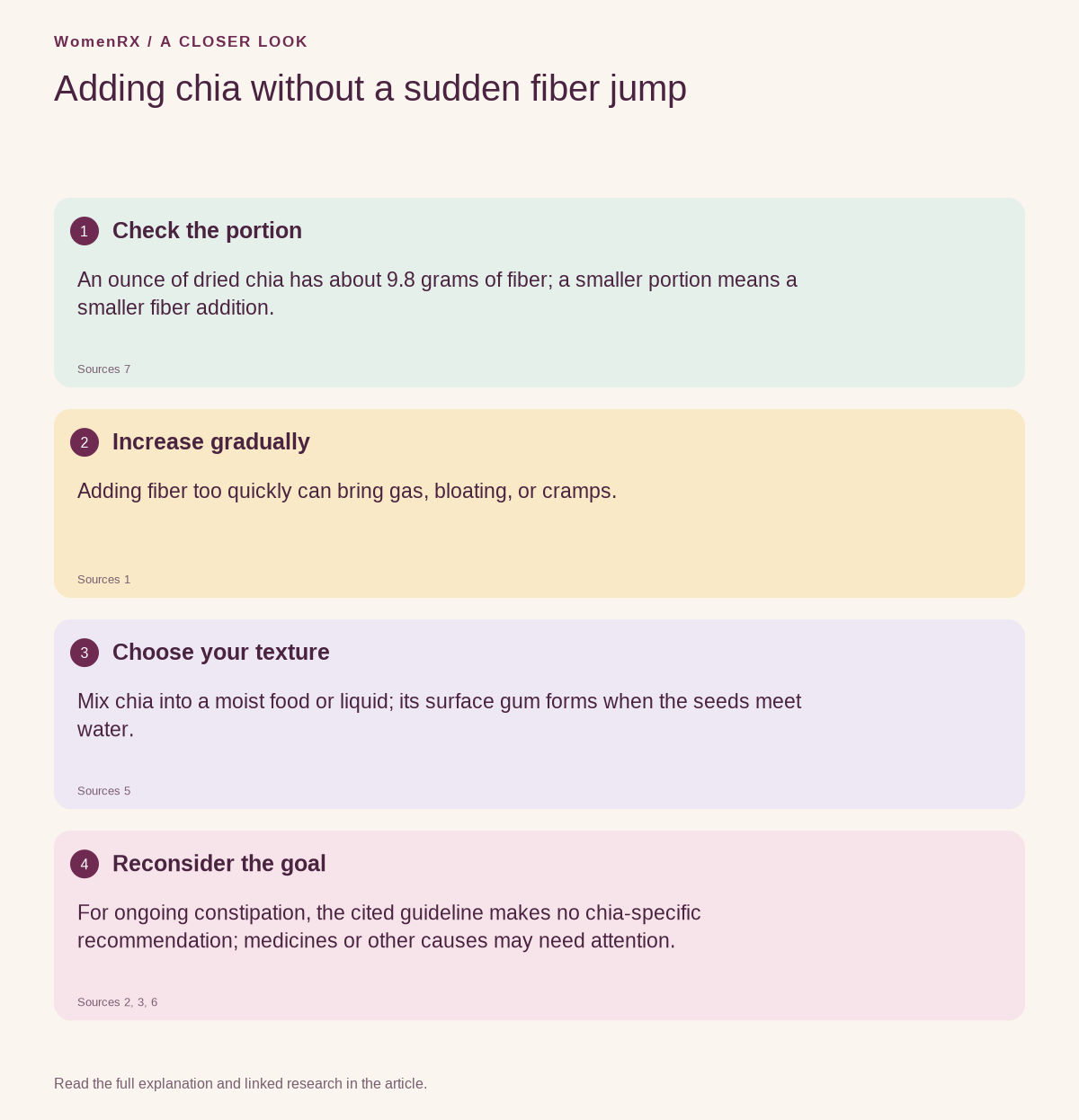
Check the portion: An ounce of dried chia has about 9.8 grams of fiber; a smaller portion means a smaller fiber addition.7
Increase gradually: Adding fiber too quickly can bring gas, bloating, or cramps.1
Choose your texture: Mix chia into a moist food or liquid; its surface gum forms when the seeds meet water.5
Reconsider the goal: For ongoing constipation, the cited guideline makes no chia-specific recommendation; medicines or other causes may need attention.236
Read the figure as text
Use these distinctions to choose a portion and a preparation that fit the meal and your digestion.- Check the portion: An ounce of dried chia has about 9.8 grams of fiber; a smaller portion means a smaller fiber addition.7
- Increase gradually: Adding fiber too quickly can bring gas, bloating, or cramps.1
- Choose your texture: Mix chia into a moist food or liquid; its surface gum forms when the seeds meet water.5
- Reconsider the goal: For ongoing constipation, the cited guideline makes no chia-specific recommendation; medicines or other causes may need attention.236
Sources you can check
- Dietary Fiber: MedlinePlusAccessed 2026-09-25Return to first citation
- Constipation | MedlinePlusAccessed 2026-09-25Return to first citation
- Constipation - NHSAccessed 2026-09-25Return to first citation
- Bloating - NHSAccessed 2026-09-25Return to first citation
- Chemical and Functional Properties of Chia Seed (Salvia hispanica L.) Gum.Segura-Campos MR, Ciau-Solís N, Rosado-Rubio G, Chel-Guerrero L, Betancur-Ancona D. · International journal of food science · 2014Return to first citation
- British Dietetic Association Guidelines for the Dietary Management of Chronic Constipation in Adults.Dimidi E, van der Schoot A, Barrett K, Farmer AD, Lomer MC, Scott SM, Whelan K. · Neurogastroenterology and motility · 2025Return to first citation
- USDA SR Legacy: Seeds, chia seeds, dried (FDC 170554)Accessed 2026-09-25Return to first citation