Can You Raise Estrogen Naturally? What Symptoms and Evidence Can Tell You
Food and lifestyle habits can support your health, but current evidence doesn’t establish them as reliable ways to restore estrogen to a therapeutic level.
There’s no established lifestyle method shown here to reliably raise estradiol to a therapeutic level. Soy compounds can act on estrogen receptors, but that doesn’t prove soy will raise your blood level or ease hot flashes. A review reports a measured estrogen change with one probiotic strain, but that narrow finding doesn’t establish a dependable treatment. Your next step depends on your symptoms, age, and menstrual pattern. 4 6
“Estrogen-like” doesn’t mean estrogen replacement
Soy, lentils, chickpeas, sesame, and some other plant foods contain phytoestrogens. These plant compounds can have estrogen-like activity, but that isn’t the same as showing they raise your own estradiol to a predictable or therapeutic level. 6
The distinction matters if you’re hoping to ease hot flashes. The North American Menopause Society’s 2023 position statement does not recommend soy foods or soy extracts for menopausal vasomotor symptoms. It also does not recommend supplements or herbal remedies for those symptoms. Those recommendations address symptom relief; they don’t establish that every product has been tested for its effect on blood estrogen. 4
A 2025 review reports increased circulating estrogen in a study of one specific probiotic strain over 12 weeks. That finding is not enough to conclude that probiotics generally raise estrogen, that the change is therapeutic, or that it relieves menopause symptoms. 6
Healthy eating and regular movement can still support your overall health. But a claimed estrogen boost isn’t a useful way to judge whether those habits are working, and they shouldn’t stand in for evaluation when low estrogen is suspected.
A test result needs the context around it
Estrogen levels can fluctuate during perimenopause. One estradiol result is therefore only a snapshot, not a complete explanation of symptoms or menstrual changes. 5
If your periods have stopped or become very irregular, the reason matters. Pregnancy, thyroid or other endocrine problems, medication use, chronic illness, stress, and changes in eating or exercise can all be part of an amenorrhea assessment. A clinical review describes evaluation that may include a pregnancy test and blood tests such as estradiol, follicle-stimulating hormone, prolactin, and thyroid-stimulating hormone. Which tests are useful depends on the situation. 2
In that review, secondary amenorrhea means periods have stopped for three months after previously regular cycles, or periods have been irregular for six months. If that describes you, or if missed periods come with symptoms that concern you, evaluation can help identify the cause rather than assuming it’s simply low estrogen. 2
The meaning of low estrogen changes with age
In your 40s or 50s, changing cycles and symptoms may be part of the menopausal transition, when reproductive hormone levels can vary. After menopause, low estrogen may be connected with symptoms such as hot flashes or vaginal and urinary changes. A test number alone doesn’t determine which treatment, if any, makes sense for you. 3 5
For bothersome hot flashes, menopause hormone therapy is the most effective treatment and has been shown to prevent bone loss. Its benefits and risks vary with factors such as age, time since menopause, treatment type, and whether a progestogen is used, so the decision is individualized. 3
If you’re younger than 40 and your periods have stopped or become irregular, premature ovarian insufficiency (POI) is one possibility to evaluate. POI means loss of ovarian function before age 40 and can have implications for fertility, bone health, and other aspects of health, not just hot flashes. 1
An American Family Physician review on amenorrhea states that people with POI benefit from hormone therapy until the average age of natural menopause. That recommendation for POI is different from decisions about symptom relief during typical midlife menopause. If POI may apply to you, relying on foods or supplements instead of finding out the cause could leave an important health question unanswered. 2
Match the next step to what you’re trying to address
If you’re focused on hot flashes, know that soy foods, soy extracts, supplements, and herbal remedies aren’t recommended for vasomotor symptoms in the NAMS position statement. The same statement identifies options with evidence for symptom relief, including cognitive behavioral therapy, clinical hypnosis, and certain prescription medicines. These treatments address symptoms; they aren’t ways to raise estrogen. 4
If vaginal or urinary symptoms are your main concern, the treatment question may be different from whether to raise estrogen throughout the body. For bothersome genitourinary symptoms that haven’t improved with over-the-counter therapies, the NAMS statement describes low-dose vaginal estrogen as an option for women without an indication for systemic hormone therapy. 3
If you’re trying to understand a low test result, consider it alongside your age, period pattern, symptoms, and relevant health or medication changes. The useful question isn’t only “How do I raise estrogen?” It’s also “What could be causing this result or these symptoms, and what outcome do I want treatment to improve?”
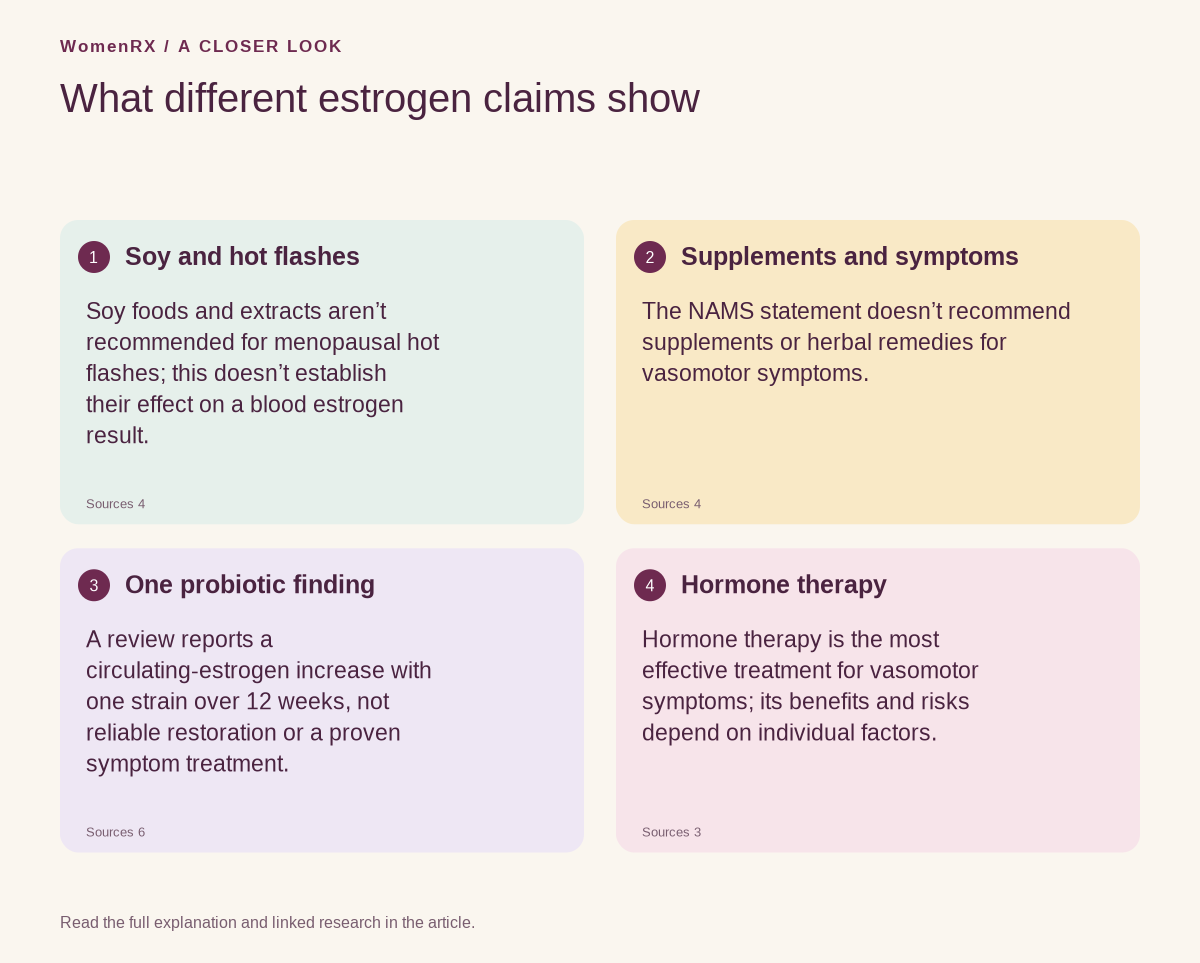
What different estrogen claims show
Soy and hot flashes: Soy foods and extracts aren’t recommended for menopausal hot flashes; this doesn’t establish their effect on a blood estrogen result.4
Supplements and symptoms: The NAMS statement doesn’t recommend supplements or herbal remedies for vasomotor symptoms.4
One probiotic finding: A review reports a circulating-estrogen increase with one strain over 12 weeks, not reliable restoration or a proven symptom treatment.6
Hormone therapy: Hormone therapy is the most effective treatment for vasomotor symptoms; its benefits and risks depend on individual factors.3
Read the figure as text
A reported symptom effect, a measured estrogen change, and a treatment for menopause symptoms are different kinds of evidence.- Soy and hot flashes: Soy foods and extracts aren’t recommended for menopausal hot flashes; this doesn’t establish their effect on a blood estrogen result.4
- Supplements and symptoms: The NAMS statement doesn’t recommend supplements or herbal remedies for vasomotor symptoms.4
- One probiotic finding: A review reports a circulating-estrogen increase with one strain over 12 weeks, not reliable restoration or a proven symptom treatment.6
- Hormone therapy: Hormone therapy is the most effective treatment for vasomotor symptoms; its benefits and risks depend on individual factors.3
More questions, answered
Can soy raise estrogen enough to stop hot flashes?
Soy contains isoflavones with estrogen-like activity, but the North American Menopause Society does not recommend soy foods or soy extracts for menopausal hot flashes. Estrogen-like activity doesn’t show that soy restores estradiol or reliably relieves symptoms. 4 6
Does a low estradiol test mean I need hormone therapy?
Not by itself. The result needs to be understood alongside your age, menstrual pattern, symptoms, and possible other causes. Hormone therapy can be effective for hot flashes, but its benefits and risks vary by individual factors. 2 3
Sources you can check
- Premature ovarian insufficiency diagnosis and management in general practice: A review based on the 2024 international guideline.Vincent AJ, Ee C. · Australian journal of general practice · 2026Return to first citation
- Amenorrhea: A Practical Approach to Diagnosis and Management.Klein DA, Sylvester JE, Paradise SL. · American family physician · 2026Return to first citation
- The 2022 hormone therapy position statement of The North American Menopause Society.“The 2022 Hormone Therapy Position Statement of The North American Menopause Society” Advisory Panel. · Menopause (New York, N.Y.) · 2022Return to first citation
- The 2023 nonhormone therapy position statement of The North American Menopause Society.Menopause (New York, N.Y.) · 2023Return to first citation
- Estrogen and Metabolism: Navigating Hormonal Transitions from Perimenopause to Postmenopause.Patel P, Patil S, Kaur N. · Journal of mid-life health · 2025Return to first citation
- Natural strategies to optimize estrogen levels in aging women: mini review.Bolgova O, Shypilova I, Mavrych V. · Frontiers in aging · 2025Return to first citation