Does Estrogen Have a Smell? What Vaginal Odor Can Tell You
A new odor may seem connected to vaginal estrogen, but accompanying symptoms matter more than the smell alone.
There isn’t a particular vaginal smell you can use to identify estrogen or judge your estrogen level. If you use vaginal estrogen, first consider whether you’re noticing the product itself or a change in vaginal odor. A strong fishy odor with changed discharge can occur with bacterial vaginosis (BV), but smell alone can’t diagnose it. Unusual discharge or suspected BV is worth having assessed. 1 2 4
First, separate the product from the symptom
If you’ve recently started vaginal estrogen and notice a smell, ask yourself where you notice it. Is it when you open or use the product, or is it a new vaginal odor at other times too? That distinction won’t give you a diagnosis, but it gives a pharmacist or prescriber a more useful description than “estrogen smells different.”
Vaginal estrogen is a medicine used for menopause-related dryness and irritation. It comes in several forms, including creams, gels, tablets, and rings. The form you use matters when you describe what you’ve noticed. For example, if the concern arises only while handling a cream, that’s a different question from an odor you notice throughout the day along with a change in discharge. Don’t assume either one tells you how much estrogen is in your body. 2
Estrogen levels fall during the menopause transition, and dryness or irritation can follow. Vaginal estrogen treats those symptoms locally; it isn’t a way to treat an unexplained odor. If dryness or irritation is your main concern, vaginal moisturizers or lubricants may also help. For bothersome menopause-related vaginal symptoms that aren’t relieved by over-the-counter options, the North American Menopause Society includes low-dose vaginal estrogen among the recommended treatments. 2 3 5
What a fishy odor can mean, and what it can’t
BV is a change in the balance of vaginal bacteria. It can cause a strong fishy odor, particularly after sex, and discharge that becomes thin, watery, or grayish-white. BV doesn’t usually cause soreness or itching. It’s not classified as a sexually transmitted infection, and it can occur even if you haven’t had sex. 1
That symptom pattern is a reason to consider BV, not a way to confirm it. In a study of 2,888 women attending health department clinics, 75% of those with BV and 82% of those without BV said they had noticed no vaginal odor in the previous six months. The study wasn’t specific to women in perimenopause or after menopause. Its practical lesson is straightforward: having an odor doesn’t prove BV, and having no odor doesn’t rule it out. 4
Timing can help you describe the change, too. For example, an odor you notice mainly after sex, together with new discharge, is different from one you notice only when opening a vaginal product. Neither observation establishes the cause. It does help you explain what’s happening if you seek care.
When to have it checked
If your discharge has changed, you think you may have BV, or the odor is new and continues to concern you, arrange an assessment rather than choosing a treatment by smell. A clinician can ask about your symptoms and may take a sample of discharge to check for BV and other infections. That matters because an odor that seems familiar isn’t enough to distinguish BV from another cause. If BV is confirmed, it may need antibiotic treatment. 1
Mention any vaginal estrogen or other vaginal product you use, when you started it, and whether you’ve noticed discharge, dryness, irritation, or soreness. These details help separate a question about the product from a vaginal symptom that needs evaluation. If you’re pregnant and think you may have BV, seek assessment, since treatment can matter during pregnancy. 1
You don’t need to find the perfect word for the smell. The useful next move is to describe when it began and what else changed, then get unusual discharge or suspected BV checked instead of assuming estrogen is the cause.
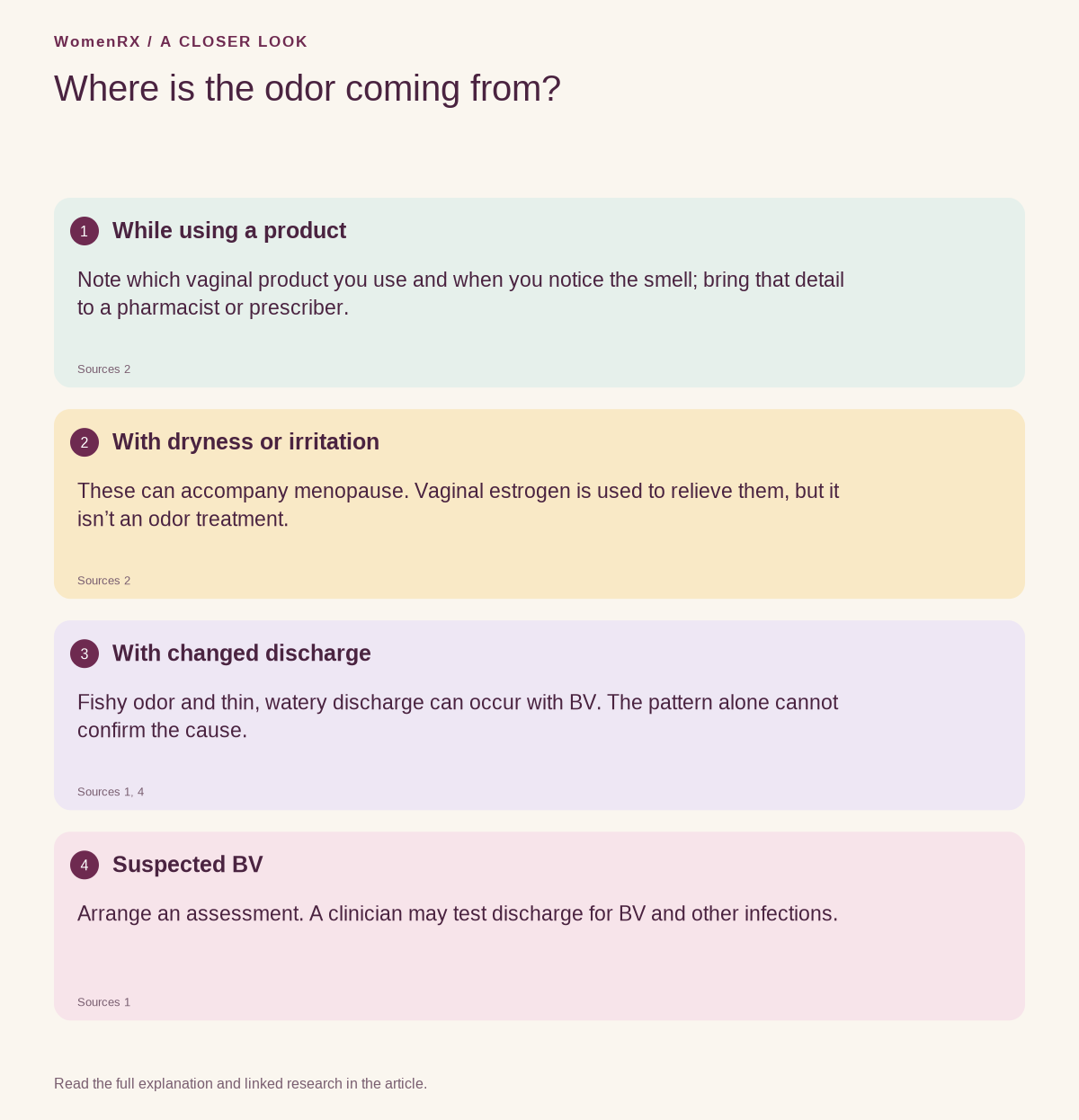
Where is the odor coming from?
While using a product: Note which vaginal product you use and when you notice the smell; bring that detail to a pharmacist or prescriber.2
With dryness or irritation: These can accompany menopause. Vaginal estrogen is used to relieve them, but it isn’t an odor treatment.2
With changed discharge: Fishy odor and thin, watery discharge can occur with BV. The pattern alone cannot confirm the cause.14
Suspected BV: Arrange an assessment. A clinician may test discharge for BV and other infections.1
Read the figure as text
Start with when you notice the smell, then consider other symptoms. This is a guide to describing the change, not a diagnostic test.- While using a product: Note which vaginal product you use and when you notice the smell; bring that detail to a pharmacist or prescriber.2
- With dryness or irritation: These can accompany menopause. Vaginal estrogen is used to relieve them, but it isn’t an odor treatment.2
- With changed discharge: Fishy odor and thin, watery discharge can occur with BV. The pattern alone cannot confirm the cause.14
- Suspected BV: Arrange an assessment. A clinician may test discharge for BV and other infections.1
More questions, answered
Could I have BV without a noticeable odor?
Yes. BV can occur without noticeable symptoms, and odor by itself is an unreliable way to identify it. If you have a change in discharge or another reason to suspect BV, an assessment can help establish the cause. 1 4
Will vaginal estrogen clear up BV?
Vaginal estrogen is used for menopause-related dryness and irritation, not to treat BV. BV may need antibiotic treatment after assessment. 1 2
Sources you can check
- Bacterial vaginosis - NHSAccessed 2026-09-25Return to first citation
- About vaginal oestrogen - NHSAccessed 2026-09-25Return to first citation
- Common questions about vaginal oestrogen - NHSAccessed 2026-09-25Return to first citation
- Vulvovaginal symptoms in women with bacterial vaginosis.Klebanoff MA, Schwebke JR, Zhang J, Nansel TR, Yu KF, Andrews WW. · Obstetrics and gynecology · 2004Return to first citation
- The 2022 hormone therapy position statement of The North American Menopause Society.“The 2022 Hormone Therapy Position Statement of The North American Menopause Society” Advisory Panel. · Menopause (New York, N.Y.) · 2022Return to first citation