What “Estrogen Dominance” Does and Doesn’t Tell You
The phrase may describe a hormone-related theory, but your symptoms and life stage are more useful starting points than the label.
“Estrogen dominance” doesn’t, by itself, tell you whether your blood estradiol is high or whether you have endometriosis. Researchers sometimes use similar language to describe estrogen activity within a particular tissue, including endometriosis lesions, which is a different claim. If the phrase came up because of pain, changing periods, or bleeding after menopause, the useful next question is what needs explaining in that specific situation. 357
A hormone label can hide different questions
If someone has called your symptoms “estrogen dominance,” ask what they mean. Are they suggesting a high blood level of estradiol, too little progesterone, or a condition in which tissue responds to hormones differently? Those aren’t interchangeable explanations. The phrase alone doesn’t establish which, if any, applies to you.
There’s a reason the wording can sound convincing. Hormones do affect reproductive tissues. But a tissue’s response isn’t necessarily a readout of the hormone level in your blood. In endometriosis research, for example, “local estrogen dominance” and resistance to progesterone describe processes associated with endometriosis tissue. They don’t mean that pelvic pain proves a person has excess circulating estrogen. Endometriosis-associated pain also involves inflammation and changes in how nerves process pain. 35
Fibroids offer another reason to be wary of a simple “too much estrogen, not enough progesterone” story. A review describes roles for both estradiol and progesterone in fibroid growth and tissue response. That biology can help researchers study fibroids; it cannot tell you from a symptom alone that you have fibroids or that lowering one hormone is the answer. 6
Start with the concern, not a hormone ratio
Consider three examples of what someone might mean when they use the label:
- Pelvic pain: The question is what could be causing the pain. Endometriosis is one condition with hormone-related biology, but its pain mechanisms extend beyond hormones, and pain severity may not match the amount of visible disease. Even if pain is severe, a claimed estrogen-to-progesterone imbalance cannot tell you whether endometriosis is the cause. 5
- Periods that have changed: The change itself needs a description: what’s different about the timing or bleeding, and whether you’re still having periods. In the reproductive years and during the transition toward menopause, don’t treat the phrase “estrogen dominance” as an explanation before the change has been considered on its own. The phrase does not show that fibroids or endometriosis caused the change. 36
- Bleeding after menopause: This is not a situation to file under a hormone nickname. Unusual vaginal bleeding after menopause should be checked for its cause. For persistent or recurring unexplained bleeding, evaluation may include sampling the uterine lining when indicated. 17
Pelvic pain, changing periods, and bleeding after menopause are different concerns, even if someone uses the same label for all three. Bleeding after menopause needs its cause checked; persistent or recurring unexplained bleeding may require uterine-lining sampling when indicated. 17
What a hormone test can, and can’t, settle
A lab result needs a defined question. For postmenopausal women managing moderate to severe hot flashes, estradiol and follicle-stimulating hormone (FSH) blood levels have not been shown to be useful for guiding that management. That is a narrow finding about that situation, not a rule that hormone tests are never useful. It also isn’t evidence that an estradiol-to-progesterone ratio can diagnose the cause of pelvic pain or changing periods. 12
The same distinction applies to treatment. Menopausal hormone therapy is discussed and studied for specific menopausal concerns, including hot flashes; a trial of an estradiol-and-progesterone product assessed relief of those symptoms in postmenopausal women. That does not establish hormone therapy as a treatment for the label “estrogen dominance.” 14
You don’t have to dismiss symptoms to set aside an imprecise explanation. A more useful conversation names the symptom, when it occurs, and whether it involves periods, pelvic pain, menopausal symptoms, or bleeding after menopause. That gives you a question someone can actually assess, rather than a hormone label you’re expected to accept.
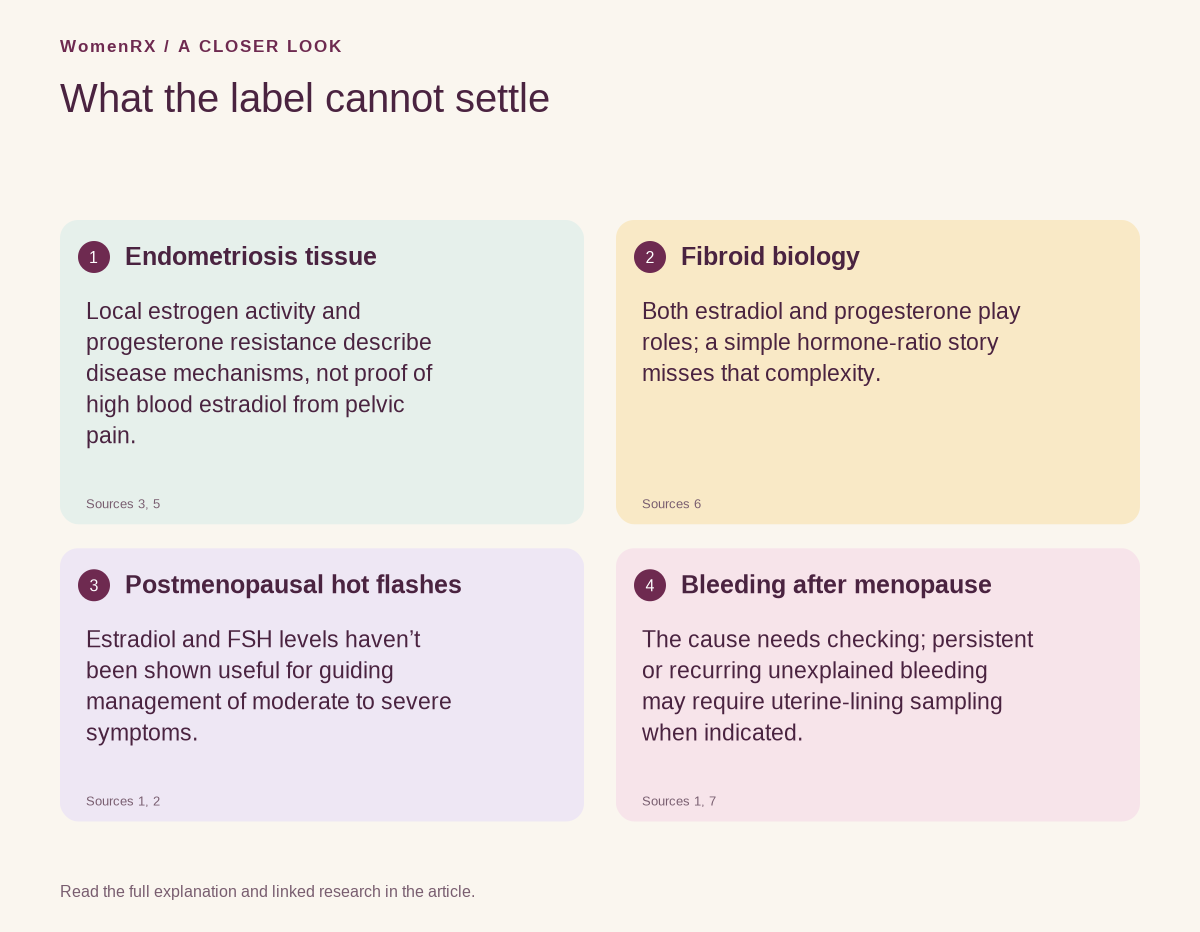
What the label cannot settle
Endometriosis tissue: Local estrogen activity and progesterone resistance describe disease mechanisms, not proof of high blood estradiol from pelvic pain.35
Fibroid biology: Both estradiol and progesterone play roles; a simple hormone-ratio story misses that complexity.6
Postmenopausal hot flashes: Estradiol and FSH levels haven’t been shown useful for guiding management of moderate to severe symptoms.12
Bleeding after menopause: The cause needs checking; persistent or recurring unexplained bleeding may require uterine-lining sampling when indicated.17
Read the figure as text
The same phrase can point toward different questions; each needs its own context.- Endometriosis tissue: Local estrogen activity and progesterone resistance describe disease mechanisms, not proof of high blood estradiol from pelvic pain.35
- Fibroid biology: Both estradiol and progesterone play roles; a simple hormone-ratio story misses that complexity.6
- Postmenopausal hot flashes: Estradiol and FSH levels haven’t been shown useful for guiding management of moderate to severe symptoms.12
- Bleeding after menopause: The cause needs checking; persistent or recurring unexplained bleeding may require uterine-lining sampling when indicated.17
More questions, answered
Does “progesterone resistance” mean I need progesterone?
Not on its own. In endometriosis research, progesterone resistance describes how affected tissue may respond; it isn’t a treatment instruction for everyone with pelvic pain. Progesterone also has a role in fibroid biology, so “more progesterone” isn’t a conclusion you can draw from the phrase alone. 36
Sources you can check
- BIJUVA (ESTRADIOL AND PROGESTERONE) CAPSULE [MAYNE PHARMA] | US prescribing information and patient instructionsAccessed 2026-09-25Return to first citation
- CLIMARA PRO (ESTRADIOL AND LEVONORGESTREL) PATCH [BAYER HEALTHCARE PHARMACEUTICALS INC.] | US prescribing information and patient instructionsAccessed 2026-09-25Return to first citation
- Endometriosis-associated infertility: Multi-omics insights into pathogenesis and precision therapeutics.Ou Y, Wang H, Zhou C, Chen Y, Lyu J, Feng M, Huang X. · Frontiers in endocrinology · 2025Return to first citation
- European society of endocrinology clinical practice guideline for evaluation and management of menopause and the perimenopause.Lumsden MA, Dekkers OM, Faubion SS, Lindén Hirschberg A, Jayasena CN, Lambrinoudaki I, Louwers Y, Pinkerton JV, Sojat AS, van Hulsteijn L. · European journal of endocrinology · 2025Return to first citation
- Endometriosis-associated Pain: Mechanism, Neuroimmune Signature, and Translational Precision Strategies.Omenge HJ, Kempa PA, Jeong JW, So KA, Kim TH. · Endocrine reviews · 2026Return to first citation
- The Gut Microbiota: a Novel Player in the Pathogenesis of Uterine Fibroids.K VK, Bhat RG, Rao BK, R AP. · Reproductive sciences (Thousand Oaks, Calif.) · 2023Return to first citation
- DOTTI (ESTRADIOL) PATCH, EXTENDED RELEASE [BRYANT RANCH PREPACK] | US prescribing information and patient instructionsAccessed 2026-09-25Return to first citation