Is “Estrogen Dominance” a Medical Diagnosis?
The phrase can point to a real hormone-related concern, but your symptoms and life stage tell you more than the label alone.
“Estrogen dominance” alone doesn’t identify a specific condition or tell you what’s causing your symptoms. Some healthcare providers use it to mean unopposed estrogen: estrogen acting on the uterine lining without enough progesterone to balance that effect. Testing and treatment are most useful when they address an identified cause or clinical goal, such as changed bleeding, menopause symptoms, or difficulty conceiving. 7142
A useful term needs a specific meaning
“Estrogen dominance” alone doesn’t identify a specific condition. Some healthcare providers use it to describe the specific situation called unopposed estrogen, while researchers also use it to describe local hormone activity in endometriosis. Hearing the phrase alone doesn’t tell you which concern applies to you. 76
Estrogen and progesterone both affect the lining of the uterus. Progesterone changes how that lining responds after estrogen has stimulated its growth. When estrogen’s effect on the lining isn’t adequately opposed by progesterone, clinicians may use the term unopposed estrogen. Cleveland Clinic notes that some healthcare providers call this “estrogen dominance.” That’s a more specific idea than using the phrase to explain every symptom attributed to hormones. 27
There’s an important distinction if you’ve encountered the phrase while reading about endometriosis. Researchers sometimes use local estrogen dominance to describe estrogen activity within endometriosis lesions, alongside reduced responsiveness to progesterone. That tissue-level mechanism doesn’t mean a blood test will show high estrogen. An endometriosis review notes that circulating estrogen levels are not significantly altered in patients with the condition. It also describes endometriosis-related infertility as involving several processes, not one hormone level. 6
So if someone tells you that you have estrogen dominance, it’s reasonable to ask: Do they mean a finding about your uterine lining, a concern about a medicine, a particular condition, or simply a possible explanation for symptoms? The answer changes what information is useful next.
Start with the symptom, not a hormone ratio
A changed period has several possible explanations. Irregular cycles are more likely as menopause approaches, but pregnancy, hormonal contraception, substantial weight change, stress, heavy exercise, and thyroid problems can also be relevant. A missed period may be an early sign of pregnancy. A change in your usual bleeding pattern deserves attention rather than an automatic “high estrogen” explanation. 1
For example, if periods have become unpredictable and you’re trying to conceive, the question may be whether you’re ovulating regularly. In an infertility assessment, a progesterone blood test can help check for ovulation, and its timing depends on how regular your periods are. That’s a targeted use of hormone testing, not a test for a general estrogen-to-progesterone “balance.” 14
If you have bleeding between periods, periods that last longer than seven days, or irregular periods alongside difficulty getting pregnant, arrange a medical assessment. 1 Any bleeding after menopause needs assessment, even if it’s a small amount or happens only once. There are several possible causes, and the bleeding pattern alone can’t establish which one applies. 8 If you take the estradiol-and-progesterone medicine BIJUVA after menopause, its prescribing information also says to report any vaginal bleeding as soon as possible. 2
Why one hormone result may not settle it
Estrogen rises and falls across the menstrual cycle and rises substantially during pregnancy. A blood result from someone who has periods therefore needs context: where she is in her cycle, whether pregnancy is possible, and whether she’s taking hormones. Cleveland Clinic notes that natural cycle fluctuations can make an estrogen blood test difficult to interpret on its own. 7
Medication matters, too. Hormonal contraception can change bleeding patterns, while menopausal hormone therapy supplies hormones as treatment. If you have a uterus and use systemic estrogen for menopause symptoms, a progestogen is generally included to protect the uterine lining. That is a defined treatment decision, not evidence that everyone with symptoms needs to lower estrogen. 153
After menopause, testing has a different limitation. Estradiol and follicle-stimulating hormone blood levels have not been shown to be useful for managing moderate to severe hot flashes in postmenopausal women. The symptoms and treatment response matter more for that particular decision. This doesn’t mean hormone tests are never useful; it means a test should answer a specific question. 2
Turn the label into a clearer conversation
You don’t need to solve a hormone puzzle before describing what’s happening. Be specific about what changed: whether bleeding is heavier, longer, between periods, or occurring after menopause; whether you’ve missed a period; and whether hot flashes or difficulty conceiving are the main concern. Mention contraception, menopausal hormone therapy, and other medicines you use. Those details can separate a possible medicine effect from a cycle change or a condition that needs assessment. 1248
Then ask what “estrogen dominance” is meant to explain in your case and whether a proposed test or treatment would change the next step. Treatment depends on the identified concern, not the label alone. Irregular bleeding calls for attention to its pattern and possible causes; bleeding after menopause needs assessment even once. For moderate to severe hot flashes after menopause, a hormone number may add little to treatment decisions. If the concern is fertility, a properly timed test for ovulation may answer a more useful question. 1824
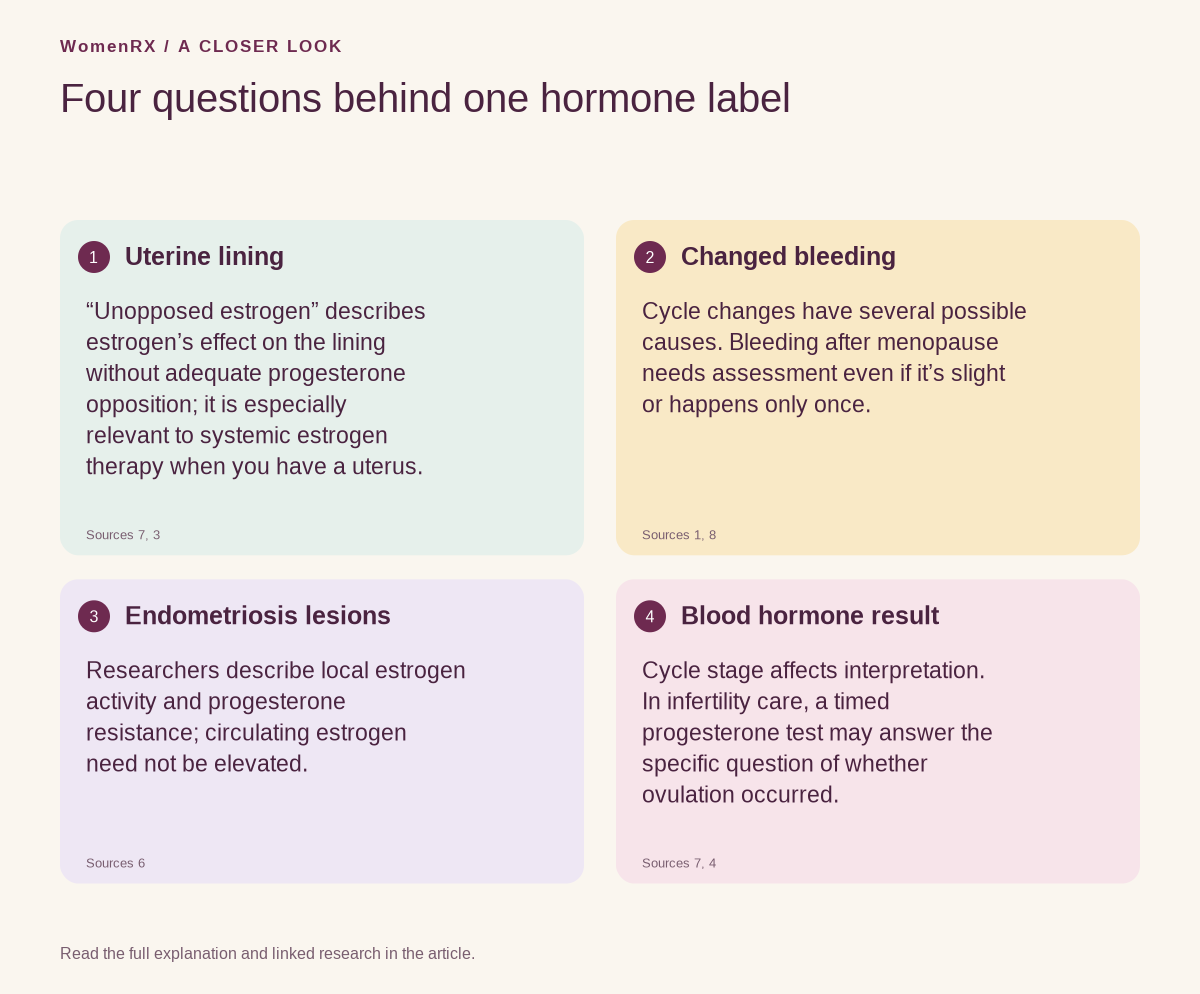
Four questions behind one hormone label
Uterine lining: “Unopposed estrogen” describes estrogen’s effect on the lining without adequate progesterone opposition; it is especially relevant to systemic estrogen therapy when you have a uterus.73
Changed bleeding: Cycle changes have several possible causes. Bleeding after menopause needs assessment even if it’s slight or happens only once.18
Endometriosis lesions: Researchers describe local estrogen activity and progesterone resistance; circulating estrogen need not be elevated.6
Blood hormone result: Cycle stage affects interpretation. In infertility care, a timed progesterone test may answer the specific question of whether ovulation occurred.74
Read the figure as text
“Estrogen dominance” does not identify a single concern on its own. These distinctions show why bleeding patterns, medicines, and the purpose of a test matter.- Uterine lining: “Unopposed estrogen” describes estrogen’s effect on the lining without adequate progesterone opposition; it is especially relevant to systemic estrogen therapy when you have a uterus.73
- Changed bleeding: Cycle changes have several possible causes. Bleeding after menopause needs assessment even if it’s slight or happens only once.18
- Endometriosis lesions: Researchers describe local estrogen activity and progesterone resistance; circulating estrogen need not be elevated.6
- Blood hormone result: Cycle stage affects interpretation. In infertility care, a timed progesterone test may answer the specific question of whether ovulation occurred.74
More questions, answered
Does a normal estrogen blood result rule out an estrogen-related condition?
Not necessarily. Estrogen results need context, including cycle stage and hormone medicine use. In endometriosis, researchers describe estrogen activity within lesions even though circulating estrogen levels are not significantly altered. A blood result cannot, on its own, settle every question about how a tissue responds to hormones. 76
Sources you can check
- Irregular periods - NHSAccessed 2026-09-25Return to first citation
- BIJUVA (ESTRADIOL AND PROGESTERONE) CAPSULE [MAYNE PHARMA] | US prescribing information and patient instructionsAccessed 2026-09-25Return to first citation
- CLIMARA PRO (ESTRADIOL AND LEVONORGESTREL) PATCH [BAYER HEALTHCARE PHARMACEUTICALS INC.] | US prescribing information and patient instructionsAccessed 2026-09-25Return to first citation
- Diagnosis of infertility - NHSAccessed 2026-09-25Return to first citation
- About oestrogen tablets, patches, gel and spray - NHSAccessed 2026-09-25Return to first citation
- Endometriosis-associated infertility: Multi-omics insights into pathogenesis and precision therapeutics.Ou Y, Wang H, Zhou C, Chen Y, Lyu J, Feng M, Huang X. · Frontiers in endocrinology · 2025Return to first citation
- High Estrogen: Causes, Symptoms, Dominance & TreatmentAccessed 2026-09-26Return to first citation
- Postmenopausal bleeding - NHSAccessed 2026-09-26Return to first citation