When Vaginal Estrogen May Be an Option
Low-dose vaginal estrogen can be worth discussing for ongoing menopause-related vaginal symptoms, especially when nonhormonal products haven’t helped.
Vaginal estrogen may be an option if dryness, irritation, or pain with sex persists around or after menopause, particularly when over-the-counter moisturizers or lubricants haven’t brought enough relief. It works mainly in vaginal tissue, unlike systemic hormone therapy for symptoms such as hot flashes. Urinary symptoms can occur with menopause-related changes too, but they don’t automatically have the same cause or treatment. 2 3 4 5
Start with the symptom pattern
Vaginal estrogen is most clearly an option to discuss when vaginal dryness, irritation, or pain with sex is ongoing around or after menopause. These symptoms can be part of genitourinary syndrome of menopause (GSM), a group of changes linked to declining sex hormones. GSM can also include urinary urgency, discomfort when urinating, or recurrent urinary tract infections. 2 5
That overlap doesn’t mean every urinary symptom is caused by menopause. If urinary symptoms are the main problem, are new, or persist, ask whether GSM fits and whether another cause needs to be considered. Vaginal estrogen is a treatment option for GSM, but not every urinary complaint is necessarily menopause-related or a reason to use it.
Local treatment is different from whole-body hormone therapy
Vaginal estrogen is placed in the vagina, using a product such as a cream, tablet, or ring. It’s called local therapy because its intended effect is mainly in vaginal tissue, and little of the medicine gets into the rest of the body. It can help vaginal dryness and irritation, but it isn’t meant to treat hot flashes, sleep problems, or other menopause symptoms throughout the body. 2
This distinction can help clarify the conversation: you can ask about local treatment for persistent vaginal symptoms even if you aren’t seeking systemic hormone therapy. The North American Menopause Society recommends considering low-dose vaginal estrogen or other therapies for bothersome GSM symptoms that haven’t improved with over-the-counter treatments, for women without an indication for systemic hormone therapy. 4
Weigh it against other approaches
Vaginal moisturizers and lubricants are nonhormonal options that may help vaginal symptoms. A clinician can help compare these with local estrogen based on what bothers you most, what you’ve already tried, and whether the symptoms point to GSM. If symptoms remain bothersome, the menopause society statement also names other prescription options, including vaginal dehydroepiandrosterone and oral ospemifene. 3 4
The choice isn’t simply hormones versus no treatment. It’s a discussion about the symptom you want to improve, how much relief you’ve had so far, and which approach fits your health history and preferences. Products and individual circumstances differ, so don’t assume that local estrogen is suitable for everyone. Bring up your medical history and current medicines, and ask whether any personal safety considerations change the options for you.
A focused conversation can make the next step clearer
You might describe whether the main issue is dryness, irritation, discomfort with sex, or a urinary symptom, and when it tends to happen. Then explain which nonhormonal products you’ve tried and whether they helped. Ask what improvement is realistic for your main symptom, how a local product differs from systemic therapy, and what to do if symptoms don’t improve or change.
Vaginal estrogen can take time to work fully; NHS guidance says improvement may take up to three months. That’s a reason to agree on how you’ll judge whether it’s helping, not a reason to assume a persistent or changing symptom is menopause-related. 3
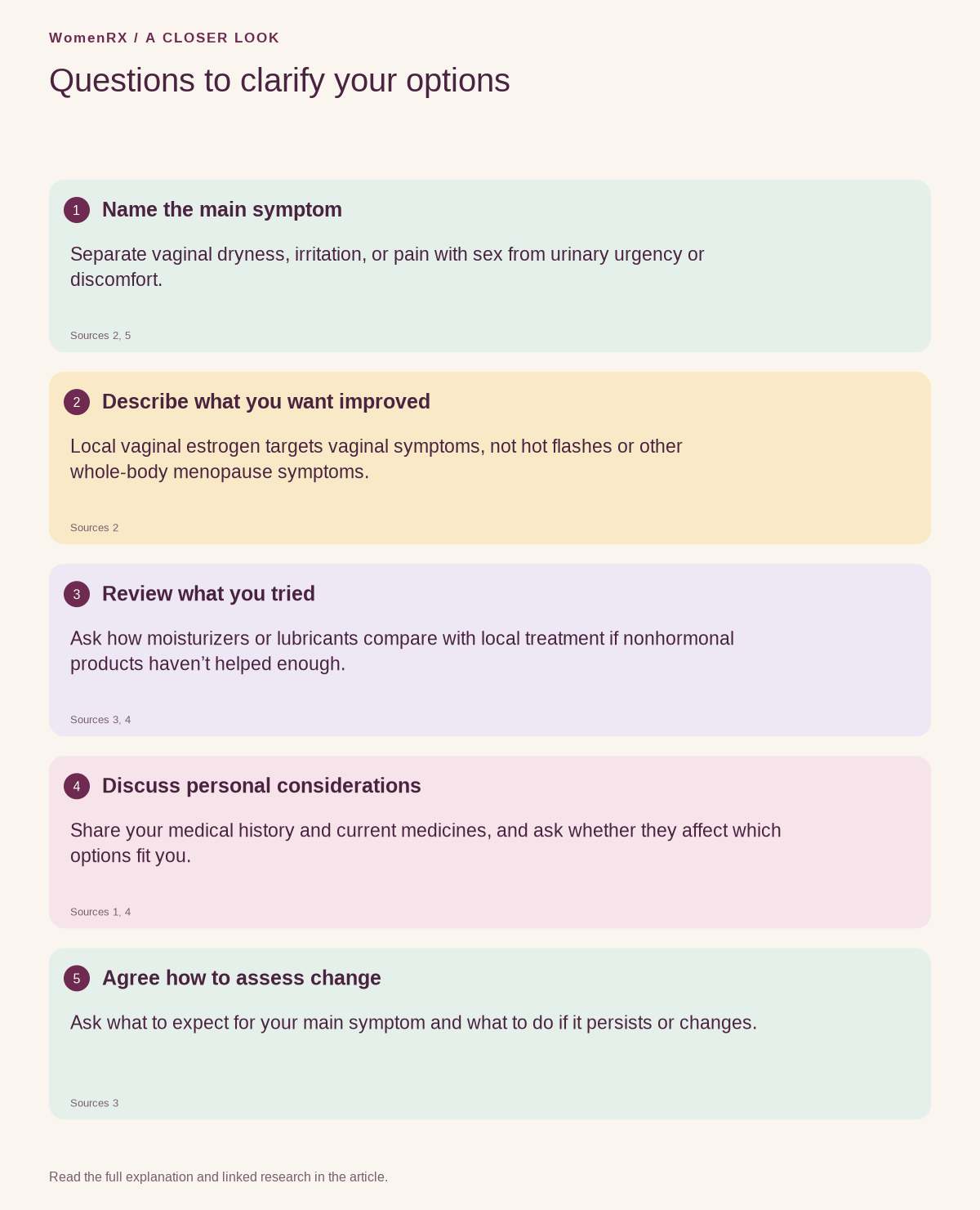
Questions to clarify your options
Name the main symptom: Separate vaginal dryness, irritation, or pain with sex from urinary urgency or discomfort.25
Describe what you want improved: Local vaginal estrogen targets vaginal symptoms, not hot flashes or other whole-body menopause symptoms.2
Review what you tried: Ask how moisturizers or lubricants compare with local treatment if nonhormonal products haven’t helped enough.34
Discuss personal considerations: Share your medical history and current medicines, and ask whether they affect which options fit you.14
Agree how to assess change: Ask what to expect for your main symptom and what to do if it persists or changes.3
Read the figure as text
Use these prompts to keep the discussion focused on your symptoms, treatment goal, and personal circumstances.- Name the main symptom: Separate vaginal dryness, irritation, or pain with sex from urinary urgency or discomfort.25
- Describe what you want improved: Local vaginal estrogen targets vaginal symptoms, not hot flashes or other whole-body menopause symptoms.2
- Review what you tried: Ask how moisturizers or lubricants compare with local treatment if nonhormonal products haven’t helped enough.34
- Discuss personal considerations: Share your medical history and current medicines, and ask whether they affect which options fit you.14
- Agree how to assess change: Ask what to expect for your main symptom and what to do if it persists or changes.3
More questions, answered
Does vaginal estrogen treat hot flashes?
No. Vaginal estrogen is local treatment for symptoms such as vaginal dryness and irritation. It isn’t intended to treat hot flashes or other menopause symptoms affecting the whole body. 2
Does urinary discomfort mean I need vaginal estrogen?
Not by itself. Urinary symptoms can occur as part of GSM, but that doesn’t show that menopause is their cause or that vaginal estrogen is the right treatment. Ask about the symptom pattern and other possible causes. 5
Sources you can check
- Using vaginal oestrogen with other medicines and herbal supplements - NHSAccessed 2026-09-25Return to first citation
- About vaginal oestrogen - NHSAccessed 2026-09-25Return to first citation
- Common questions about vaginal oestrogen - NHSAccessed 2026-09-25Return to first citation
- The 2022 hormone therapy position statement of The North American Menopause Society.“The 2022 Hormone Therapy Position Statement of The North American Menopause Society” Advisory Panel. · Menopause (New York, N.Y.) · 2022Return to first citation
- Vaginal Estrogen: Pearls for the Practitioner A Practical Review of Evidence, Guidelines, and Prescribing Strategies for Genitourinary Syndrome of Menopause.Perelmuter S, Srivastava M, Freedman KP, Hanfling S, Rubin RS. · Journal of women's health (2002) · 2026Return to first citation