How Vaginal Estrogen Helps Menopause-Related Symptoms
Low-dose vaginal estrogen is designed to ease symptoms in vaginal tissue, not to replace whole-body menopause treatment.
Vaginal estrogen delivers a low dose of estrogen inside the vagina. It can help menopause-related vaginal dryness and irritation, and it may be considered for bothersome genitourinary symptoms when nonprescription options aren’t enough. 1 2 5 It comes in several forms and can take time to help. The broad recommendation for genitourinary symptoms doesn’t establish relief for specific urinary problems. 1 2 5
Local treatment, with a specific purpose
After menopause, lower estrogen can contribute to vaginal dryness and irritation. Vaginal estrogen places a low dose of estrogen in the vagina to address those local symptoms. It comes as a tablet, cream, gel, pessary, or vaginal ring; the instructions depend on the particular product. 1 2
That local approach is different from systemic hormone therapy, which reaches the body more broadly and may be used for symptoms such as hot flashes. Vaginal estrogen isn’t intended to treat hot flashes, sleep problems, or mood changes. The amount that reaches the rest of the body is described as low, but “local” doesn’t mean no absorption or no need to consider your health history. 1 2
For bothersome genitourinary symptoms that haven’t improved with over-the-counter options, the North American Menopause Society includes low-dose vaginal estrogen among treatment options for women who don’t have a reason to use systemic hormone therapy. Decisions about hormone treatment depend on factors such as type, dose, route, and personal risk, and should be revisited over time. 5
What it may help, and what’s less certain
Vaginal dryness and irritation are the clearest established treatment goals. Menopause-related genitourinary syndrome can also involve urinary symptoms, but that doesn’t mean every urinary problem will respond to vaginal estrogen. Urgency accompanied by fever or local pain and itching can be a sign of infection. 1 4 7
A 2022 menopause position statement recommends low-dose vaginal estrogen as an option for bothersome genitourinary symptoms when nonprescription treatments haven’t helped. That broad recommendation doesn’t establish whether vaginal estrogen improves specific urinary outcomes, such as urgency, pain with urination, or recurrent urinary tract infections. 5 7 If your main concern is urinary, it’s useful to be specific about what’s happening rather than assuming all of it is menopause-related. 4 7
Research also suggests that estrogen therapy can change the vaginal environment, but those changes don’t guarantee that symptoms will improve. A 2026 systematic review found that estrogen therapy partly restored the presence of Lactobacillus bacteria in postmenopausal women, but this didn’t consistently track with symptom improvement. 6
Using it and weighing personal factors
The right form and schedule depend on the product, so follow its instructions rather than borrowing a schedule meant for a different cream, tablet, or ring. NHS guidance says it can take up to three months to work fully. 1 2 If it isn’t helping, that’s a reason to review the diagnosis, product, and treatment plan, not to assume you need a higher dose.
Low-dose vaginal treatment generally has less effect on the rest of the body than systemic hormone therapy, but treatment risks vary by product and dose. The North American Menopause Society recommends individualizing hormone therapy decisions and periodically reviewing benefits and risks. Bring up your health history and any concerns about estrogen so the clinician can consider how they apply to this treatment. 1 5
Some people have side effects, including vaginal discomfort or bleeding. Bleeding can occur early and often settles, but heavy or unexpected bleeding after six months of treatment, or changes in bleeding after several months, should be discussed with a clinician. And if urinary symptoms come with signs of infection, such as fever or local pain and itching, get medical advice rather than relying on vaginal estrogen to treat them. 4
The practical distinction is this: vaginal estrogen is a local option for menopause-related vaginal symptoms, with a possible role in broader genitourinary symptoms. It isn’t a universal fix for urinary problems or a substitute for systemic treatment when symptoms elsewhere in the body are the concern.
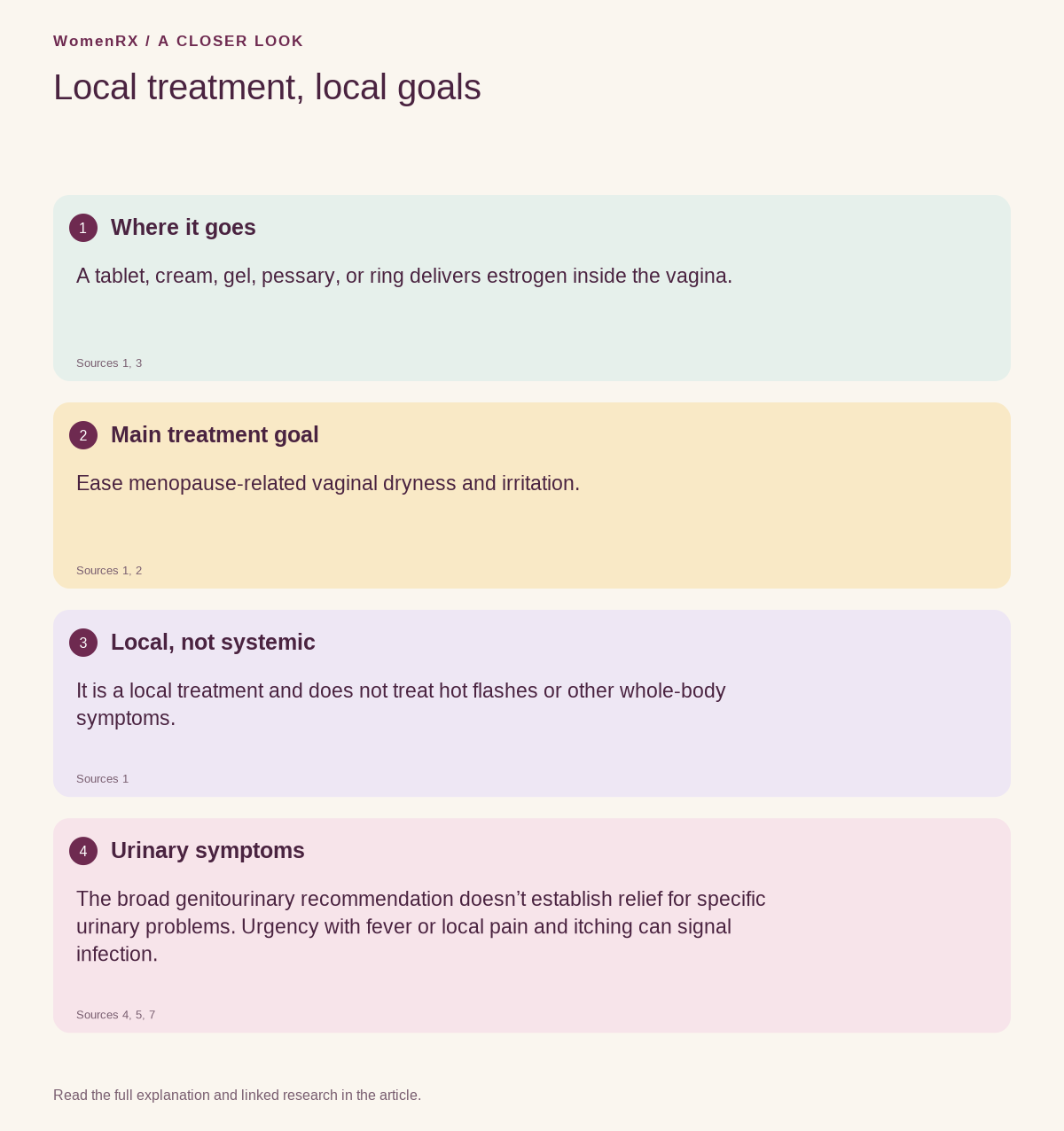
Local treatment, local goals
Where it goes: A tablet, cream, gel, pessary, or ring delivers estrogen inside the vagina.13
Main treatment goal: Ease menopause-related vaginal dryness and irritation.12
Local, not systemic: It is a local treatment and does not treat hot flashes or other whole-body symptoms.1
Urinary symptoms: The broad genitourinary recommendation doesn’t establish relief for specific urinary problems. Urgency with fever or local pain and itching can signal infection.457
Read the figure as text
This figure separates where vaginal estrogen is used from the symptoms it is intended to address and the limits of that goal.- Where it goes: A tablet, cream, gel, pessary, or ring delivers estrogen inside the vagina.13
- Main treatment goal: Ease menopause-related vaginal dryness and irritation.12
- Local, not systemic: It is a local treatment and does not treat hot flashes or other whole-body symptoms.1
- Urinary symptoms: The broad genitourinary recommendation doesn’t establish relief for specific urinary problems. Urgency with fever or local pain and itching can signal infection.457
More questions, answered
Does vaginal estrogen help hot flashes?
No. Vaginal estrogen is used for local vaginal symptoms and doesn’t treat hot flashes or other whole-body menopause symptoms. 1
How long might it take to notice a difference?
It may take up to three months to work fully. If symptoms aren’t improving, review the treatment and possible other causes with a clinician. 2
Sources you can check
- About vaginal oestrogen - NHSAccessed 2026-09-25Return to first citation
- Common questions about vaginal oestrogen - NHSAccessed 2026-09-25Return to first citation
- How and when to use vaginal oestrogen - NHSAccessed 2026-09-25Return to first citation
- Side effects of vaginal oestrogen - NHSAccessed 2026-09-25Return to first citation
- The 2022 hormone therapy position statement of The North American Menopause Society.“The 2022 Hormone Therapy Position Statement of The North American Menopause Society” Advisory Panel. · Menopause (New York, N.Y.) · 2022Return to first citation
- Gut, vaginal, and urinary microbiome alterations in women with genitourinary syndrome of menopause: A systematic review.Tsuboi I, Inoue S, Hirayama T, Mitsui Y, Watanabe M, Hirakawa H, Sadahira T. · Maturitas · 2026Return to first citation
- Vaginal Estrogen: Pearls for the Practitioner A Practical Review of Evidence, Guidelines, and Prescribing Strategies for Genitourinary Syndrome of Menopause.Perelmuter S, Srivastava M, Freedman KP, Hanfling S, Rubin RS. · Journal of women's health (2002) · 2026Return to first citation