DHEA Supplements: What to Check Before You Buy
DHEA can affect sex-hormone levels, but the reason you’re considering it matters more than a broad promise on the bottle.
Start with the product’s form and your goal. Oral DHEA supplements aren’t interchangeable with vaginal DHEA studied for postmenopausal vaginal symptoms.1 Evidence for oral DHEA’s effects depends on the condition studied, and longer-term safety data are limited.5 If you’re pursuing fertility care, receiving cancer treatment, or taking medicines for a condition such as lupus, discuss the specific product before using it.347
First, make sure it’s the DHEA you mean
DHEA, short for dehydroepiandrosterone, is a steroid hormone the body can use to make androgens and estrogens. DHEA sulfate, often written DHEAS, is a related circulating form. Neither term means a product has been shown to “balance hormones.”5
When you read a label, look for dehydroepiandrosterone or DHEA in the ingredient list, then check whether it’s an oral product or one intended for vaginal use. Note any other active ingredients, too. A study of one form, used for one purpose, doesn’t establish what a different product will do.
That distinction is especially useful after menopause. Randomized trials pooled in a systematic review found that intravaginal DHEA improved vaginal dryness and pain with sex compared with placebo in postmenopausal women. Those findings answer a focused question about local treatment. They don’t show that swallowing a DHEA supplement treats the same symptoms, improves energy, or makes oral use safe.1
Match the claim to the outcome you want
If a bottle promises better libido or general well-being, the evidence deserves a closer look. A review of trials in otherwise well postmenopausal women found inconsistent results for those outcomes, with studies limited by small samples and short treatment periods. The same review found too little safety information to settle questions about longer-term oral use.5 A falling DHEA level with age, by itself, isn’t evidence that replacing it will make you feel better.5
Fertility is a different question, not a stronger version of a wellness claim. In a study of 60 women with PCOS-related infertility, researchers compared 12 weeks of oral DHEA with no supplement and reported changes in measured hormones and adipokines. The reported results do not establish that DHEA improves pregnancy or live-birth outcomes. If fertility care is your reason for considering it, ask your care team which outcome they’re trying to improve and whether DHEA fits your particular diagnosis and treatment plan.3
Research in lupus illustrates another limit of broad claims. One randomized trial in women with active lupus found more acne and higher testosterone levels with oral DHEA; its primary disease-activity measure did not differ significantly from placebo, although fewer women in the DHEA group had flares during the 24-week study.6 Another trial studied oral DHEA as part of a closely managed plan to reduce corticosteroid use in women with lupus and also reported acne and other androgenic changes.7 These were condition-specific treatment studies, not evidence that a store-bought supplement is a good addition to someone else’s routine.
Put your medical context beside the label
DHEA’s relationship to androgens and estrogens is a reason to review more than the marketing claim. Bring the exact product name and full ingredient list to a conversation about its use, along with the medicines and hormone treatments you take. For example, a lupus trial involved planned, monitored changes to corticosteroid treatment; it doesn’t support changing a steroid medicine on your own when starting DHEA.7
If you have a history of breast or gynecologic cancer, or you’re receiving hormone-sensitive treatment, don’t borrow reassurance from studies of vaginal products. A six-month retrospective study of cancer survivors observed no recurrence in its vaginal DHEA group, but it was not a trial of oral supplements and cannot establish long-term cancer safety.2 A review of hormone treatment after gynecologic cancer emphasizes that decisions differ by cancer type and recurrence risk.4 The useful question for your treating team is whether this form of DHEA for this symptom makes sense in your situation.
Before buying, you should be able to finish one sentence: “I’m considering this product for ___.” Then compare that purpose with the outcomes actually studied, not just the words on the front of the bottle. For postmenopausal vaginal dryness, the relevant evidence concerns intravaginal DHEA. For broad well-being claims, oral results are inconsistent. For fertility, a change in a lab marker is not the same as a demonstrated improvement in having a baby.153 That comparison may save you from using a hormone-active product for a promise the research hasn’t established.
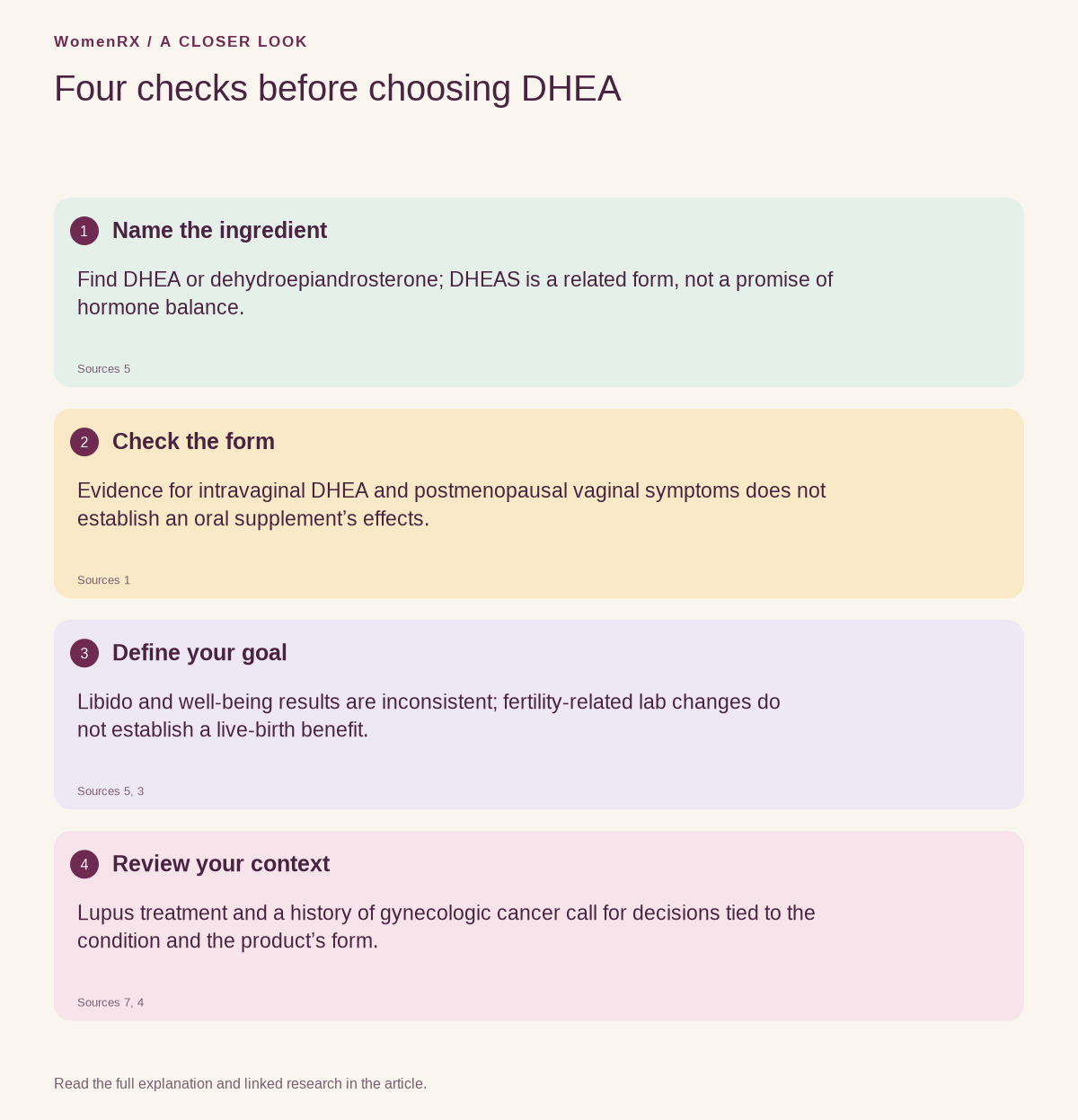
Four checks before choosing DHEA
Name the ingredient: Find DHEA or dehydroepiandrosterone; DHEAS is a related form, not a promise of hormone balance.5
Check the form: Evidence for intravaginal DHEA and postmenopausal vaginal symptoms does not establish an oral supplement’s effects.1
Define your goal: Libido and well-being results are inconsistent; fertility-related lab changes do not establish a live-birth benefit.53
Review your context: Lupus treatment and a history of gynecologic cancer call for decisions tied to the condition and the product’s form.74
Read the figure as text
Use the product label and your reason for considering DHEA to identify which research, if any, answers your question.- Name the ingredient: Find DHEA or dehydroepiandrosterone; DHEAS is a related form, not a promise of hormone balance.5
- Check the form: Evidence for intravaginal DHEA and postmenopausal vaginal symptoms does not establish an oral supplement’s effects.1
- Define your goal: Libido and well-being results are inconsistent; fertility-related lab changes do not establish a live-birth benefit.53
- Review your context: Lupus treatment and a history of gynecologic cancer call for decisions tied to the condition and the product’s form.74
Sources you can check
- Intravaginal dehydroepiandrosterone for the treatment of vulvovaginal atrophy: a systematic review and meta-analysis.Lemos MJ, Queiroz LF, Diniz AF, Longo da Silva CM, Dos Santos PL, de Oliveira Gomide P, Ferraz JM, De Marco Novellino AM. · Menopause (New York, N.Y.) · 2026Return to first citation
- Treatment of Genitourinary Syndrome of Menopause in Breast Cancer and Gynecologic Cancer Survivors: Retrospective Analysis of Efficacy and Safety of Vaginal Estriol, Vaginal Dehydroepiandrosterone and Ospemifene.Pennacchini E, Dall'Alba R, Iapaolo S, Marinelli M, Palazzetti PL, Zullo MA, Cervigni M, Morciano A, Campanella L, Ferraresi B, Schiavi MC. · Journal of menopausal medicine · 2024Return to first citation
- Exploring Adipokines in Assessing the Role of Dehydroepiandrosterone in Polycystic Ovary Syndrome-Linked Infertility.Danish S, Gul E, Chaudhry S, Minhas M. · Cureus · 2025Return to first citation
- Hormone replacement therapy in gynecologic cancer: oncologic safety and alternative therapies.Luzarraga Aznar A, Elyashiv O, Dababou S, Palasz NA, Canturk MM, Montero-Macias R, Pavone M, Jayraj AS, Hsu HC, Ramirez PT. · International journal of gynecological cancer : official journal of the International Gynecological Cancer Society · 2026Return to first citation
- DHEA therapy for women: effect on sexual function and wellbeing.Panjari M, Davis SR. · Human reproduction update · 2007Return to first citation
- Dehydroepiandrosterone treatment of women with mild-to-moderate systemic lupus erythematosus: a multicenter randomized, double-blind, placebo-controlled trial.Chang DM, Lan JL, Lin HY, Luo SF. · Arthritis and rheumatism · 2002Return to first citation
- Effects of prasterone on corticosteroid requirements of women with systemic lupus erythematosus: a double-blind, randomized, placebo-controlled trial.Petri MA, Lahita RG, Van Vollenhoven RF, Merrill JT, Schiff M, Ginzler EM, Strand V, Kunz A, Gorelick KJ, Schwartz KE, GL601 Study Group. · Arthritis and rheumatism · 2002Return to first citation