Can Nuts and Seeds Help With Menopause Symptoms?
Flaxseed has been tested for menopause symptoms, but ordinary nuts and seeds haven’t been shown to work as a group.
Flaxseed is the seed with the most directly relevant findings here. One trial in perimenopausal women found improved symptom scores after three months, but an earlier review of controlled flax studies found no clear advantage over comparison treatments for hot flushes or overall symptom scores. 23 Nuts and seeds can still be foods you enjoy; the evidence doesn’t establish a portion that treats menopause symptoms.
A plant compound isn’t a symptom treatment
It’s easy to see why seeds come up in menopause conversations. Flaxseed contains lignans, a type of phytoestrogen. Gut microorganisms convert flax lignans into compounds called enterodiol and enterolactone. Sesame also provides lignans. But having a compound with estrogen-like activity is not the same as showing that a food raises your estrogen level or eases hot flashes. Those are separate questions that need to be tested in women experiencing those symptoms. 12
The distinction matters if you’re deciding what to put in your grocery cart. A flaxseed study can tell you something about the flax preparation it tested. It can’t tell you whether almonds, walnuts, pumpkin seeds, sesame seeds, or a mixed handful of nuts and seeds will help you sleep or reduce hot flashes.
What researchers actually measured with flaxseed
In a single-blind randomized trial in India, 145 perimenopausal women were assigned to take either 10 grams of flaxseed powder or 10 grams of roasted wheat flour for three months. Researchers measured scores on three menopause symptom questionnaires and levels of the two lignan metabolites. In all, 123 women completed the study. Average symptom scores fell more in the flax group than in the comparison group, and the measured metabolites increased. 2
That’s a promising result for the particular preparation and women studied. It isn’t a finding that every symptom disappeared, or proof that whole flaxseed eaten occasionally would have the same effect. The trial measured combined questionnaire scores, so its overall result shouldn’t be turned into a promise about any one symptom. 2
An earlier systematic review looked across 11 controlled flax interventions in perimenopausal or postmenopausal women. Five assessed hot-flush frequency or severity, and five assessed menopause symptom scores. Both flax and control groups improved from baseline, but the reviewers found no significant difference between groups for those outcomes. Only a few studies examined bone density or markers of bone turnover, leaving the effect on postmenopausal bone health inconclusive. 3
The newer trial and the earlier review don’t say exactly the same thing. The useful takeaway is that one encouraging three-month trial hasn’t settled whether flax reliably relieves symptoms. It also hasn’t established a benefit for nuts and seeds generally.
What an ordinary food choice can contribute
You can choose nuts and seeds for meals without asking them to do the job of a treatment. For example, flaxseed powder can be stirred into oatmeal, and sesame can be used as a topping. In that setting, their clearest menopause-related distinction in this evidence is that they provide lignans, not that either has been shown to balance hormones. 12
There’s no proven symptom-relieving serving to copy. The flax trial’s 10 grams was its research intervention, not a recommended daily portion for menopause. It tested powder for three months against a particular comparison food; it didn’t compare everyday portions of different nuts and seeds. 2 Choose an amount that suits the meal rather than measuring out seeds in expectation of hot-flash relief.
If you have a known allergy to a particular nut or seed, a menopause claim is no reason to try it. Check the ingredients of mixed products for foods you need to avoid. There’s no need to eat a specific nut or seed to get the benefit of a varied diet.
If relief, rather than a meal idea, is the goal
Food choices and symptom care don’t have to compete. The Menopause Society identifies hormone therapy as the most effective treatment for hot flashes and other vasomotor symptoms, with the balance of benefits and risks varying by personal circumstances. 4 Its nonhormone guidance identifies several evidence-supported options, including cognitive behavioral therapy and certain prescription treatments; it does not recommend supplements or soy foods as hot-flash treatments. 5
So enjoy nuts and seeds that work for you, and keep the claim appropriately small: flaxseed has been studied, with mixed controlled findings. Other nuts and seeds don’t inherit its trial result simply because they’re plant foods.
What seed research measured
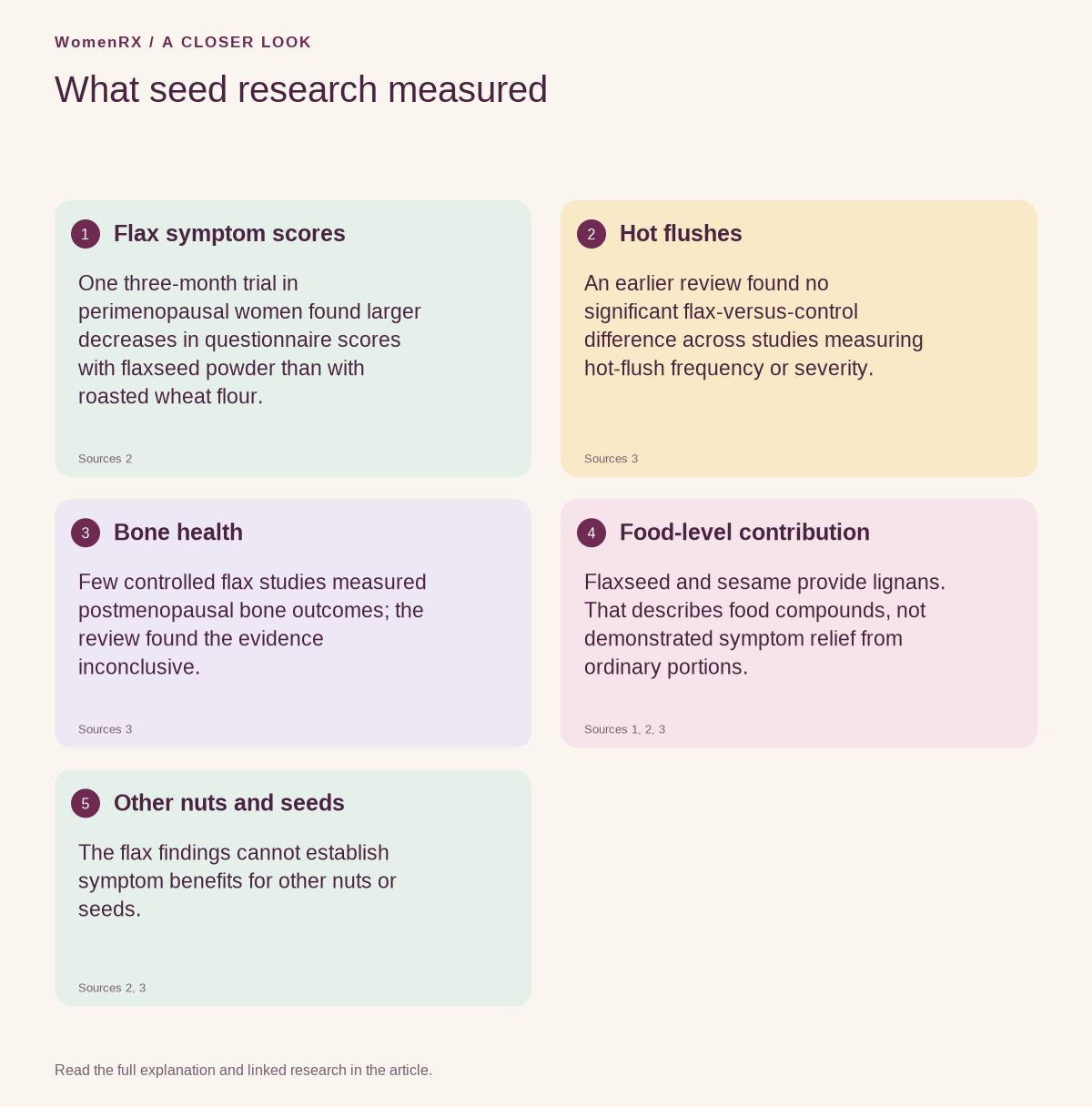
Flax symptom scores: One three-month trial in perimenopausal women found larger decreases in questionnaire scores with flaxseed powder than with roasted wheat flour.2
Hot flushes: An earlier review found no significant flax-versus-control difference across studies measuring hot-flush frequency or severity.3
Bone health: Few controlled flax studies measured postmenopausal bone outcomes; the review found the evidence inconclusive.3
Food-level contribution: Flaxseed and sesame provide lignans. That describes food compounds, not demonstrated symptom relief from ordinary portions.123
Other nuts and seeds: The flax findings cannot establish symptom benefits for other nuts or seeds.23
Read the figure as text
The findings depend on both the food tested and the menopause outcome measured.- Flax symptom scores: One three-month trial in perimenopausal women found larger decreases in questionnaire scores with flaxseed powder than with roasted wheat flour.2
- Hot flushes: An earlier review found no significant flax-versus-control difference across studies measuring hot-flush frequency or severity.3
- Bone health: Few controlled flax studies measured postmenopausal bone outcomes; the review found the evidence inconclusive.3
- Food-level contribution: Flaxseed and sesame provide lignans. That describes food compounds, not demonstrated symptom relief from ordinary portions.123
- Other nuts and seeds: The flax findings cannot establish symptom benefits for other nuts or seeds.23
More questions, answered
Does the flaxseed trial show that flax raises estrogen?
No. The trial reported higher levels of two compounds produced when gut microorganisms process flax lignans. A change in those metabolites is not proof that participants’ estrogen levels rose. 2
Sources you can check
- Natural strategies to optimize estrogen levels in aging women: mini review.Bolgova O, Shypilova I, Mavrych V. · Frontiers in aging · 2025Return to first citation
- Effects of Flaxseed on Perimenopausal Symptoms: Findings From a Single-Blind, Randomized, Placebo-Controlled Study.Shrivastava R, Bhattacharya S, Verma N, Mehdi AA, Pandey A, Ansari JA. · Cureus · 2024Return to first citation
- Controlled flax interventions for the improvement of menopausal symptoms and postmenopausal bone health: a systematic review.Dew TP, Williamson G. · Menopause (New York, N.Y.) · 2013Return to first citation
- The 2022 hormone therapy position statement of The North American Menopause Society.“The 2022 Hormone Therapy Position Statement of The North American Menopause Society” Advisory Panel. · Menopause (New York, N.Y.) · 2022Return to first citation
- The 2023 nonhormone therapy position statement of The North American Menopause Society.Menopause (New York, N.Y.) · 2023Return to first citation