Flaxseed for Menopause Symptoms: What Trials Show
Ground flaxseed has been tested for hot flashes, but the clearest trial didn’t show a reliable benefit.
In a 16-week trial, postmenopausal women ate a daily muffin containing 25 grams of ground flaxseed, but the study found no significant improvement in hot-flash frequency or menopause-related quality of life. One analysis found lower hot-flash severity, though the change over time wasn’t significantly different between groups. A review also found no significant pooled effect on severity. 3 4
What the ground-seed trial found
The clearest individual trial compared daily muffins made with ground flaxseed, soy flour, or wheat flour. It enrolled 99 postmenopausal women who were one to eight years past menopause; 87 completed the study. The flaxseed muffin contained 25 grams of ground seed, providing 50 milligrams of lignans, and participants ate the muffins for 16 weeks. 3
The trial found no significant group differences in hot-flash frequency or menopause-related quality of life. One analysis found that hot flashes were less severe in the flaxseed group, but the difference in change over time between groups was not significant. That result is a reason to be cautious, not proof that flaxseed reduced symptom severity. 3
A 2016 review pooled hot-flash severity results from three flaxseed trials involving 212 participants. The pooled reduction was not statistically significant. The review also described possible benefits for hot-flash frequency and intensity, but said those findings were not statistically significant. 4
Why some results can sound more positive
The review describes one small study in which hot-flash frequency fell by 41% within the flaxseed group. But the researchers did not report a statistical comparison between that group and the other groups. A change within one group alone can’t show that flaxseed worked better than the comparison treatment. Another trial included in the review found no significant difference among flaxseed, soy, and control groups. 4
Taken together, the results don’t establish a dependable hot-flash benefit. A promising-looking result from one analysis or one group doesn’t outweigh the broader pattern of nonsignificant comparisons.
Ground seed, lignans, and oil aren’t interchangeable
“Flaxseed” can refer to ground seed or meal, flax-containing foods, a concentrated lignan extract, or flaxseed oil. The menopause trials described in the review used several forms, including bread, muffins, bars, meal, and an extract. They do not establish that flaxseed oil reduces hot flashes, or that a lignan supplement has the same effect as eating ground seed. 3 4
Lignans are plant compounds found in flaxseed and are classified as phytoestrogens. That label doesn’t mean flaxseed has been shown to act like hormone therapy or reliably change menopause symptoms. The review reported estrogenic effects in two trials, but concluded that the evidence was too limited to determine whether flaxseed increases or protects against estrogen-dependent cancer risk. 4
The North American Menopause Society’s 2023 position statement does not recommend supplements or herbal remedies as treatment for vasomotor symptoms such as hot flashes. That is guidance about using those products to treat symptoms; it does not establish a hot-flash benefit or a safety conclusion for eating flax as food. 2
What to consider if hot flashes are bothering you
If hot flashes are disrupting sleep or daily life, flaxseed isn’t a proven substitute for treatments with stronger support. The North American Menopause Society identifies hormone therapy as the most effective treatment for vasomotor symptoms. Its 2023 statement also recommends several nonhormonal options, including cognitive behavioral therapy, clinical hypnosis, and certain prescription medicines. Which option fits depends on your health and preferences. 1 2
The practical takeaway is specific: 25 grams of ground flaxseed in a daily muffin was tested for 16 weeks, without a significant improvement in hot-flash frequency or quality of life. The findings don’t show that oil, lignan extracts, or other products will work the same way.
What flaxseed studies tested
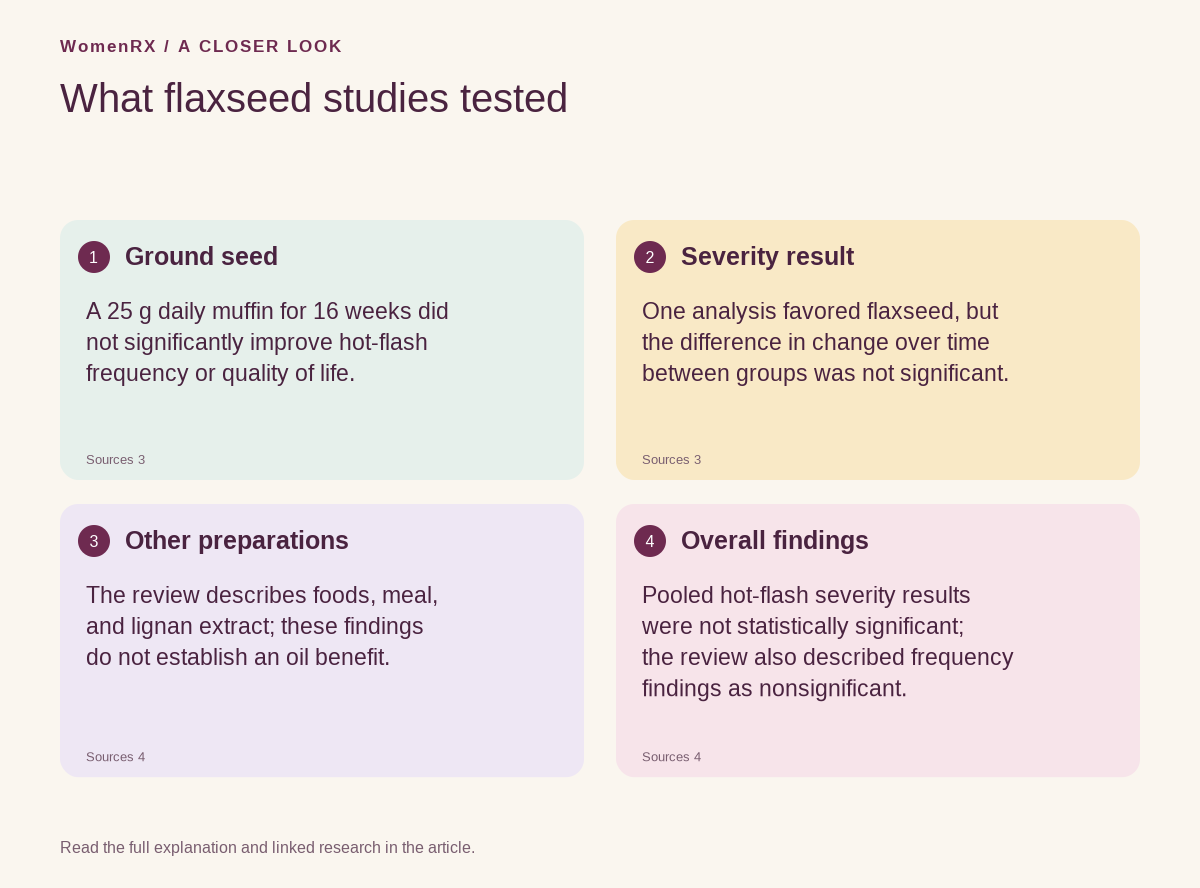
Ground seed: A 25 g daily muffin for 16 weeks did not significantly improve hot-flash frequency or quality of life.3
Severity result: One analysis favored flaxseed, but the difference in change over time between groups was not significant.3
Other preparations: The review describes foods, meal, and lignan extract; these findings do not establish an oil benefit.4
Overall findings: Pooled hot-flash severity results were not statistically significant; the review also described frequency findings as nonsignificant.4
Read the figure as text
The preparations and findings differ; evidence from one form shouldn’t be assumed to apply to another.- Ground seed: A 25 g daily muffin for 16 weeks did not significantly improve hot-flash frequency or quality of life.3
- Severity result: One analysis favored flaxseed, but the difference in change over time between groups was not significant.3
- Other preparations: The review describes foods, meal, and lignan extract; these findings do not establish an oil benefit.4
- Overall findings: Pooled hot-flash severity results were not statistically significant; the review also described frequency findings as nonsignificant.4
More questions, answered
How much ground flaxseed did the trial test?
The trial tested 25 grams of ground flaxseed in a daily muffin for 16 weeks. The muffin provided 50 milligrams of lignans. The study did not find significant improvement in hot-flash frequency or menopause-related quality of life. 3
Does the menopause research show flaxseed oil helps hot flashes?
The trials described in the review tested foods, flaxseed meal, and a lignan extract. They do not establish a hot-flash benefit from flaxseed oil. 4
Sources you can check
- The 2022 hormone therapy position statement of The North American Menopause Society.“The 2022 Hormone Therapy Position Statement of The North American Menopause Society” Advisory Panel. · Menopause (New York, N.Y.) · 2022Return to first citation
- The 2023 nonhormone therapy position statement of The North American Menopause Society.Menopause (New York, N.Y.) · 2023Return to first citation
- A randomized controlled trial of the effect of dietary soy and flaxseed muffins on quality of life and hot flashes during menopause.Lewis JE, Nickell LA, Thompson LU, Szalai JP, Kiss A, Hilditch JR. · Menopause (New York, N.Y.) · 2006Return to first citation
- Effects of flaxseed and Hypericum perforatum on hot flash, vaginal atrophy and estrogen-dependent cancers in menopausal women: a systematic review and meta-analysis.Ghazanfarpour M, Sadeghi R, Latifnejad Roudsari R, Khadivzadeh T, Khorsand I, Afiat M, Esmaeilizadeh M. · Avicenna journal of phytomedicine · 2016Return to first citation