Ground or Whole Flaxseed: Which Form Should You Choose?
Grinding flaxseed makes its ALA and lignans more accessible, and a small food-use starting point can make it easier to add gradually.
Choose ground flaxseed if you want fiber along with more accessible ALA and lignans. One tablespoon (7 g) of ground flaxseed has about 1.3 g protein, 1.9 g fiber, 37.4 calories, 2 g carbohydrate, and 3 g fat. A practical food-use starting point is 1 teaspoon mixed into food, then gradually add more if it feels comfortable. 3 4
Choose ground seed for more accessible ALA and lignans
Grinding breaks flaxseed’s hard outer coat, making its ALA and lignans more available than they are in whole seeds. Whole seeds still provide fiber, but their hard coat limits access to ALA and lignans. If you want to add flaxseed to food and get more from the seed itself, ground flaxseed is the practical choice. 3
Oil is a different option, not a more concentrated version of every benefit. It’s rich in the omega-3 fat ALA, but it doesn’t stand in for the fiber in the seed. Choose oil when you specifically want an oil; choose ground seed when you want a food that includes fiber and lignans as well. 3
What’s in a tablespoon of ground flaxseed?
For a practical nutrition reference, one tablespoon of ground flaxseed weighs 7 g. USDA SR Legacy food-composition data estimate that portion provides the following; values can vary by product and preparation. 4
| Ground flaxseed, 1 tablespoon (7 g) | Estimated amount |
|---|---|
| Energy | 37.4 calories |
| Protein | 1.3 g |
| Fiber | 1.9 g |
| Carbohydrate | 2.0 g |
| Fat | 3.0 g |
Flaxseed can be stirred into oatmeal or yogurt. If you’re starting with it, try 1 teaspoon mixed into food, then gradually add more if it feels comfortable. That’s a practical way to introduce it, not a proven serving target or a tested schedule.
How much is a serving?
There isn’t an established, evidence-based daily serving for general health or menopause symptoms in these human studies. The amounts used in two menopause trials give context, not a prescription: one perimenopause trial studied 10 g of flaxseed, and a postmenopause trial tested 25 g of ground flaxseed in muffins daily for 16 weeks. Those trials don’t establish that either amount is the right target for you. 1 2
Flaxseed and menopause: promising, but not settled
The results aren’t consistent enough to count on flaxseed for hot flashes or other menopause symptoms. In a randomized trial of women one to eight years after menopause, 99 women were assigned to daily muffins with ground flaxseed, soy, or wheat; 87 completed the study. Flaxseed didn’t significantly improve overall menopause-related quality of life or the hot-flash measures overall. A separate analysis found lower hot-flash severity with flaxseed, but the group-by-time interaction was not significant, which makes that finding harder to interpret as a clear treatment effect. 1
A 2025 single-blind, placebo-controlled trial analyzed 145 perimenopausal participants and reported a greater reduction in symptom severity in the flaxseed group. That is a relevant result, but one trial doesn’t settle whether flaxseed reliably helps, which symptoms it might help, or what amount to use. The two studies also involved different life stages and amounts, so they don’t establish one shared dose for perimenopause and postmenopause. 2
Grinding affects access to the seed’s ALA and lignans. But that difference does not prove that flaxseed balances hormones or relieves symptoms. Changes in lignan exposure or hormone-related measurements aren’t the same as demonstrated symptom relief. 3
Keep each form fresh
Whole flaxseeds have a more protective outer coat. Grinding increases the seed’s sensitivity to oxidation, though the review does not establish a specific use-after-grinding timeframe. As a practical household approach, keep ground flaxseed sealed and follow the package’s storage directions. Flaxseed oil is more sensitive still; the review recommends keeping it refrigerated in an opaque container. 3
A simple way to choose
- For fiber and lignans: choose ground flaxseed; grinding makes lignans and ALA more accessible than they are in whole seed. 3
- For convenience and crunch: whole flaxseed is easy to sprinkle on food, but its hard coat can limit access to ALA and lignans. 3
- For ALA as an oil: choose flaxseed oil, knowing it isn’t interchangeable with the whole seed. The review recommends storing it refrigerated in an opaque container. 3
- For menopause symptoms: don’t treat either seed or oil as a proven substitute for symptom care; the seed trials had differing findings, and these trials did not test oil for symptom relief. 1 2
If you take regular medicines and wonder whether flaxseed is right for you or how to time it, ask a pharmacist about your specific medications.
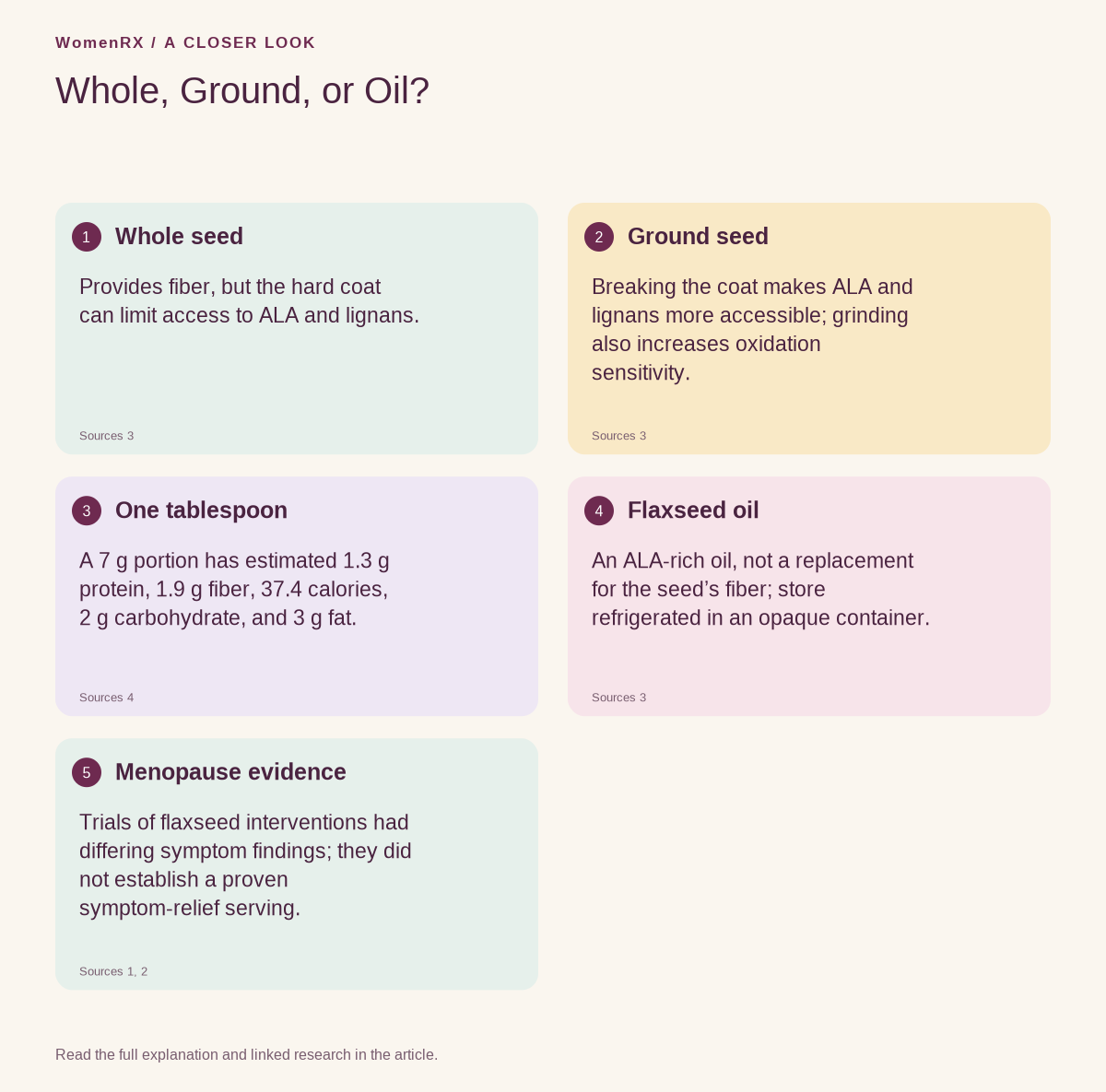
Whole, Ground, or Oil?
Whole seed: Provides fiber, but the hard coat can limit access to ALA and lignans.3
Ground seed: Breaking the coat makes ALA and lignans more accessible; grinding also increases oxidation sensitivity.3
One tablespoon: A 7 g portion has estimated 1.3 g protein, 1.9 g fiber, 37.4 calories, 2 g carbohydrate, and 3 g fat.4
Flaxseed oil: An ALA-rich oil, not a replacement for the seed’s fiber; store refrigerated in an opaque container.3
Menopause evidence: Trials of flaxseed interventions had differing symptom findings; they did not establish a proven symptom-relief serving.12
Read the figure as text
Compare what each form contributes, the estimated nutrition in a tablespoon of ground seed, and what to consider when using or storing it.- Whole seed: Provides fiber, but the hard coat can limit access to ALA and lignans.3
- Ground seed: Breaking the coat makes ALA and lignans more accessible; grinding also increases oxidation sensitivity.3
- One tablespoon: A 7 g portion has estimated 1.3 g protein, 1.9 g fiber, 37.4 calories, 2 g carbohydrate, and 3 g fat.4
- Flaxseed oil: An ALA-rich oil, not a replacement for the seed’s fiber; store refrigerated in an opaque container.3
- Menopause evidence: Trials of flaxseed interventions had differing symptom findings; they did not establish a proven symptom-relief serving.12
More questions, answered
Is flaxseed oil a substitute for ground flaxseed?
No. Oil is rich in ALA, while ground seed also provides fiber and lignans. Choose based on what you want to add to your food; the forms aren’t interchangeable. 3
Does flaxseed reliably help with hot flashes?
That hasn’t been established. A postmenopause trial found no overall significant benefit for hot flashes, while a separate perimenopause trial reported reduced symptom severity. The results are not enough to promise relief. 1 2
Sources you can check
- A randomized controlled trial of the effect of dietary soy and flaxseed muffins on quality of life and hot flashes during menopause.Lewis JE, Nickell LA, Thompson LU, Szalai JP, Kiss A, Hilditch JR. · Menopause (New York, N.Y.) · 2006Return to first citation
- Dietary Status and the Effect of Flaxseed Supplementation on the Severity of Perimenopausal Symptoms.Shrivastava R, Bhattacharya S, Verma N, Mehdi AA, Pandey A, Ansari JA. · Cureus · 2025Return to first citation
- The Role of Flaxseed in Improving Human Health.Nowak W, Jeziorek M. · Healthcare (Basel, Switzerland) · 2023Return to first citation
- USDA SR Legacy: Seeds, flaxseed (FDC 169414)Accessed 2026-09-25Return to first citation