Black Beans: What They Offer and How to Use Them
Black beans bring plant protein and fiber to meals; here’s a serving-specific nutrition estimate and a practical look at canned and dried options.
A half cup (86 g) of cooked black beans boiled without salt provides an estimated 7.6 g protein, 7.5 g fiber, 113.5 calories, 20.4 g carbohydrate, and 0.5 g fat, according to USDA SR Legacy data for FDC 173735. 6 Canned beans are convenient; check the label if you’re monitoring sodium. If beans cause gas or bloating, increase fiber gradually. 1
What black beans bring to a meal
Black beans contribute plant protein and dietary fiber. Beans also supply nutrients such as potassium, magnesium, iron, and folate, making them one useful part of a varied eating pattern rather than a food expected to cover all your nutrition needs. 5
Here’s a serving-specific estimate for ½ cup (86 g) of cooked black beans, boiled without salt. The figures come from USDA SR Legacy food-composition data for FDC 173735; they describe a reference food, not every brand or recipe. 6
| Nutrient | Amount per ½ cup (86 g) |
|---|---|
| Energy | 113.5 calories |
| Protein | 7.6 g |
| Dietary fiber | 7.5 g |
| Carbohydrate | 20.4 g |
| Fat | 0.5 g |
Beans are plant proteins. MedlinePlus notes that most plant proteins are incomplete, and that eating different types of plant proteins can provide the amino acids your body needs. Black beans can contribute to your protein intake, but one serving alone doesn’t tell you whether you’re meeting your overall needs. 2
Canned or cooked from dried?
Canned beans are ready to use, which can make them handy for a quick meal. Add them to soup, fold them into a grain bowl with vegetables, or mash them with seasonings for a spread. Dried beans take advance preparation and cooking, but a cooked batch can be used across meals: add some to soup, serve them with rice and vegetables, or mash them into a filling for tacos. These are examples, not a prescribed meal plan.
If you’re monitoring sodium, check the sodium per serving on a canned product’s Nutrition Facts label and account for salty ingredients you add. With dried beans, consider the salt and other seasonings in your recipe. The amount depends on the product and preparation, so don’t assume one form is always lower in sodium.
A dietary-pattern study used US survey data to model adding servings of canned and dried beans to adults’ usual diets. The model estimated higher intakes of several nutrients, including fiber, potassium, magnesium, iron, and folate. This was a dietary-pattern analysis, not a trial showing that a particular preparation causes a health outcome or a direct comparison of canned and dried black beans. 4
If beans don’t sit comfortably
A sudden increase in dietary fiber can lead to gas, bloating, or cramps. If you’re adding beans after eating little fiber, try a smaller amount first and build up gradually according to your comfort. 1
Fiber comes from many plant foods, so beans aren’t the only way to include it in meals. 1
A broadly useful food, not a life-stage treatment
Black beans can be part of meals at different ages, but this research doesn’t establish a specific benefit for women during pregnancy, postpartum, cycling years, perimenopause, or postmenopause. A small pilot study included mothers in Guatemala and used dietary simulations involving cooked black beans; it did not test a clinical effect or a benefit tied to a particular life stage. 3
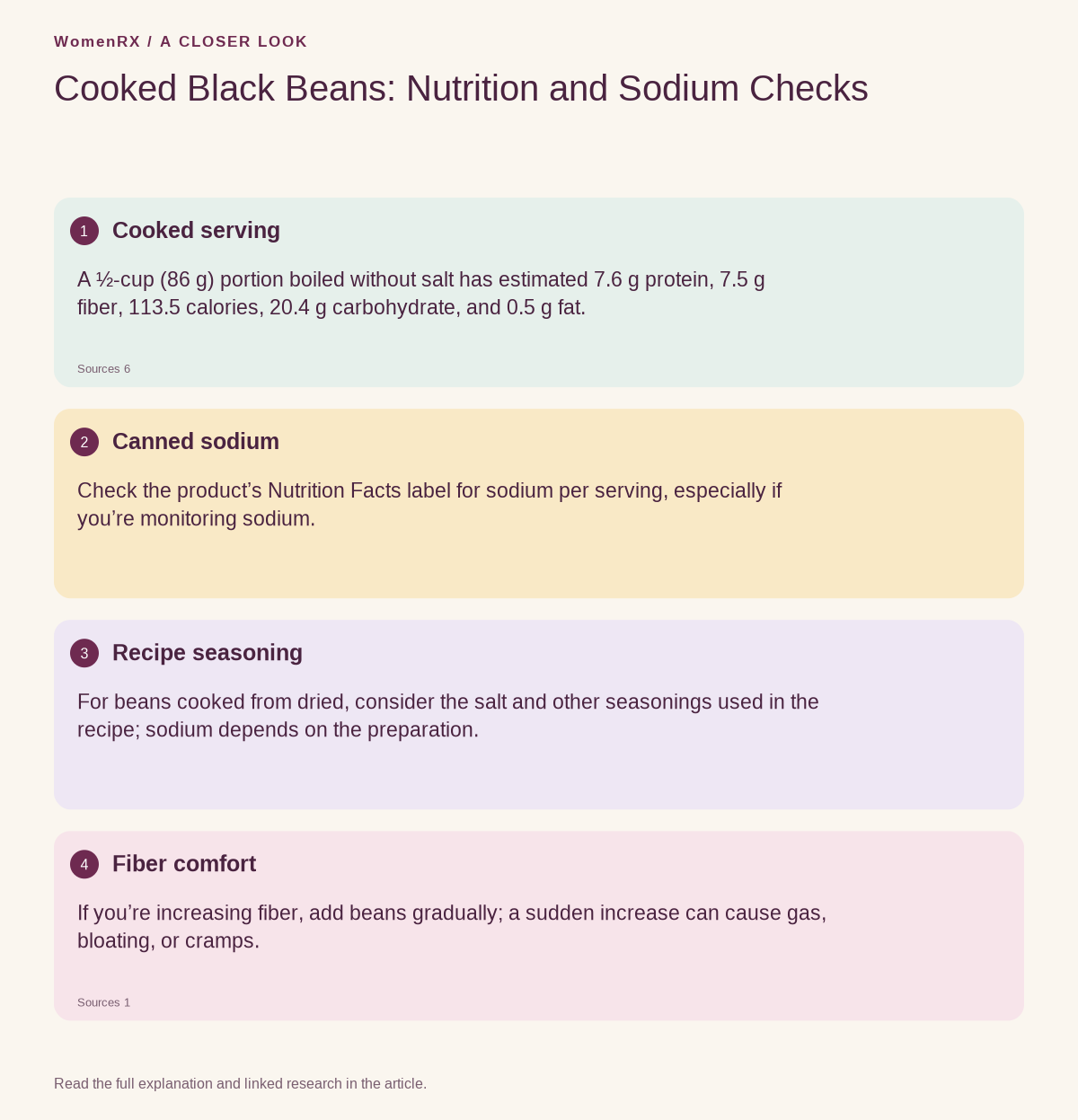
Cooked Black Beans: Nutrition and Sodium Checks
Cooked serving: A ½-cup (86 g) portion boiled without salt has estimated 7.6 g protein, 7.5 g fiber, 113.5 calories, 20.4 g carbohydrate, and 0.5 g fat.6
Canned sodium: Check the product’s Nutrition Facts label for sodium per serving, especially if you’re monitoring sodium.
Recipe seasoning: For beans cooked from dried, consider the salt and other seasonings used in the recipe; sodium depends on the preparation.
Fiber comfort: If you’re increasing fiber, add beans gradually; a sudden increase can cause gas, bloating, or cramps.1
Read the figure as text
Use the cooked, unsalted half-cup serving as a nutrition reference, then check the product label or recipe for sodium when that matters to you. This is not a nutrient comparison of canned and dried beans.- Cooked serving: A ½-cup (86 g) portion boiled without salt has estimated 7.6 g protein, 7.5 g fiber, 113.5 calories, 20.4 g carbohydrate, and 0.5 g fat.6
- Canned sodium: Check the product’s Nutrition Facts label for sodium per serving, especially if you’re monitoring sodium.
- Recipe seasoning: For beans cooked from dried, consider the salt and other seasonings used in the recipe; sodium depends on the preparation.
- Fiber comfort: If you’re increasing fiber, add beans gradually; a sudden increase can cause gas, bloating, or cramps.1
More questions, answered
Do canned and dried black beans have the same sodium?
Don’t assume they do. Check sodium per serving on a canned product’s label; for dried beans, consider the salt and other ingredients in your recipe.
Can I eat beans if they cause gas?
A quick increase in fiber can cause gas, bloating, or cramps. You could try adding beans more gradually and see how you feel. 1
Sources you can check
- Dietary Fiber: MedlinePlusAccessed 2026-09-25Return to first citation
- Dietary Proteins: MedlinePlusAccessed 2026-09-25Return to first citation
- Pilot Study of Heat-Stabilized Rice Bran Acceptability in Households of Rural Southwest Guatemala and Estimates of Fiber, Protein, and Micro-Nutrient Intakes among Mothers and Children.Pfluger BA, Giunta A, Calvimontes DM, Lamb MM, Delgado-Zapata R, Ramakrishnan U, Ryan EP. · Nutrients · 2024Return to first citation
- Adding more beans to the US typical dietary pattern can lead to greater intake of shortfall nutrients and a higher diet quality in younger and older adults.Papanikolaou Y, Slavin J, Papanikolaou S, Fulgoni VL. · Maturitas · 2024Return to first citation
- Adult dietary patterns with increased bean consumption are associated with greater overall shortfall nutrient intakes, lower added sugar, improved weight-related outcomes and better diet quality.Papanikolaou Y, Slavin J, Fulgoni VL. · Nutrition journal · 2024Return to first citation
- USDA SR Legacy: Beans, black, mature seeds, cooked, boiled, without salt (FDC 173735)Accessed 2026-09-25Return to first citation