Vaginal Estradiol Tablets: What They Treat and How to Use Them
A tablet and a cream both deliver estrogen locally, but their application and directions aren’t interchangeable.
Vaginal estradiol is a local treatment for menopause-related vaginal symptoms such as dryness and irritation; it isn’t meant to treat hot flashes. Tablets and creams differ in form and how you apply them, and their schedules can vary by product. Follow the directions for your exact prescription, and ask what to do if symptoms persist, irritation worsens, or bleeding occurs. 1 3
What the tablet is for
As estrogen levels fall around menopause, vaginal dryness and irritation can develop. Vaginal estradiol places estrogen in the vagina to treat these local symptoms. It isn’t the same as systemic hormone therapy for hot flashes, sleep changes, or other symptoms throughout the body. 1 5
Burning or discomfort when you pee can occur alongside vaginal symptoms, but it doesn’t identify the cause by itself. Urinary urgency, pain or itching, or a fever can also signal an infection, so don’t assume every urinary symptom is from menopause. 4 7
Tablet or cream: a practical comparison
Both are vaginal forms of estrogen, but one isn’t a simple substitute for the other. A tablet is inserted, typically with an applicator. Cream is measured and used according to its own product directions. The amount, applicator, and schedule may differ, including between products in the same form. 1 3
There’s no basis here for ranking tablets above creams for effectiveness. If you’re switching forms or brands, ask whether the replacement is intended to match your treatment and which directions to follow. Don’t carry over a schedule from an old product without checking.
| What to compare | Vaginal tablet | Vaginal cream |
|---|---|---|
| Form | A tablet inserted into the vagina | A measured amount of cream |
| How it’s used | Use the applicator as the product instructions describe | Follow the cream’s directions for measuring and applying it |
| What can vary | Applicator design and product-specific schedule | Product-specific amount and schedule |
| What to verify | How to insert it and what to do if you miss a dose | How to measure it and whether it affects barrier contraception |
Some estrogen creams and gels can affect condoms or diaphragms, so ask about your specific product if you use either. That warning shouldn’t automatically be applied to every vaginal estrogen form. 3
Confirm these details for your prescription
Before you start, make sure you know the exact product and strength, how often to use it, how to insert it, and what to do after a missed dose. Instructions differ across products; don’t double a dose to make up for one you missed. If the leaflet and the instructions you received don’t match, ask the pharmacist or prescriber which directions apply to your product. 3
You can usually use an applicator while standing or lying down, inserting it only as far as is comfortable. Check the leaflet to learn whether your applicator is disposable or reusable. If insertion is painful or difficult, don’t force it; ask whether the technique or formulation should be changed. 3
What to expect, and when to check back
Vaginal estrogen may take up to three months to work fully. If symptoms aren’t improving, or if they worsen, check back rather than changing the schedule yourself. Persistent urinary symptoms may need evaluation for causes other than menopause-related vaginal changes. 1 2 4
Mild side effects can include vaginal pain or irritation, headache, or bleeding. If pain or itching doesn’t improve, ask about it; fever, urinary urgency, or local pain and itching can point to infection. Heavy or unexpected bleeding, or bleeding that begins after you’ve been using treatment for months, also deserves a prompt conversation with your prescriber. 1 4
Low-dose vaginal estrogen is an option for bothersome genitourinary symptoms when over-the-counter treatments haven’t helped and systemic hormone therapy isn’t otherwise indicated. It is still worth discussing your health history and concerns with the person who prescribed it. In one 12-week trial analysis of postmenopausal women using a 10-microgram tablet, average blood estradiol was slightly higher than with placebo; the clinical meaning of that difference was uncertain. This finding is a reason to discuss individual concerns, not a way to predict your own risk. 5 6
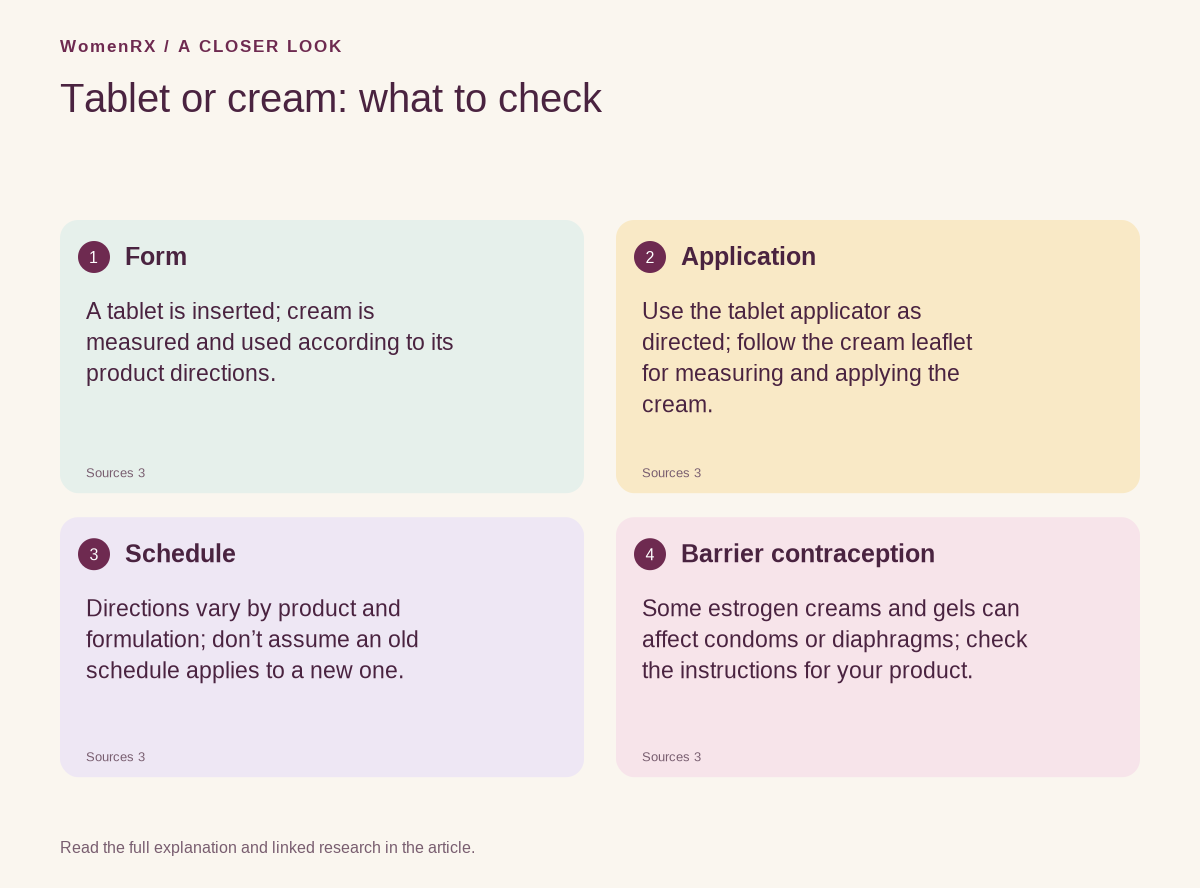
Tablet or cream: what to check
Form: A tablet is inserted; cream is measured and used according to its product directions.3
Application: Use the tablet applicator as directed; follow the cream leaflet for measuring and applying the cream.3
Schedule: Directions vary by product and formulation; don’t assume an old schedule applies to a new one.3
Barrier contraception: Some estrogen creams and gels can affect condoms or diaphragms; check the instructions for your product.3
Read the figure as text
Both are vaginal estrogen treatments, but their forms and instructions differ. Use this comparison to identify what to confirm for your exact product.- Form: A tablet is inserted; cream is measured and used according to its product directions.3
- Application: Use the tablet applicator as directed; follow the cream leaflet for measuring and applying the cream.3
- Schedule: Directions vary by product and formulation; don’t assume an old schedule applies to a new one.3
- Barrier contraception: Some estrogen creams and gels can affect condoms or diaphragms; check the instructions for your product.3
More questions, answered
Will a vaginal estradiol tablet help hot flashes?
No. Vaginal estrogen is used for local symptoms such as vaginal dryness and irritation; it doesn’t treat hot flashes or other menopause symptoms throughout the body. 1
Can I use the same schedule for a tablet and cream?
No. Directions vary by product and formulation. Check the leaflet for your exact product or ask a pharmacist or prescriber before switching. 3
Sources you can check
- About vaginal oestrogen - NHSAccessed 2026-09-25Return to first citation
- Common questions about vaginal oestrogen - NHSAccessed 2026-09-25Return to first citation
- How and when to use vaginal oestrogen - NHSAccessed 2026-09-25Return to first citation
- Side effects of vaginal oestrogen - NHSAccessed 2026-09-25Return to first citation
- The 2022 hormone therapy position statement of The North American Menopause Society.“The 2022 Hormone Therapy Position Statement of The North American Menopause Society” Advisory Panel. · Menopause (New York, N.Y.) · 2022Return to first citation
- Association of Vaginal Estradiol Tablet With Serum Estrogen Levels in Women Who Are Postmenopausal: Secondary Analysis of a Randomized Clinical Trial.Mitchell CM, Larson JC, Crandall CJ, Bhasin S, LaCroix AZ, Ensrud KE, Guthrie KA, Reed SD. · JAMA network open · 2022Return to first citation
- Managing Genitourinary Syndrome of Menopause in Breast Cancer Survivors Receiving Endocrine Therapy.Sussman TA, Kruse ML, Thacker HL, Abraham J. · Journal of oncology practice · 2019Return to first citation