How to Check Claims About Over-the-Counter Estrogen Products
Before buying something marketed as estrogen, check what it contains, what kind of product it is, and whether the evidence supports its specific promise.
Don’t use “estrogen” on the front of a package as proof that it contains estrogen or works like hormone therapy. Check two things separately: whether it’s a prescription medicine, an over-the-counter medicine, or a dietary supplement, and what ingredients it contains. Then look for evidence about the outcome you want. Menopause guidance does not recommend supplements or herbal remedies for hot flashes. 1 5
First, separate product type from hormone content
A product described as “estrogen support” might be marketed for menopause without being an estrogen medicine. Start by identifying what’s being sold: a prescription medicine, an over-the-counter (OTC) medicine, or a dietary supplement. In the U.S., an OTC medicine is a drug that can be bought without a prescription; the FDA determines whether a medicine can be sold that way. Being available without a prescription does not, by itself, tell you that a product contains estrogen. 1
Next, read the ingredients. Hormonal or nonhormonal describes what a product contains or how a treatment works, not its regulatory category. For a concrete comparison, Climara is a prescription patch containing estradiol, an estrogen hormone. Climara Pro contains estradiol and levonorgestrel, a progestogen; its product information states that it is used after menopause to reduce moderate to severe hot flashes. A supplement with menopause-related language on its package should not be treated as either medicine on the strength of that language. 2 3
Match the evidence to the promise
Once you have the ingredient name, ask what the product claims to do. “Supports estrogen levels,” “helps hot flashes,” and “replaces hormone therapy” are different promises. Evidence for one does not establish the others.
DHEA shows why this matters. A meta-analysis of randomized trials in women found that DHEA supplementation increased circulating estradiol concentrations. The outcome reported in that analysis was a hormone measurement, not whether women’s hot flashes or other menopause symptoms improved. A higher estradiol result alone cannot establish that a DHEA product relieves symptoms or works like prescribed estradiol. 6
If your goal is hot-flash relief, look for evidence about hot flashes. The 2023 North American Menopause Society position statement does not recommend supplements or herbal remedies for menopause-associated hot flashes. It also lists soy foods and soy extracts among approaches not recommended for that purpose. This is a judgment about hot-flash treatment, not a claim that every supplement has been tested for every menopause concern. 5
There are supported treatment options that do not use estrogen, but “nonhormonal” is not a shortcut for “supplement.” The same position statement recommends options including cognitive-behavioral therapy, clinical hypnosis, and certain prescription medicines for hot flashes. Those options differ in what they involve; none becomes hormone replacement simply because it helps with a symptom. Hormone therapy remains the most effective treatment for hot flashes, according to menopause position statements. 4 5
A label audit you can use while shopping
- Find the product type. Is it identified as a prescription medicine, OTC medicine, or dietary supplement? If that isn’t clear from the listing, don’t infer it from the product name. 1 2
- Name the ingredients. Look past phrases such as “estrogen support” to the actual ingredients. Check separately whether the product contains an estrogen hormone or is being promoted as a nonhormonal approach. The words “for menopause” answer neither question. 2 3 5
- Check the listed amount. Record the amount given for the ingredient you’re interested in. If you’re comparing a marketing claim with a study, you need to know whether the study examined a comparable ingredient and amount. An amount on a label is not proof that it works.
- Pin down the promised result. Is the claim about a blood hormone level, hot flashes, vaginal symptoms, or something else? Look for evidence measuring that result in a relevant population. The DHEA estradiol finding, for example, cannot answer whether a product eases hot flashes. 6
- Question replacement claims. If the pitch says a supplement can replace hormone therapy, look for evidence of symptom benefit for that product rather than treating “natural” or “estrogen-like” as evidence. The benefits and risks of actual hormone therapy vary by type, dose, route, timing, and whether a progestogen is used. 4 5
That last distinction matters if you’re trying to avoid a prescription because you want a gentler version of estrogen. “Natural” does not establish a different endometrial risk for an estrogen at an equivalent estrogen dose. For women with a uterus, adding a progestogen to estrogen therapy reduces the risk of endometrial hyperplasia. A product’s reassuring language cannot settle those treatment decisions. 2 3
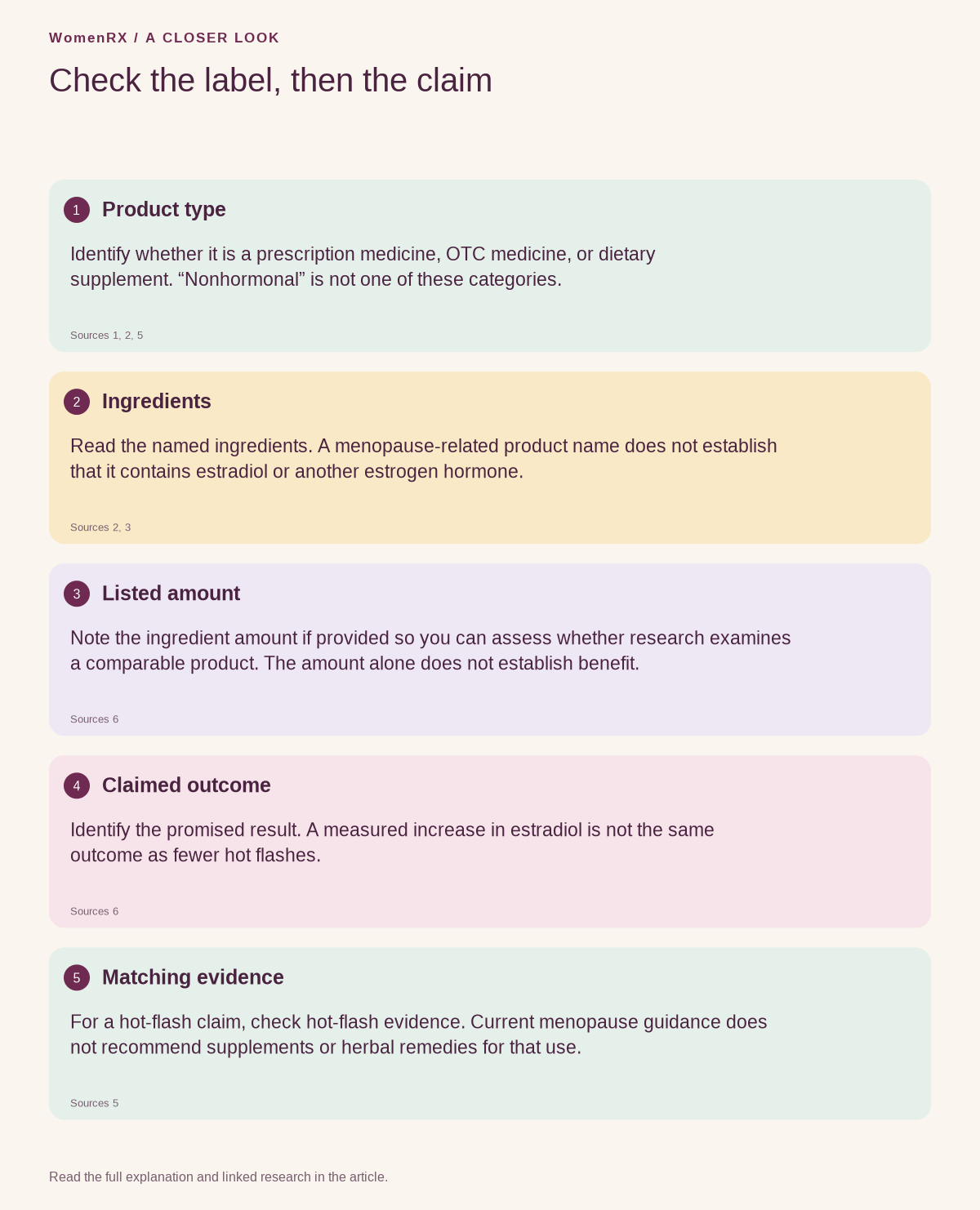
Check the label, then the claim
Product type: Identify whether it is a prescription medicine, OTC medicine, or dietary supplement. “Nonhormonal” is not one of these categories.125
Ingredients: Read the named ingredients. A menopause-related product name does not establish that it contains estradiol or another estrogen hormone.23
Listed amount: Note the ingredient amount if provided so you can assess whether research examines a comparable product. The amount alone does not establish benefit.6
Claimed outcome: Identify the promised result. A measured increase in estradiol is not the same outcome as fewer hot flashes.6
Matching evidence: For a hot-flash claim, check hot-flash evidence. Current menopause guidance does not recommend supplements or herbal remedies for that use.5
Read the figure as text
Use these checks in order, keeping product category separate from whether its ingredients are hormonal.- Product type: Identify whether it is a prescription medicine, OTC medicine, or dietary supplement. “Nonhormonal” is not one of these categories.125
- Ingredients: Read the named ingredients. A menopause-related product name does not establish that it contains estradiol or another estrogen hormone.23
- Listed amount: Note the ingredient amount if provided so you can assess whether research examines a comparable product. The amount alone does not establish benefit.6
- Claimed outcome: Identify the promised result. A measured increase in estradiol is not the same outcome as fewer hot flashes.6
- Matching evidence: For a hot-flash claim, check hot-flash evidence. Current menopause guidance does not recommend supplements or herbal remedies for that use.5
More questions, answered
If a supplement raises estradiol, is it estrogen replacement?
Not on that evidence alone. A meta-analysis found higher circulating estradiol after DHEA supplementation, but its reported outcome was estradiol concentration. It does not establish symptom relief or equivalence to prescribed estrogen therapy. 6 4
Does “nonhormonal” mean a product is a dietary supplement?
No. Nonhormonal describes an approach that does not use hormone therapy; it is not a product category. Evidence-supported nonhormonal options for hot flashes include behavioral approaches and certain prescription medicines, while the 2023 menopause statement does not recommend supplements or herbal remedies for that use. 5
Sources you can check
- Over-the-Counter Medicines: MedlinePlusAccessed 2026-09-25Return to first citation
- CLIMARA PRO (ESTRADIOL AND LEVONORGESTREL) PATCH [BAYER HEALTHCARE PHARMACEUTICALS INC.] | US prescribing information and patient instructionsAccessed 2026-09-25Return to first citation
- CLIMARA (ESTRADIOL) PATCH [BAYER HEALTHCARE PHARMACEUTICALS INC.] | US prescribing information and patient instructionsAccessed 2026-09-25Return to first citation
- The 2022 hormone therapy position statement of The North American Menopause Society.“The 2022 Hormone Therapy Position Statement of The North American Menopause Society” Advisory Panel. · Menopause (New York, N.Y.) · 2022Return to first citation
- The 2023 nonhormone therapy position statement of The North American Menopause Society.Menopause (New York, N.Y.) · 2023Return to first citation
- The effect of dehydroepiandrosterone (DHEA) supplementation on estradiol levels in women: A dose-response and meta-analysis of randomized clinical trials.Zhu Y, Qiu L, Jiang F, Găman MA, Abudoraehem OS, Okunade KS, Zhang M. · Steroids · 2021Return to first citation