Before You Take Estrogen Pills for Menopause
Oral estrogen can ease hot flashes, but your symptoms, uterus, and clotting history help shape whether a pill or another treatment fits.
Oral estrogen is a systemic treatment, often considered for hot flashes and other menopause symptoms affecting the body. It is different from low-dose vaginal estrogen, which treats vaginal dryness and irritation locally and does not usually treat hot flashes. If you have a uterus, ask how the plan will protect its lining with a progestogen; also compare oral with transdermal estrogen in light of your personal clot and cardiovascular history. 1 2 4 6
Start with the symptom you want to treat
Estrogen pills are a form of systemic menopausal hormone therapy: they act beyond the vagina and can relieve vasomotor symptoms such as hot flashes. The right starting point is the problem you want help with, because treatments that both contain estrogen may work in different parts of the body. 2 5
If your main concern is vaginal dryness or irritation, low-dose vaginal estrogen is a different option. It acts mainly in vaginal tissue and is used for genitourinary symptoms; it does not treat hot flashes or sleep problems caused by menopause. That means a local treatment may fit symptoms limited to the vagina, while systemic treatment is considered when symptoms such as hot flashes call for broader effects. They are not interchangeable. 1
Oral and transdermal estrogen are not the same route
A pill is taken by mouth. Transdermal estrogen is delivered through the skin, such as with a patch or gel. Both are systemic options, but evidence reviews report a higher venous blood clot risk with oral than transdermal estrogen. In a meta-analysis of postmenopausal women using estrogen alone, oral preparations had a relative risk of 1.48 for venous thromboembolism, while the estimate for transdermal preparations was 0.97. These are relative estimates, not your personal odds; they do not tell you the absolute risk for an individual woman. 6
The comparison is not a promise that transdermal treatment is risk-free, or that it is automatically the right choice for everyone. The meta-analysis also found that results for estrogen paired with a progestogen varied by the type of progestogen. Reviews describe route, formulation, timing, and individual cardiovascular risk as relevant to treatment decisions. 3 5 6
Ask what your personal history means for the route discussion, especially if you have had a blood clot or have cardiovascular disease or other clotting concerns. Menopausal hormone therapy is used for symptom relief, not to prevent cardiovascular disease. 5
Your uterus changes the hormone plan
If you still have your uterus, the discussion is not simply “estrogen or no estrogen.” A systematic review states that women with an intact uterus using systemic estrogen therapy should receive a progestogen for endometrial protection. Ask which progestogen is being considered and how it fits your circumstances. 4
If you have had a hysterectomy, estrogen may be used without a progestogen in some treatment plans. The evidence summarized in a 2026 review describes estrogen-alone therapy after hysterectomy, while also emphasizing that the plan depends on individual factors. Your surgical history matters, so say clearly whether your uterus is present. 2
This is also why low-dose vaginal estrogen is a separate conversation: because little of it reaches the rest of the body, the cited clinical guidance says a progestogen is usually not needed with low-dose vaginal treatment. Do not assume that this applies to oral or other systemic estrogen. 1
Bring your history into the risk discussion
The expected benefit is symptom relief, and the balance depends partly on when treatment starts, which formulation and route are used, and your health history. Reviews describe higher concern when hormone therapy is started later or in women with established cardiovascular disease, and report that oral estrogen is linked to more thromboembolic risk than transdermal formulations. These findings support an individualized discussion, not a single route recommendation for every woman. 3 5
Breast history also belongs in that conversation. A recent review describes breast-cancer considerations as differing between estrogen-alone and combined estrogen-progestogen therapy, with duration and individual circumstances relevant. If you have had breast cancer, or have a strong personal concern about breast risk, raise it before deciding; the summary evidence does not establish one regimen as suitable for all survivors. 2
Useful questions to ask before choosing a pill
- Which symptom are we treating, and is a systemic treatment needed for it?
- If my symptoms are mainly vaginal, would low-dose local treatment address them instead?
- Do I have a uterus, and if so, what is the progestogen plan for protecting the uterine lining?
- How does my history of blood clots, cardiovascular disease, or breast cancer affect the choice of route and formulation?
- What would make us reassess whether the benefits still outweigh the risks?
These questions keep the decision focused on your symptoms and circumstances rather than treating all estrogen products as if they work the same way.
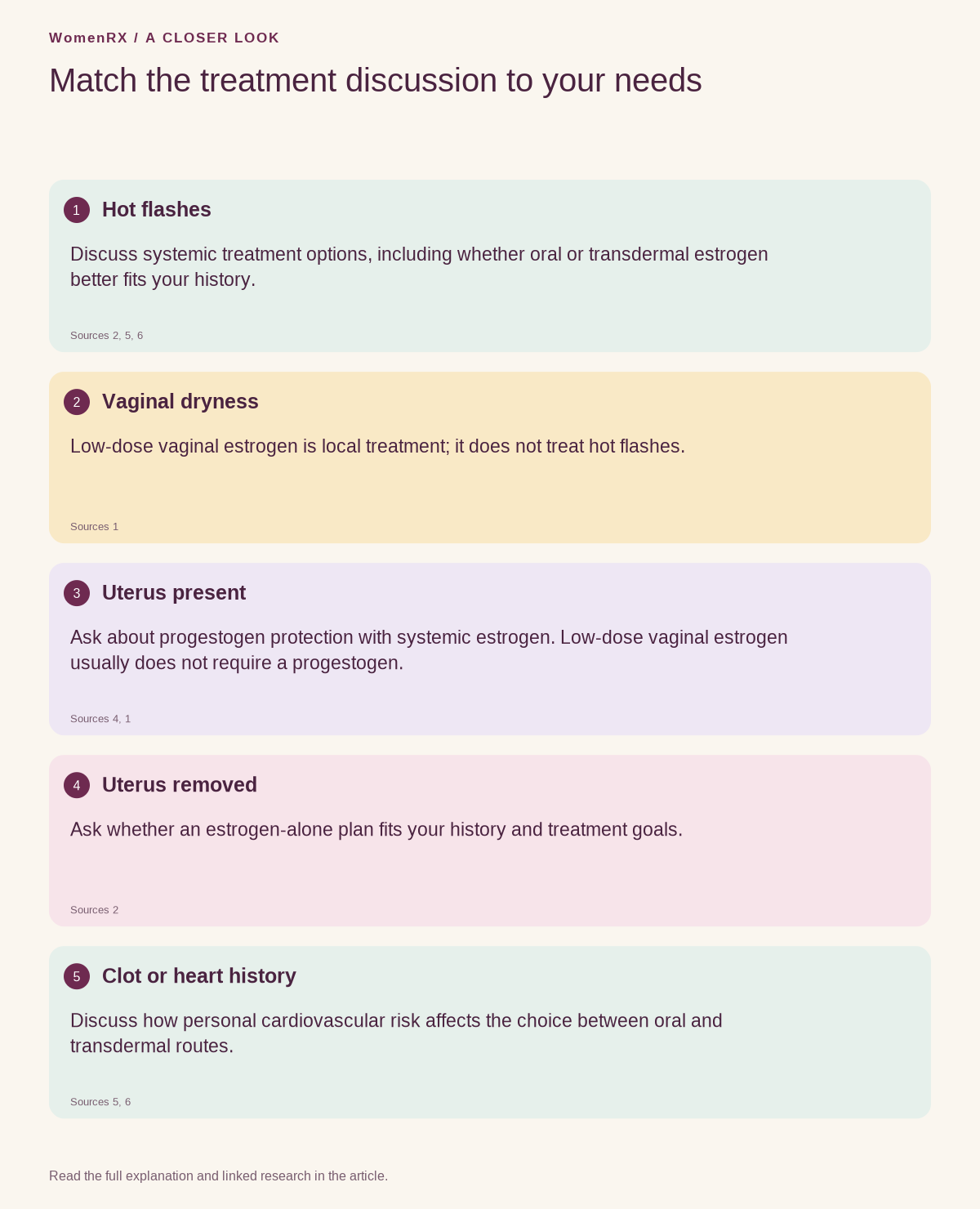
Match the treatment discussion to your needs
Hot flashes: Discuss systemic treatment options, including whether oral or transdermal estrogen better fits your history.256
Vaginal dryness: Low-dose vaginal estrogen is local treatment; it does not treat hot flashes.1
Uterus present: Ask about progestogen protection with systemic estrogen. Low-dose vaginal estrogen usually does not require a progestogen.41
Uterus removed: Ask whether an estrogen-alone plan fits your history and treatment goals.2
Clot or heart history: Discuss how personal cardiovascular risk affects the choice between oral and transdermal routes.56
Read the figure as text
Use the symptom you want to treat and whether you have a uterus to guide the main treatment conversations.- Hot flashes: Discuss systemic treatment options, including whether oral or transdermal estrogen better fits your history.256
- Vaginal dryness: Low-dose vaginal estrogen is local treatment; it does not treat hot flashes.1
- Uterus present: Ask about progestogen protection with systemic estrogen. Low-dose vaginal estrogen usually does not require a progestogen.41
- Uterus removed: Ask whether an estrogen-alone plan fits your history and treatment goals.2
- Clot or heart history: Discuss how personal cardiovascular risk affects the choice between oral and transdermal routes.56
More questions, answered
Can vaginal estrogen replace an estrogen pill for hot flashes?
No. Low-dose vaginal estrogen is used for vaginal dryness and irritation and does not treat hot flashes. It is a local treatment, while an estrogen pill is systemic. 1
Does estrogen therapy prevent heart disease?
Menopausal hormone therapy should not be used to prevent cardiovascular disease. Its use is directed at symptoms, with cardiovascular history considered when weighing options. 5
Sources you can check
- About vaginal oestrogen - NHSAccessed 2026-09-25Return to first citation
- Menopausal hormone therapy and breast cancer: risk and management.Sanserino K. · Current opinion in obstetrics & gynecology · 2026Return to first citation
- Menopausal Hormone Therapy: A Narrative Review of Contemporary Evidence.Finks SW, Cieri-Hutcherson NE, Vernon V, McBane SE. · Pharmacotherapy · 2026Return to first citation
- The impact of micronized progesterone on breast cancer risk: a systematic review.Stute P, Wildt L, Neulen J. · Climacteric : the journal of the International Menopause Society · 2018Return to first citation
- Menopausal Hormone Therapy and Cardiovascular Risk: Current Evidence and Clinical Implications.Buzduga CM, Bobu AM, Covali R, Costea CF, Cucu AI, Graur M, Patrascanu E, Solomon-Condriuc I, Carauleanu A. · Medical sciences (Basel, Switzerland) · 2026Return to first citation
- Progestogens and venous thromboembolism in menopausal women: an updated oral versus transdermal estrogen meta-analysis.Scarabin PY. · Climacteric : the journal of the International Menopause Society · 2018Return to first citation