When Can You Take Estrogen Without a Progestogen?
For systemic menopause therapy, the key question is whether you still have a uterus, with a history of endometriosis changing the answer for some women.
If you still have a uterus, systemic estrogen is generally paired with a progestogen to protect the uterine lining. After a hysterectomy that removed the uterus, estrogen can usually be used without one. A history of endometriosis, especially residual disease, needs a closer look even after hysterectomy. There’s no single number of years that answers the question for everyone. 739
Why having a uterus changes the answer
Systemic estrogen, whether taken as a tablet or used as a patch, gel, or spray, can stimulate the endometrium, the lining inside the uterus. Without a progestogen to counter that effect, the lining can become abnormally thick. Unopposed estrogen is associated with an increased risk of endometrial cancer; adding a progestogen reduces the risk of endometrial hyperplasia, a change that can precede cancer. 147
That’s why the usual answer if you still have a uterus is estrogen with a progestogen, not estrogen alone. “Progestogen” is the umbrella term; progesterone and synthetic progestins are different members of that group. The choice of regimen matters too. A systematic review found that endometrial cancer risk varied with the type of progestogen and how it was used, so simply seeing both hormones on a medication list doesn’t tell you everything about endometrial protection. 47
After hysterectomy, estrogen alone is usually an option
If your hysterectomy removed your uterus, there is usually no uterine lining to protect, and systemic estrogen can generally be used without a progestogen. This is a treatment distinction, not a promise that estrogen is right for every person after hysterectomy. In the Women’s Health Initiative trials, women with a prior hysterectomy were studied in the estrogen-alone trial, while women with a uterus were studied in the estrogen-plus-progestin trial. 785
If you’re unsure what your surgery removed, check the operative record or ask the clinician prescribing your therapy before assuming the standard post-hysterectomy advice applies. What matters for this question is whether uterine lining remains, not just whether you call the operation a hysterectomy. A history of endometrial disease is another reason to have your own diagnosis and surgical findings considered rather than relying on a general rule. 17
The exception worth knowing: endometriosis
Endometriosis involves tissue similar to the uterine lining growing elsewhere in the body, so removing the uterus does not necessarily settle every question about hormone therapy. An expert clinical guide recommends avoiding estrogen-only menopausal hormone therapy in women with a history of endometriosis, even after hysterectomy, because of concern about residual disease recurring or changing. US prescribing information also says to consider adding a progestin when residual endometriosis is known after hysterectomy. 236
That doesn’t mean recurrence is inevitable or that the best regimen has been established by a large trial for every woman with past endometriosis. The guide’s recommendation draws on a literature review and expert consensus. Its practical value is to make your endometriosis history, what was found at surgery, and any current pelvic symptoms part of the estrogen-only decision. 3
Does the answer change after a certain number of years?
The need for endometrial protection isn’t a countdown: if you have a uterus and are using systemic estrogen, the concern about unopposed estrogen applies while you’re using it. If your uterus was removed, there isn’t a universal deadline at which you must add a progestogen. How long to continue hormone therapy is a separate decision based on its benefits and risks for you. Study treatment periods describe how long participants were observed on particular regimens; they aren’t a personal expiration date. 1459
Route matters when applying this answer. Tablets, patches, gels, and sprays are systemic estrogen options covered by the uterus-based guidance above. Vaginal estrogen for local symptoms is a different type of treatment; don’t assume advice about systemic estrogen automatically answers a question about a vaginal product. 78
If you have bleeding after menopause, especially persistent or recurring bleeding, don’t treat it as a routine effect to ignore. It needs assessment to find the cause, whether or not you’re using hormone therapy. 1
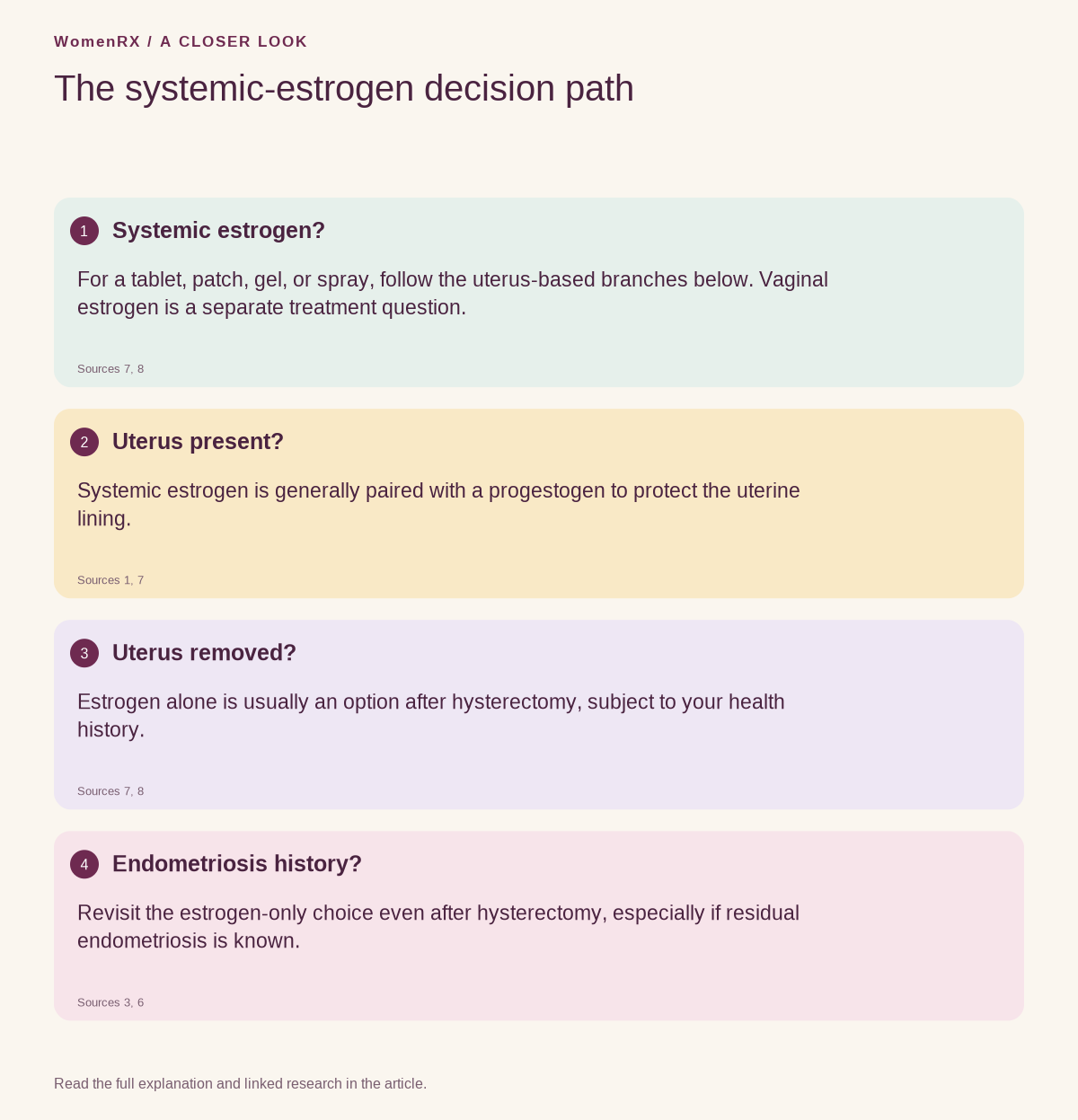
The systemic-estrogen decision path
Systemic estrogen?: For a tablet, patch, gel, or spray, follow the uterus-based branches below. Vaginal estrogen is a separate treatment question.78
Uterus present?: Systemic estrogen is generally paired with a progestogen to protect the uterine lining.17
Uterus removed?: Estrogen alone is usually an option after hysterectomy, subject to your health history.78
Endometriosis history?: Revisit the estrogen-only choice even after hysterectomy, especially if residual endometriosis is known.36
Read the figure as text
Start with the type of estrogen, then whether a uterus is present; endometriosis can change the usual post-hysterectomy answer.- Systemic estrogen?: For a tablet, patch, gel, or spray, follow the uterus-based branches below. Vaginal estrogen is a separate treatment question.78
- Uterus present?: Systemic estrogen is generally paired with a progestogen to protect the uterine lining.17
- Uterus removed?: Estrogen alone is usually an option after hysterectomy, subject to your health history.78
- Endometriosis history?: Revisit the estrogen-only choice even after hysterectomy, especially if residual endometriosis is known.36
More questions, answered
Does using an estrogen patch instead of a pill remove the need for a progestogen?
No. Guidance for systemic estrogen includes patches as well as tablets, gels, and sprays: if you still have a uterus, a progestogen is generally needed for endometrial protection. 7
Does a hysterectomy always mean estrogen-only therapy is the better choice?
Not always. Estrogen without a progestogen is usually an option after removal of the uterus, but a history of endometriosis can change the decision, particularly if residual disease is known. 736
Sources you can check
- PREMPHASE (CONJUGATED ESTROGENS AND MEDROXYPROGESTERONE ACETATE) KIT PREMPRO (CONJUGATED ESTROGENS AND MEDROXYPROGESTERONE ACETATE) TABLET, SUGAR COATED [WYETH PHARMACEUTICALS LLC, A SUBSIDIARY OF PFIZER INC.] | US prescribing information and patient instructionsAccessed 2026-09-25Return to first citation
- Endometriosis - NHSAccessed 2026-09-25Return to first citation
- Endometriosis and menopausal health: An EMAS clinical guide.Erel CT, Nigdelis MP, Ozcivit Erkan IB, Goulis DG, Chedraui P, Giannini A, Kiesel L, Phillips N, Simoncini T, Armeni E, Boban J, Ceausu I, Hillard T, Lambrinoudaki I, Smetnik A, Go... · Maturitas · 2025Return to first citation
- Menopausal Hormone Therapy and Risk of Endometrial Cancer: A Systematic Review.Tempfer CB, Hilal Z, Kern P, Juhasz-Boess I, Rezniczek GA. · Cancers · 2020Return to first citation
- Menopausal hormone therapy and health outcomes during the intervention and extended poststopping phases of the Women's Health Initiative randomized trials.Manson JE, Chlebowski RT, Stefanick ML, Aragaki AK, Rossouw JE, Prentice RL, Anderson G, Howard BV, Thomson CA, LaCroix AZ, Wactawski-Wende J, Jackson RD, Limacher M, Margolis KL, ... · JAMA · 2013Return to first citation
- PREMARIN (CONJUGATED ESTROGENS) INJECTION, POWDER, LYOPHILIZED, FOR SOLUTION [WYETH PHARMACEUTICALS LLC, A SUBSIDIARY OF PFIZER INC.] | US prescribing information and patient instructionsAccessed 2026-09-25Return to first citation
- Who can and cannot take or use oestrogen tablets, patches, gel and spray - NHSAccessed 2026-09-25Return to first citation
- About oestrogen tablets, patches, gel and spray - NHSAccessed 2026-09-25Return to first citation
- How and when to take or use oestrogen tablets, patches, gel and spray - NHSAccessed 2026-09-25Return to first citation