Why Estrogen and a Progestogen Are Sometimes Paired
The reason for adding a progestogen is usually to protect the uterine lining, not to make every menopause treatment reproduce a menstrual cycle.
Estrogen can help with menopause symptoms. If you still have a uterus and use systemic estrogen, a progestogen is generally added because estrogen alone can cause the uterine lining to grow too much. The need is different after the uterus has been removed and with low-dose vaginal estrogen. The right plan also depends on the hormone regimen and your individual history. 1 2 4
Each hormone has a different job
Menopause hormone therapy can ease bothersome hot flashes and other symptoms. When a progestogen is included, its main job is usually different: it helps protect the endometrium, the lining inside the uterus. Estrogen without adequate progestogen can raise the risk of endometrial overgrowth, also called hyperplasia. 1 2 3
Progesterone is one type of progestogen. Other medicines can also act as progestogens, but the terms don’t mean every option or schedule is interchangeable. The regimen needs to provide adequate protection alongside the estrogen being used. 2 3
That’s why a menopause regimen containing both hormones isn’t necessarily an attempt to recreate the hormones of a menstrual cycle. The key reason for adding a progestogen to systemic estrogen is often the uterus-specific need to protect its lining.
Start with whether you have a uterus
If you have a uterus and use systemic estrogen: a progestogen is generally part of the conversation because unopposed estrogen can increase the risk of endometrial hyperplasia. A Cochrane review of randomized studies found increased hyperplasia risk with unopposed estrogen; it also found that protection depends on the combined regimen, not simply on the presence of any progestogen. 2 3
If your uterus has been removed: the specific reason to protect the uterine lining no longer applies. That doesn’t, by itself, tell you which hormone treatment is right for you. The broader choice still depends on the reason for treatment and personal health factors. 1 2
If you use low-dose vaginal estrogen: this is a different situation from systemic estrogen. A review of local estrogen treatments reports that a progestogen generally isn’t needed for endometrial protection with low-dose vaginal estrogen. The review’s summarized evidence on endometrial safety extended up to one year, so that time limit matters when interpreting its findings. 4
Route and dose matter, but don’t decide the question alone
Hormone therapy’s risks can vary with its type, dose, route, duration, timing, and whether a progestogen is used. Those factors matter to the overall treatment decision. For the lining-protection question, though, it’s useful to distinguish systemic estrogen from low-dose vaginal estrogen and to consider whether you have a uterus. The available guidance doesn’t establish that every route or dose has identical protection requirements. 1 4
The progestogen regimen matters too. A guideline identifies adequate dose and duration as necessary for protection and doesn’t name one approach as best for everyone. A Cochrane review likewise examined specific combined regimens, rather than treating progestogens as a single interchangeable treatment. 2 3
Menopause stage and personal history shape the plan
The uterus-specific reason for adding a progestogen is one part of a larger decision. Menopausal stage, symptoms, and personal health history also matter; hormone therapy recommendations call for individualizing treatment and periodically reassessing its benefits and risks. 1
A useful way to clarify a proposed regimen is to ask: Is this estrogen systemic or low-dose vaginal estrogen? Do I still have a uterus? If I do, what part of the plan protects the lining, and is the regimen intended to provide adequate protection? Those questions get to the decision logic without assuming that everyone needs progesterone or that one combination suits every woman.
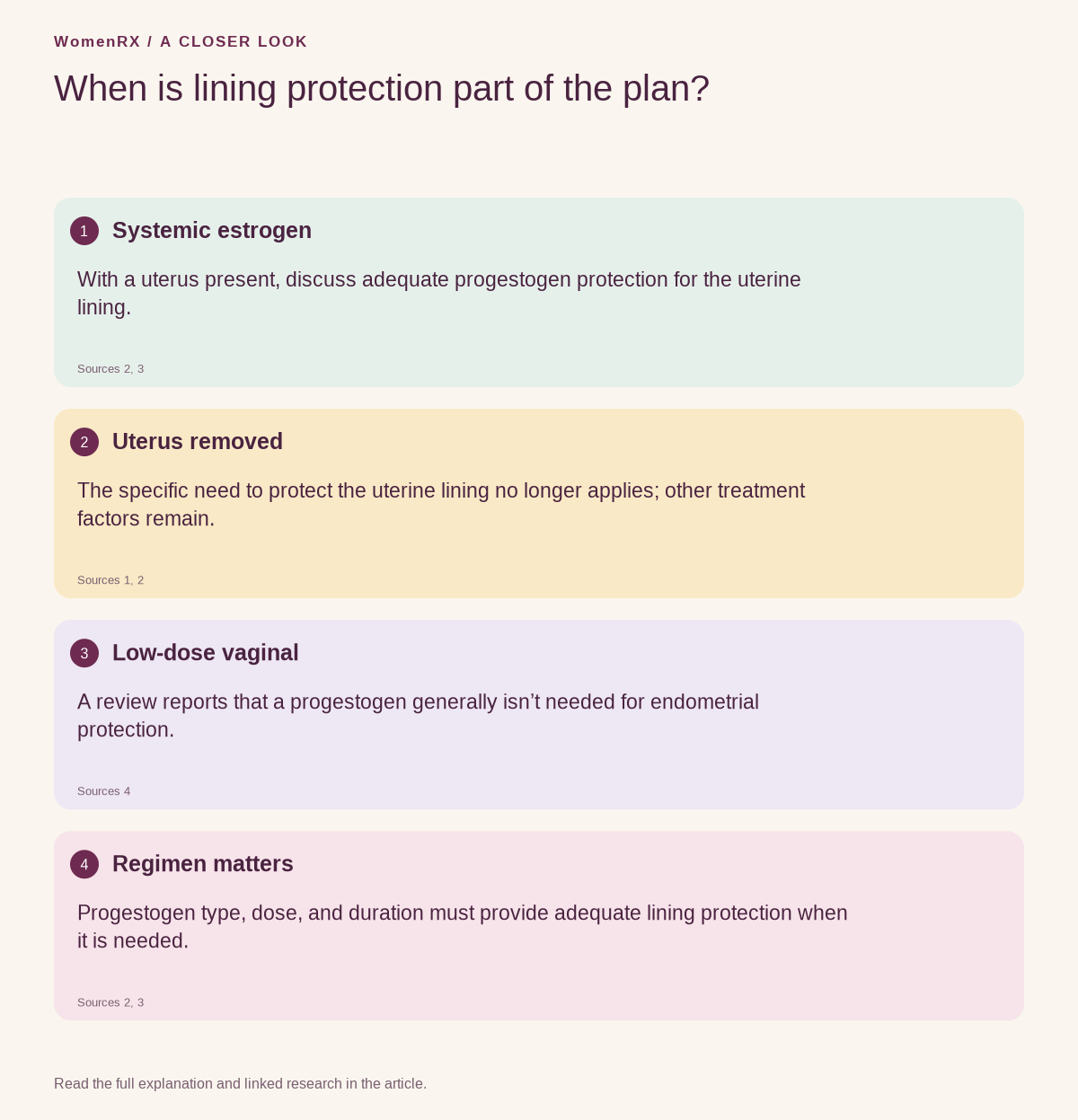
When is lining protection part of the plan?
Systemic estrogen: With a uterus present, discuss adequate progestogen protection for the uterine lining.23
Uterus removed: The specific need to protect the uterine lining no longer applies; other treatment factors remain.12
Low-dose vaginal: A review reports that a progestogen generally isn’t needed for endometrial protection.4
Regimen matters: Progestogen type, dose, and duration must provide adequate lining protection when it is needed.23
Read the figure as text
Use uterine status and the kind of estrogen to frame the endometrial-protection discussion. The specific regimen still matters.- Systemic estrogen: With a uterus present, discuss adequate progestogen protection for the uterine lining.23
- Uterus removed: The specific need to protect the uterine lining no longer applies; other treatment factors remain.12
- Low-dose vaginal: A review reports that a progestogen generally isn’t needed for endometrial protection.4
- Regimen matters: Progestogen type, dose, and duration must provide adequate lining protection when it is needed.23
More questions, answered
Does everyone using estrogen for menopause need progesterone?
No. The need depends in part on whether you have a uterus and whether the estrogen is systemic or low-dose vaginal estrogen. When progestogen is needed, progesterone is one option within the broader progestogen category. 2 4
Can the progestogen schedule vary?
Yes. Different regimens have been studied, and guidance does not identify one preferred approach for everyone. The regimen’s dose and duration need to be adequate for endometrial protection. 2 3
Sources you can check
- The 2022 hormone therapy position statement of The North American Menopause Society.“The 2022 Hormone Therapy Position Statement of The North American Menopause Society” Advisory Panel. · Menopause (New York, N.Y.) · 2022Return to first citation
- Role of progestogen in hormone therapy for postmenopausal women: position statement of The North American Menopause Society.North American Menopause Society. · Menopause (New York, N.Y.) · 2003Return to first citation
- Hormone therapy in postmenopausal women and risk of endometrial hyperplasia.Furness S, Roberts H, Marjoribanks J, Lethaby A. · The Cochrane database of systematic reviews · 2012Return to first citation
- Reviewing the options for local estrogen treatment of vaginal atrophy.Lindahl SH. · International journal of women's health · 2014Return to first citation