Cyclic or continuous progestogen with estrogen: how do regimens differ?
The main difference is whether progestogen is taken for part of each month or every day, which affects expected bleeding and often makes menopause stage part of the choice.
With sequential (cyclic) therapy, estrogen is taken daily and progestogen is added for part of each cycle; a bleed often follows that progestogen course. With continuous combined therapy, both hormones are taken every day, aiming to avoid a scheduled monthly bleed, though spotting can happen at first. Sequential therapy is commonly used while periods continue or soon after the last one; continuous therapy is generally considered after a year without periods. 1 4
The schedule changes the bleeding pattern
Both approaches pair systemic estrogen with a progestogen, a term that includes progesterone and progestin medicines. If you have a uterus, the progestogen helps protect the uterine lining from the thickening that estrogen alone can cause. If your uterus has been removed, estrogen-only therapy is often used instead, so the need for a progestogen may be different. 2 4
In a sequential, or cyclic, regimen, estrogen is taken every day and progestogen is added for part of each 28-day cycle. One common schedule in the guidance is progestogen for 10 to 14 days of the cycle. A bleed often occurs after that course. It is a planned response to the schedule, but the exact pattern can vary. 4
In a continuous combined regimen, estrogen and progestogen are both taken every day, without a monthly break. The aim is to avoid a regular, scheduled bleed. Spotting or irregular bleeding can occur during the first months, so “continuous” does not mean you can count on no bleeding from the start. 1 3
Menopause stage is one useful clue
If you are still having periods, or your last period was less than a year ago, sequential therapy is commonly used. A full-year stretch without a period is a common dividing line in regimen guidance: continuous combined therapy is generally considered after that point. The reason is practical as well as hormonal: starting continuous treatment while your own cycle is still active can make bleeding irregular and harder to predict. 1 4
That dividing line is a guide, not a schedule to choose on your own. Your usual bleeding pattern, the therapy you are considering, and your treatment goals all matter. Menopause hormone therapy decisions are individualized, and a clinician can weigh the benefits and risks for your circumstances. 5
What research says about the bleeding tradeoff
The basic schedule difference is straightforward, but a study of one continuous approach illustrates why bleeding experiences don’t always follow a neat calendar. In a two-year randomized trial of 200 perimenopausal women, the cyclic regimen produced a more regular bleeding pattern. The comparison group used continuous levonorgestrel delivered by an intrauterine system alongside oral estradiol; that group initially had prolonged and frequent bleeding, followed by reduced bleeding, and 38% had no bleeding. 6
That result applies to the specific intrauterine system and estrogen regimen studied. It isn’t a direct comparison of the same progestogen, delivered the same way, on a cyclic versus daily schedule. It can’t predict exactly what your bleeding will be on a different product. 6
When bleeding deserves a closer look
A predictable bleed after the progestogen course is part of many sequential schedules. With continuous treatment, some irregular bleeding can occur in the first few months. But heavy bleeding, bleeding that is unexpected for your regimen, or bleeding that appears after things had settled shouldn’t automatically be written off as a normal adjustment. One clinical review emphasizes tailoring treatment to the person and assessing possible causes of abnormal bleeding; NHS guidance specifically advises review for heavy or unexpected bleeding after six months on continuous combined therapy. 3 7
If bleeding doesn’t match what you were told to expect, describe its timing and pattern to your prescriber. That information can help distinguish a schedule-related pattern from bleeding that needs further evaluation. A clinician may consider changing the regimen or formulation, but the right response depends on the situation. 7
A useful way to frame the choice
The practical tradeoff is often a more expected, scheduled bleed with sequential therapy versus no planned monthly bleed, with possible early spotting on continuous therapy. For someone still having periods, a sequential schedule may fit better with the current cycle stage. After a year without periods, continuous treatment may be an option if avoiding a scheduled bleed is a priority. Neither pattern guarantees what an individual will experience, and neither is automatically the right choice for everyone. 1 3 4
When you discuss options, it may help to say whether you are still having periods, when your last period occurred, and whether a scheduled bleed or the possibility of early spotting feels more manageable. Those details make the discussion more specific without assuming one regimen is best for every person. Treatment choices should also account for your health and the benefits and risks of hormone therapy overall. 5
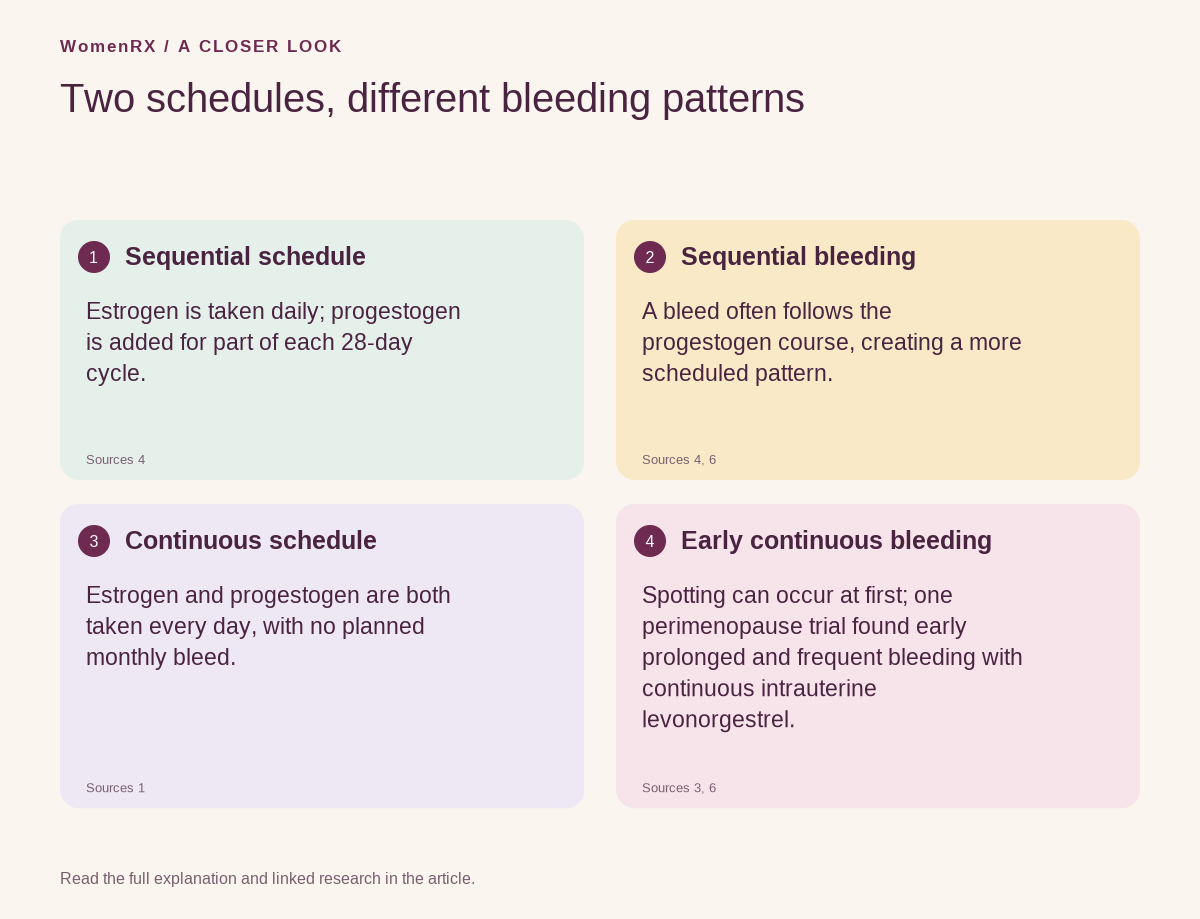
Two schedules, different bleeding patterns
Sequential schedule: Estrogen is taken daily; progestogen is added for part of each 28-day cycle.4
Sequential bleeding: A bleed often follows the progestogen course, creating a more scheduled pattern.46
Continuous schedule: Estrogen and progestogen are both taken every day, with no planned monthly bleed.1
Early continuous bleeding: Spotting can occur at first; one perimenopause trial found early prolonged and frequent bleeding with continuous intrauterine levonorgestrel.36
Read the figure as text
Compare when progestogen is taken and what bleeding pattern each schedule is intended to produce, including the limits of a specific perimenopause trial.- Sequential schedule: Estrogen is taken daily; progestogen is added for part of each 28-day cycle.4
- Sequential bleeding: A bleed often follows the progestogen course, creating a more scheduled pattern.46
- Continuous schedule: Estrogen and progestogen are both taken every day, with no planned monthly bleed.1
- Early continuous bleeding: Spotting can occur at first; one perimenopause trial found early prolonged and frequent bleeding with continuous intrauterine levonorgestrel.36
More questions, answered
Does continuous combined therapy mean bleeding is impossible?
No. It has no planned monthly bleed, but irregular bleeding is common during the first few months for some people. Heavy or unexpected bleeding, especially after treatment has been established, merits review rather than an assumption that it is just part of the regimen. 3
Why might someone with a uterus take both hormones?
Systemic estrogen alone can thicken the uterine lining. Adding a progestogen helps reduce that risk; after the uterus has been removed, estrogen-only therapy is often used instead. 2 4
Sources you can check
- About continuous combined HRT - NHSAccessed 2026-09-25Return to first citation
- Common questions about continuous combined HRT - NHSAccessed 2026-09-25Return to first citation
- Side effects of continuous combined HRT - NHSAccessed 2026-09-25Return to first citation
- About sequential combined hormone replacement therapy (HRT) - NHSAccessed 2026-09-25Return to first citation
- The 2022 hormone therapy position statement of The North American Menopause Society.“The 2022 Hormone Therapy Position Statement of The North American Menopause Society” Advisory Panel. · Menopause (New York, N.Y.) · 2022Return to first citation
- Continuous intrauterine compared with cyclic oral progestin administration in perimenopausal HRT.Boon J, Scholten PC, Oldenhave A, Heintz AP. · Maturitas · 2003Return to first citation
- Abnormal bleeding during menopause hormone therapy: insights for clinical management.de Medeiros SF, Yamamoto MM, Barbosa JS. · Clinical medicine insights. Women's health · 2013Return to first citation